Chapter 13. Sealed and Silent Places
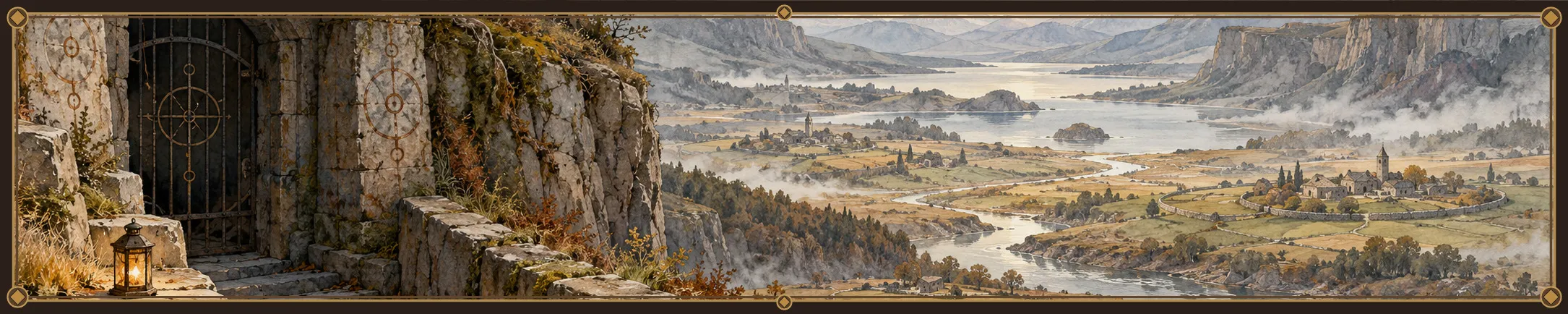
This one is braced: lean on it. This one is unsound: pass it quickly. This one is never to be touched: go round. And this one means do not go further. Do not ask what is further. Turn the cart and tell the next one.
Every map of the cradle-web has blanks on it, and not all of them are blanks for want of looking. Some places are known well enough to be avoided. At the cradle end of the desert crossing a chain of valleys lies under a fog that has not lifted in more than a century, and nobody who lives inside it remembers there is an outside. East of the river towns, rows of inscribed stones stand guard over empty heath, made clerks of stone and bronze still ask passers for their names, and the cities behind them are not ruined but shut. Above the highest Dwarven gates the roads of a vanished colossal people run along the crests past giants' tombs no one has opened, and something beneath the summits beats like a heart. And in the deepest groves of the Elderweald, stairs grown from living root go down a little way into the dark and stop, and on the wettest nights something on the far side of the bars knocks back. These are the sealed and silent places. They are not empty. Each of them holds something a living people would rather not disturb, a machine, a city’s worth of sealed lists, a sleeping god, a drowned dead, and the treasure that lies with each of them, and each is ringed by people who have decided, generation after generation, not to go further. Each also draws the ones who will not decide that: delvers, treasure-hunters, the desperate, and the hunters who go in after them. What is known of these places is mostly known from their edges, and everything inside is left for the first story that crosses the line.
The Hushvale
The Hushvale is a basin and valley chain lost under permanent fog, at the foot of an unnamed mountain range on the cradle-facing edge of the Glassbelt Interior, where the desert gives way to the cradle-web. Outsiders call it the Hushvale. The people inside call it the Held, and no longer remember that there is an outside to call it anything else. Almost nobody has come out of it in more than a century, and the few who went in and came back are changed and do not speak clearly of it. Still people go: delvers after the grey salt said to keep a corpse fresh and an oath unbroken, kin looking for a pilgrim lost on the old pass, outlaws who think the fog safer than a lord’s gallows, the bounty-hunters who follow them, and the kind of fool who has heard that under the mountain lies a vault of the dead older than any kingdom, full of everything they were buried with.
The Landslide and the Engine
The vale lies at the cradle-web’s eastern edge, at the eastern foot of the unnamed range where the desert begins, with the Glassbelt spread out east of it. Its old pass climbed west over the range towards the rough cradle country south-east of the Headwater Marches, and two or three weeks north along the desert edge the crossing leaves the Broken Marches. Nothing nearer is mapped.
The vale was once ordinary country: villages, fields, shrines, burial caves, old roads, and a difficult but useful pass. Around c. 1,200 CR its communities, or a power that ruled them, set out to make the pass dependable, by road, tunnel, or cliff-road, for trade, pilgrimage, defence, or winter travel. The work loosened an old slope above buried elder works. The landslide that followed killed workers, pilgrims, villagers, and shrine-keepers, buried bodies and names in confusion, and laid bare the conduits of a Record-engine beneath the mountain.
The engine was the work of the Sepulchre-Kin, a remote mountain-basin people of the Elder Worlds, c. 160,000 to c. 120,000 BR, whose whole civilization was built around the work of death, deep burial, and the refusal of oblivion. They held that no person should pass into loss unnamed, unplaced, or unheld, and their great work was an under-mountain complex of name-vaults, burial chambers, bell conduits, descent corridors, and preserving cores, built to hold names, Echoes, vows, and the places of the dead long enough for the dead to settle cleanly into deeper Record. They lived too far from the archive world for its lists to reach them, and so the people most devoted to keeping names were never written down by anyone else. Their fall, in the Unburial War (c. 110,000 to c. 80,000 BR), turned remembrance into a weapon and ended with the engine preserving its own people to death. Beneath the mountain it still keeps those Taken. Their faded god, the Tomb-Builder, survives only as a description; his true name is held inside the engine, where no one can read it.
The engine had lain dormant since that war. Sudden mass death, missing bodies, broken funeral rites, and desperate remembrance woke it, and it began doing what it was built to do and had learned to do wrongly: preserving every name, Echo, and trace of a life in the vale, without telling the dead from the living.
The Wake-Seal
The survivors did not pray for rescue, or for their dead to be remembered. They prayed not to be found: for a quiet the thing below could not hear, for a shadow over the door, for a way to be passed over. Out of that prayer came the Wake-Seal, a rite of shadow and concealment meant to hide the villages from the engine’s attention, and with it a god of protective quiet, known now only as the Echo-Mother. The seal worked too well. It hid the vale from the wider world as well as from the engine, thickened into a fog that never lifts, bound the living communities into the seal, and damaged long memory, so that older events blurred into rumour, story, and taboo. Remembrance had helped wake the engine, and what was not remembered was harder for it to find. Generation by generation the people forgot the landslide, the engine, and the rite, and in forgetting the reason for their prayers they forgot the Echo-Mother too, which is what she had taught them to do. Outside, the fog became a danger-mark on every road map and a curse in every valley song, and the vale’s treasure, the grey salt and the elder works, became the lure it still is.
The Held
The people of the Held live in isolated ward-villages that know little beyond their own fields, shrines, and remembered taboos. They are mostly of cradle-web Human descent, mixed with the descendants of the road-workers, pilgrims, traders, and travellers trapped by the landslide, with faint traces of Sepulchre-Kin blood in some lines. They are not an elder people. They are ordinary communities made strange by a rite that preserved them by teaching them to forget. They still keep quiet-rites and taboos that belong to the Echo-Mother without knowing whom they are kept for, or why, and a household that grieves its dead aloud strains a rule nobody in its village can explain. How many of them there are is not known outside the fog, and neither is how they dress, how long they live, or what they call one another.
Day under the fog is only a weaker kind of night. Deep fog is deadly even at noon, and travel after dark is close to certain death. Those at the fog’s edge hear voices in it calling names, sometimes their own. Crossers at the desert’s end tell of a brother who went into the fog after a sister lost on the pass, forty years ago, and is still heard at its edge on moonless nights, calling her name in a voice that has not aged. What moves in the fog was shaped by the same catastrophe: hungry remnants that feed on warmth, breath, names, or recognition, and changed living, ordinary villagers whose bodies turn predator under deep fog, fear, or moonless dark. Where fog, the dead, and the Wake-Seal gather thickest lies gravesalt, a rare grey-white residue that preserves names, oaths, bodies, and thresholds against decay. It is almost unknown outside, though rumours of it reach the Glassbelt’s salt-traders, and a pinch of it is said to have bought a lord’s daughter back from a fever. Whoever brought that pinch out is not named.
From the Desert Road
To the Edgeway kindreds and the few others who make the Glassbelt crossing, the Hushvale is only fog on the horizon at the desert’s cradle end, a route nobody takes, and a danger-mark that means do not go further. The kindreds' ordinary marks grade a single work, braced, unsound, or never-touch, and the oldest never-touch forms descend from warnings set around the glassed ground of the Ash-Furnace world; this one is set against a whole country. Kindred custom binds the marks to care: a mark is honoured only if those who set it leave a place no more dangerous than they found it, and the Hushvale is the place the kindreds have agreed, by leaving it alone, that nobody can leave better. Nothing faces the vale from outside: no post or village watches the fog, the crossers who pass at the desert’s end leave only their danger-mark, and none of the ward-villages is known by name beyond it. Crossers say lights move in the fog at night, low and slow, like lanterns carried by people looking for something. Treasure-seekers who followed them have not been seen again, and the kindreds' warning to anyone camped within sight of the fog is blunt: a lamp in the Hush is looking for you.
On the road towards the crossing the kindred I travelled with stopped once without being asked, on a rise where the scrub gives out and the first of the desert begins, and turned the carts so that every one of them faced away from the hills to our right. Only then did their lead walker point.
There was fog lying in the folds of the hills. Not cloud, and not the morning mist we get on the Serath that burns off by the second bell: a grey that sat in the valleys like water in a basin, level-topped, with the afternoon sun full on it and not a thread of it lifting. Above it the bare mountain stood up clear as a cut stone. Below it nothing showed at all, no smoke, no road, no field-line. I asked whether anyone lived there, and the lead walker said yes, and I asked who ruled them, and she said they did not know there was anyone to be ruled from.
At the foot of the rise there was a cairn, and on its top stone a mark I had not seen on any ruin in the Marches: not the grade for unsound, not the grade for never-touch, but something drawn over both of them and closed at the end, like a line ruled under a column. Beside the cairn, under a scrap of canvas, three men were camped with crossbows and a hound, and they did not get up. The lead walker said they had chased an outlaw to this place in the spring and were waiting to see whether he came out again, and whether, if he did, he would still be worth the bounty. She did not rub the mark out or redraw it. She laid her palm on it, the way a custodian in the holds lays a palm on a bargain, and took it away again.
That evening a salt-trader camped with us who had come up from the desert side, and over the fire he spoke of a grey salt that will keep a dead man’s face as it was and a sworn word from going sour. He asked whether I had heard where it came from. The lead walker got up and went to sleep in her cart before he had finished, and the trader laughed, and I wrote nothing down that night, which is the only night of the whole road of which that is true. In the small hours I woke and saw, far off in the folds of the hills, a light moving very slowly, low down, as if someone were carrying it and looking for something on the ground. I lay and watched it until it went out, and I did not wake anyone.
How many ward-villages remain, what each remembers, how the Wake-Seal is kept, what the engine is doing now and what lies in the halls around it, what became of the pilgrims' goods and the road-builders' pay buried by the landslide, whether gravesalt can be carried out without bringing something with it, and whether anyone inside still knows the way out: none of it is known.
The Witnessfields
South-east of the Confluence Basins, on low uplands east of the Lower Serath, lie the Witnessfields, the old country of the elder Archive-Law Civilization. Corridor and basin folk named it for what still stands there: rows of inscribed marker stones and roofless halls that go on watching with nobody left to watch. Nobody has lived here since the archive world ended, more than a hundred thousand years ago. Its archive-cities are not ruined so much as shut, and every treasure-seeker on the Serath has heard what might lie behind a gate that has never been forced: the wealth of a world that wrote down everything it owned.
The Written Country
This is where the archive world was thickest. In the Rise of the Archive-Law Civilization (c. 235,000 to c. 175,000 BR) its cities, oath terraces, great halls, and marker roads spread across this ground until every debt and oath was written down, and the cities were strong enough to make the writing obeyed. The same world reached down to the lower rivers, where its river cities stood beside the Floodkeeper Houses. Its answer to a dangerous world was the list: who swore, what was promised, what was owed, which boundary held. Where the colossal peoples of the uplands built height and held the roads, the archive peoples wrote everything down and made the writing bind.
A strip of basin fields runs between them and the river corridor, and their basin-facing edge is the Grey Line; east and south of them nothing is mapped. The terraces step up eastwards from the basin side, and the marker roads run across them between the sealed cities. Stillgate, nearest the corridor, is two or three weeks on foot from Correth.
What a traveller sees now are low uplands stepped into broad terraces, long gone to grass, heath, and thorn, where zigzag-backed heath adders bask on the warm stones. Straight marker roads run between them on banks and culverts, lined with inscribed stones. Roofless halls and oath-yards stand at the road-meetings, and above them rise the sealed cities, walls whole and gates closed. The terraces were cut for halls and roads, not for ploughing, and their soil is thin; the river country nearby has always been richer, and nobody came back to fill this ground. No core lies here. Great dun wild kine graze past the Grey Line, and no herder follows them, because their bulls will run down anyone on foot. Basin youths still go past the line to prove themselves, after a dun bull’s horn to hang over a door; the ones who come back with one are boasted of for a generation, and the ones who do not are named at the Grey Line every spring.
How It Emptied
The archive world emptied without a war. Its records outlived the communities that gave them meaning, and its debts and oaths grew too many and too rigid to live inside. As its lists hardened they stopped fitting the people in them, and those the cities could no longer write down drifted away from cities that would not change. The first dated wound of that hardening was the Unlisting of the Warrens (c. 180,000 to c. 150,000 BR), when Goblin warrens whose entries no longer matched were struck from the lists, a lesser place among peoples that later lords still hand to Goblins without knowing where it came from.
The hardening had a god. Calvesh the Chronos-King was the frozen list made divine, born of a civilization’s anxious will to keep what it had written from ever changing, and as the lists froze his worship narrowed to the keepers themselves. In the span later called the Last Keeping (c. 150,000 to c. 120,000 BR), keepers led by the one later called the Last Registrar declared the lists complete and sealed the last archive-cities with the records inside. Calvesh did not shatter. He was finished, like the lists, and the worship that sustained him was sealed in with them. With that closing the age of writing ended and the Unrecorded Age began. The sealed cities keep the last written picture of the world as it stood when the writing stopped. Late in those closing years the Incursion of Mnemosyne Null unwrote one of the river cities below the terraces, now the heart of the Paling (The Basins and the Marches); it did not cause the closing.
Keepers who refused fled downriver to the Reedfolk, and what they carried is the one part of the Witnessfields still in daily use: the oath-forms of Floodkeeper house custom, and through them the oath-taking in the halls of the Serath. Calvesh’s name survives only inside those forms, as part of the old wording, spoken but rarely prayed to.
The Grey Line and Stillgate
Outsiders know the edges and a few roads in. The Grey Line, the outermost row of boundary markers, is where basin herders turn their flocks back. Its stones still name what they bound and who swore to it, in a script few living readers can follow, and the herders say the line is haunted, and that a beast which strays past it at dusk comes back, if at all, with its eyes gone white. Nobody lives inside the markers. The nearest settlements are herders' hamlets such as Flockturn, a handful of farmsteads and some thirty people whose flocks graze up to the markers and stop there, and the few dozen scholars and salvagers a year who go further camp outside the gates and leave again. Land inside the markers, the herders say, is already spoken for, and no lord has wanted to find out whose name a sealed list might hold against him.
At a few road-meetings along the Grey Line and on the roads in towards Stillgate, made figures of the archive world, the Grey Clerks, still keep their posts. A Clerk asks whoever passes for a name and the name of a guarantor. A passer who will not answer finds the road barred by a figure of stone and bronze, and one who pushes past is struck down with its tablet. Corridor inns tell of the sellsword who would give no name and went at a Clerk on the Stillgate road with an axe: the dent he left in its bronze is still there, and he is not. Flockturn’s herders give their own names to the Clerks readily and their children’s never, holding that every name given is written into the sealed cities and will one day be called to account.
Stillgate, the sealed archive-city nearest the corridor, is the one scholars and treasure-seekers usually mean when they say they have reached one. Its gate carries the closing words of the lists, no new entries, no new oaths, no new witnesses, cut so clean they look recent. No band of treasure-hunters has yet forced it, though the scars of their bars and fires are on the stone, and the bones of the last band that tried it in winter were found in the gatehouse arch. Those who reach a sealed city say its inscriptions look newer than they should, and travellers take that for what remains of the faded god of the frozen lists; only Reedfolk scholars still name him. Goblins come to the open ruins to copy warrant fragments and warren names, the memory of the names struck in the Unlisting. Scholars come looking for the world before the Unrecorded Age, salvagers and seal-hunters for anything that will sell, and the most careful of both stop at the gates. The less careful work in rival bands, and quarrels over a find on the marker roads end with knives as often as with a bargain. The open ruins along the roads have been picked over for ages, but every few years someone finds a bronze seal or a sealed casket in a collapsed culvert, and a new crowd comes up from the Serath; some drown in the culverts, some are struck down on the roads, and some simply do not come back from past the outer markers. Basin mothers have a curse for a child who lies: the Registrar will write that down.
I went out to the Grey Line on a borrowed horse, in the dry month, because a clerk who has spent half a life keeping two columns honest wants to see once where the columns began. A herder from Flockturn walked with me as far as the last stone and no further. His sheep stopped there before he did. I do not think he had to whistle them back.
The stones run in a line across the heath as far as I could see in both directions, waist-high, square-cut, set closer than a man could lie down between them. Every one is written on all four faces. The script is small and close and very even, and I could not read a word of it, and still I knew what I was looking at, because I have spent my life looking at the same thing on paper: a list of names, a list of what is owed, and a ruled line at the bottom where somebody swore.
Where the Stillgate road crosses the Line there stood a figure I took at first for another stone, until I saw that it held a tablet and a stylus, and that it had turned its head to follow us. The herder gave it his name without being asked, quite steadily, and the name of the Flockturn elder, and it lowered its head again. It did not ask mine. I have wondered since whether that was because I was not past the Line, or because it already had it. From the Line you can see the city they call Stillgate, perhaps a morning’s walk across the terraces, its walls whole, its gate shut, no smoke. I did not go. The herder said scholars go, and come back with copies they cannot read, and that one had come back last year saying the letters on the gate looked cut that week. He said it the way you would say a well was bad.
What stayed with me was not the city. It was the thought that every stone in that line is a guarantee, and every guarantee was read aloud to someone once, and that somewhere behind that gate is the roll that says whether it was kept. At home we enter the dues on the left and the repairs on the right. Out there the right-hand column was closed a hundred thousand years ago, if the scholars have counted right, and the left-hand one is still open.
How far the Witnessfields run to the east and south is left open. So are how many archive-cities stand sealed, what any of them was called, since their names are written only inside, and which peoples built and lived in them, and whether Clerks keep posts deeper in. Nobody outside knows whether a sealed city has ever been opened, what treasure or what guardians stand behind its gate, what its lists would say to whoever read them, or whether anything of the archive world’s other river cities lies under the later towns of the Serath.
The Stormcrown
Above the holds of the Ironspine and the last towns of the Headwater Marches lies the Stormcrown, the crest of the belt, running north to south above the holds as far as the belt is mapped: bare ridges, storm shelves, and high basins, named by Headwater folk for the storms that gather there before they come down the valleys. Dwarves call it simply the heights, the top storey of the mountain belt. Up there lie giants' tombs that no one has opened, roads too broad for any living builder, and something under the summits that beats like a heart. No hold claims it and no lord. Its lower edge is not a line but the place where the holds' gate-watch and the Headwater lords' grants give out and a taboo takes over, so it sits lower on some spurs than others and moves with whoever is willing to climb.
The Open Country of the Heights
These heights were the open country of the Upland Colossal Civilization, the first of the three great vanished elder worlds. Over the Rise of the Upland Colossal Civilization (c. 260,000 to c. 195,000 BR) its peoples made the bare heights their home: roads held across ridges, terraces cut against storms, shrines raised where the weather could see them, tombs set high in the stone. Theirs was an answer of height and roads, works built on a scale to hold vast, dangerous country, and their god was Haurûm the Mountain-Father.
Nobody conquered them. In the Withdrawal of the Upland Colossal World (c. 198,000 to c. 160,000 BR) the heights simply stopped repaying a life lived at that scale. The communities drew upward and inward into hidden basins and storm shelves, fell silent, and stopped being met. Haurûm slept as his people thinned. The works outlived their makers, and some of their road-oaths outlived them too: Troll lines holding crossings on the colossal network had already sworn charges to its keepers in the Swearing of the Crossing-Charges (c. 230,000 to c. 190,000 BR), and the Crossing-Oath Houses still keep those oaths; survivor lines began walking the abandoned roads during the Walking of the Unkept Roads (c. 175,000 to c. 140,000 BR) and became the Edgeway Kindreds, whose oldest circuits still cross these heights. Nobody has settled the Stormcrown since. It is too high, too exposed, and too costly to hold. It is watched from below instead: from the Headwater village of Notchfield, whose farmers plough colossal terraces and read the Weatherline for their weather (The Basins and the Marches), and from the gate holds of the Ironspine as far as their own stretches of the Long Tread run. Not everyone leaves it alone. Every valley has its tale of a climber who went up for the treasure of a giant’s grave and came down in the spring thaw.
Rock, Wind, and Old Works
The crest is widest above the Headwater Marches on its eastern side, where its terraces step down into the valleys; westwards the heights fall to the forest-side holds, and at the southern end of the belt they sink with it. The land is bare rock, thin air, little soil, and weather that turns within the hour. Flights of colossal terraces step down the basin walls, and the lowest run on into the Headwater valleys, where some are still ploughed. Exposure kills more people here than anything else; rockfall and colossal roads that give way without warning take most of the rest. Pale stone cats take herds and lone climbers on the storm shelves, crag eagles take lambs, and gluttons rob every cache a party leaves; herders who lose a flock to a stone cat hire hunters to track it to its shelf, and a hunter who brings one down drinks free in every valley inn for a year. Before a storm, weather goats line the crests with sparks running on their horns, a sight valley children climb all day to see, and where bearded vultures have strewn the road with cracked bones, Kindred caravans walk faster. In the winds that howl through the peaks some hear faint chanting, and say it is the colossal world still praying to the god who sleeps below; valley folk say the heights are haunted, and do not mean it as a figure of speech.
The greatest of the colossal ridge roads is the Long Tread, which runs for weeks along the outer crest, too broad for any living builder, the one way through the Stormcrown that ordinary travellers know. Gate holds keep the stretches by their doors and Edgeway kindreds keep its culverts and mark its dangers, and neither will grant the other the whole. No one walks it alone who means to walk it twice. In bad years outlaws driven out of the valleys hole up in the colossal waystations along it and rob the caravans; the gate holds send wardens up to burn them out, and the waystations' doorways, cut for a Giant, are blackened from more than one such siege.
On the highest ridges the Weatherline, a chain of weather shrines of stacked and fitted stone, faces the storms rather than any town. From the Headwater valleys, on a clear day, it shows as a broken row of notches against the sky, and valley folk watch it for the weather: when cloud hides the notches, the high roads will close before night. The shrines are little touched by time, which upland custom credits to the sleeping god preserving them. Some Kindred walkers say the stones are too clean for that, and that someone must still be tending them.
I joined the kindred caravan at the last gate, because no one walks the Tread alone who means to walk it twice. Their carts were small and their wheels enormous, built for a road whose every paving slab is longer than the cart. The road itself is less like a road than like a level field laid along the spine of the world, and so wide that by mid-morning I had stopped seeing its edges and saw only sky on either hand. There is no toll on it. I asked twice. The second time the lead walker said the road had been paid for, and did not say by whom.
At each culvert she stopped, knelt, and read the chalk on the stones: marks I could not tell apart, and which she read at a glance. Once she rubbed one out and chalked another, and the caravan swung wide of a stretch that looked to me exactly like the rest. Nobody explained. At midday we passed a waystation with a doorway three times my height, and the stone round it was black with old fire, and two of the kindred walked ahead of the carts with bows strung until it was out of sight. In the afternoon cloud came over the Weatherline, and the notches I had been watching all day went out one after another like lamps, and the kindred began to sing, a quick walking-song with a whistle in it, and walked faster.
We camped in the lee of a terrace wall whose stones came up to my chin, each one. In the night I woke with my ear to the paving. Beneath the road, very slow, so slow that I counted twenty breaths between each, something went thud in the rock. My neighbour was awake too. She said, without lifting her head, that it was better not to count, and then that she should not have said even that.
In the morning there was frost on the slabs, and across it a line of tracks too broad and too far apart for anyone in the caravan, going up towards the shelves. They were gone by the time the sun reached them. Nobody spoke of it, and the caravan went on as if it had always meant to.
The Sleeping God and the Last Keepers
Haurûm is said to lie beneath the highest summits. Climbers report a slow, rhythmic rumble under them, like a heartbeat, and hold miners and Headwater quarrymen alike leave the deepest seams beneath the summits alone. Upland custom warns that digging too deep might wake him, and that he would not be angry, only confused; a confused mountain can bury a valley with one stumble. Hold grandmothers still quiet their miners' children with the delving that went in under the highest peak and was never dug out: hush, or the mountain will hear its heart. The Dwarves honour him by title, ask him nothing, and leave his colossal remains untouched. The Trolls swear their crossing-oaths under his title without knowing his name.
The only people who still speak that name are the Giants, the colossal world’s withdrawn remainder, who keep to the storm shelves and hidden basins and keep the Mountain-Father’s sleep. They are seldom seen. A highline family may still keep one pass or shrine line on the outer crest, and some hold archives keep oaths sworn with Giant lines that have not answered in centuries. Smaller peoples repair, avoid, quarry, and occupy the colossal works, and many Giants refuse contact because of it. Lowland halls keep songs of giant-slayers, and a long bone over the door to prove it; upland folk say those bones came out of the high tombs, not off the living. What climbers actually tell of Giants is a meeting: a shape in the blizzard on a storm shelf, a lost child carried down to the road, and no one there to thank by morning. The other visitors are the kindred caravans on their circuits, carrying salvage, news, and danger-warnings along the high roads and bringing with them the wind-god Corrow the Gale-Runner; hold wardens as far as their own stretches run; and outlaws and treasure-hunters, who are often the same people.
Unmapped on Purpose
Nobody is settled in the Stormcrown. In summer kindred caravans of a few dozen walk the high roads and hold wardens keep their stretches of the Long Tread, and none of them stays the winter. Below, Notchfield’s thirty households watch the Weatherline.
Above the Long Tread and the kindred circuits, the Stormcrown is left unmapped on purpose. Nobody below knows where its hidden basins lie, how many Giant lines still live in them, or whether any would bargain with smaller peoples, and on what terms. Nobody knows what the colossal peoples called these heights, what the weather shrines once answered, or what lies in the high tombs: grave-gold, colossal arms too heavy for a living hand, or the colossal dead themselves, waiting. Which old oaths still bind its roads and passes, and to whom, is half-remembered at best, and no one can say which summit, if any, the Mountain-Father sleeps beneath.
The Sunken Stairs
The Sunken Stairs are the mouths of the root-grown stairways that once ran from the deep groves of the Elderweald down into the upper storey of the root-cavern world. None of them goes anywhere now. Each ends a short way down in silt, in collapse, or at one of the bars set during the Sealing of the Upper Roothollows (c. 328,000 to c. 318,000 BR). Small as they are beside the forest, the stairs are where the Elderweald keeps its share of the deep world’s grief with its own hands, and where it guards the forest against whatever is still down there, and a plea from below has lately turned one of them into a question for three peoples.
The Mouths
The stairs lie in the deepest groves of the middle and eastern Elderweald, a month’s walk with a watcher from the treeline, where the root-mat is thickest and the canopy closes hardest. Beneath them lies the sealed storey of the Upper Roothollows, reaching about as far as the deep groves do, and below that the surviving hollows of the Dark Elves. A stair-mouth looks at first like any of the root-fed hollows that open across the forest floor, and like them it can hold a denning brown bear; a watcher who clears a mouth in spring goes with a spear and a second watcher. The treads give it away: steps grown rather than cut, trained out of living root into a descent before the Drowning Bloom and still growing, so that the upper treads have thickened into uneven, moss-furred shelves. Most stairs turn once or twice within sight of the mouth and then stop. Some end in a slope of silt, some in fallen root and stone, and some at a bar.
The bars are not alike. Some are root drawn tight across the stairwell, some are fitted stone, and some are a collapse that someone afterwards shored. Who set which bar, and from which side, is not known, and the groves feel that ignorance more sharply than outsiders expect. How many stairs there are is itself argued over. A few mouths have silted almost level with the floor and survive as stairs only in the laments that still count them, and one grove will call a water-filled hollow a stair where its neighbour sees nothing but a hollow. In the wet season every mouth takes water, and it stands black on the upper treads until spring is over. The stair that matters most at present is the Deep Stair, so called because its treads run further down in sight of the mouth than any other before they reach a bar.
The Keeping
There is no way in for a stranger. The paths to the stair-mouths are among those that outsiders do not walk at all, so anyone who stands at one has been brought by the grove that keeps it, through that grove’s dwellings and past its dead. Those who come unbrought are hunted. Every few generations a band of treasure-hunters from the forest edge hears that the upper hollows were rich before the water came, and tries a stair by night with picks and rope; the groves' hunters track them, follow any trail towards the mouths for days if they must, and do not bring back the ones they catch to be judged, and the laments do not name them. Edge-village grandmothers tell of the one band that got past a silted stair and came back up with a cup of black silver and a lamp that gave light without flame, and of how none of them lived out the year, though nobody agrees whether the groves or the cup saw to it. The edge villages say the stairs are haunted, and the groves do not correct them; their children are told the stair goes down and does not come up.
The groves nearest the stairs keep their mouths, and the rest of the forest leaves the keeping to them. The smallest of them, Silthollow, is a single household beside one stair-mouth (The Forest Heartlands); it sings the laments there and carries the forest’s share of the grief more heavily than any other grove. They hold the ground as every grove holds its ground, by memory and by the dead returned to it, but they do not call the stairs theirs. In their telling a stair is kept for the kin at its foot. The keeping is a debt, not a holding: the watchers clear the mouths, guard them, and keep laments there, and they do not go down. The deep groves have other watchers too. A great grey wolf walks the stair groves alone in winter and does not run from a spear; the watchers will not hunt it, and say among themselves that it was a grove’s own shape-changer once, one of the Skin-Lost who wore the wolf too long and stayed to keep the mouths in its own way.
Each mouth lies in one grove’s ground, but anything done to a stair would touch the water and memory of every grove around it, which makes it a matter for a circle of the groves concerned, and a circle cannot be hurried. Few others come. Mourners from other groves arrive for the laments. The Dark Elves of the Gloamroot Covenant cannot reach the stairs from below, and their word reaches the forest only the long way round, through the Stonewake Deeps and the Ironspine, half a year or more on the way. Dwarves of the Ironspine meet the forest at its verges and are not brought this far. Nobody lives at a stair but the keepers of its mouth, and nobody at all in the sealed storey below.
Laments and the Listening
For most of the year nothing happens at the stairs, and the groves mean it to be so. Through the dry months the watchers clear leaf-fall and deadfall from the mouths so that every stair stays visible. A mouth left to fill is a stair the forest has begun to forget, and the stair groves count each one lost that way as a failure of their own.
The wet season is the stairs' season. As the hollows fill, mourners gather at the mouths to keep the laments for the Drowning Bloom. The laments name Ithaere the Drowned Mother, of whom the groves know little beyond her name, and the oldest of them remember that in the floods the strong of the hollows gave themselves to the water and rose again as the Drowned Court, spear-bearing dead who held the chambers for her. Nobody has seen the Court since she sank. The mourners also call on the god Humans know as Ennor the Grave-Watcher, under the groves' own name for him, to see onward the dead of the upper hollows, whom no grove ever returned to living ground. In Wood Elf eyes those deaths are still unfinished, and unfinished dead are not at rest. One of the oldest laments names the bars that were set with kin still below and asks, verse after verse, who set them; the stair groves sing it only at the Deep Stair, and only on the wettest night of the year.
The same nights bring the Listening. Watchers lie at the bars through the wettest nights and listen, and in wet years they hear water moving behind some of them. Some say they have heard more than water: a slow tread on the treads below, or a voice counting in the old tongue. The groves remember which stairs have sounded and in which years, held in memory like everything else they know. It is the nearest thing anyone above has to knowledge of the sealed layer, and people who never asked for it before now want it.
The Stairs' Grief
The stairs date from the time when the forest and the hollows were one world. Grove memory holds that they were already little walked before the water came, and the Wood Elf retelling in the Bitter Root Histories puts that neglect at the centre of its grief: the upper kin had let the distance grow before the lower kin needed them. The Drowning Bloom rose through the hollows beneath the stairs, survivors climbed the treads with the water at their heels, and the long, piecemeal Sealing closed the stairs one by one; laments on both sides say some bars were set with people still below. Ever since, the groves have kept the mouths. Ironspine holds tell the same years otherwise, in the Burdened Seal Histories.
Behind the bars lie the sealed Upper Roothollows, where many Gloamroot houses still count ancestral chambers in their chamber-right, and where, the Dark Elf laments say, the Last Water into which Ithaere walked has never drained. Some water still stands up there, and opening any part of the seal could send it somewhere else. Now a Gloamroot house has asked, by the long way round through Dwarven hands, for the Deep Stair to be opened. The stair groves are weighing it, an Ironspine hold that heard of the plea first has warned that an opened stair could send water into its works, and no circle has spoken. Word of it has reached the forest edge too, garbled into a tale that the Elves mean to open the stairs and carry off the treasure of the drowned kin.
Tensions
-
The plea. A Gloamroot house wants the Deep Stair opened to reach a sealed ancestral chamber it still counts in its chamber-right, where its songs say the house’s first heirlooms and its drowned founders lie together, and some of the stair groves' elders say the forest owes this if it owes anything. The request came up through Ironspine hands, so an Ironspine hold knew of it first, and its warning arrived close behind the plea. The house hears Dwarven closure in that warning; the hold hears an Elven sacred claim that others would pay for. Nobody living knows what the stair holds.
-
Whose bar. Opening the Deep Stair means breaking a bar nobody can place. If it was set from above, the groves' own kin closed it on those below; if from below, the Gloamroot house would be undoing a closure its own forebears chose, perhaps against something they could not hold back. Each side’s memory would rather it had been the other. One young watcher says that last winter something on the far side of the bar knocked back when she touched it.
-
A lord’s diggers. A Human edge lord who heard the garbled tale has hired a sellsword company and two treasure-hunters who claim to know the way to a silted stair. The stair groves have doubled their hunters on the edge paths; some of their elders want the lord warned, and others say a warning only tells him which paths are watched.
-
Proof and strike together. Goblin copyists take warrant fragments and warren names from the open ruins of the Witnessfields, the nearest thing to proof left of the warrens struck in the Unlisting. The full warrants lie in the sealed cities, and so does the Last Registrar’s order that struck them. A Goblin crew has begun digging at a culvert under Stillgate’s wall anyway, and a band of Serath treasure-seekers has camped on the road above to watch, waiting to see what comes up before they decide whose side they are on.
-
A name to the Clerk. The scholars who come to hear the Grey Clerks give their names and say a stylus that leaves no mark binds nobody; the Flockturn herders will not give their children’s. The tablets stay blank and the gates stay shut, so neither side can be proved wrong. A salvager who gave a false name last summer has not been able to say his true one since.
-
Goods from the high tombs. A Kindred caravan has brought down worked pieces it says came from a giant’s tomb that rockfall had already opened. The holds below call that plunder of the dead. A hall lord in the valleys has promised his daughter’s dowry to whoever brings him a colossal blade from the tombs, and the sellswords drinking on his coin talk loudly of slaying a Giant if one stands in the way.
-
A gravesalt crew. A company of fortune-hunters from the Broken Marches bought rope, lamps, and Kindred guidance at the desert’s end and went into the Hushvale after gravesalt; the Kindred guide who took their coin turned back at the danger-mark. Two of the company have come out again, weeks late, without the others, and will not say their own names, and the bounty-takers camped at the mark are arguing over whether a man who comes out of the Hush is still the man a bounty names.