Chapter 9. Unnatural Afflictions
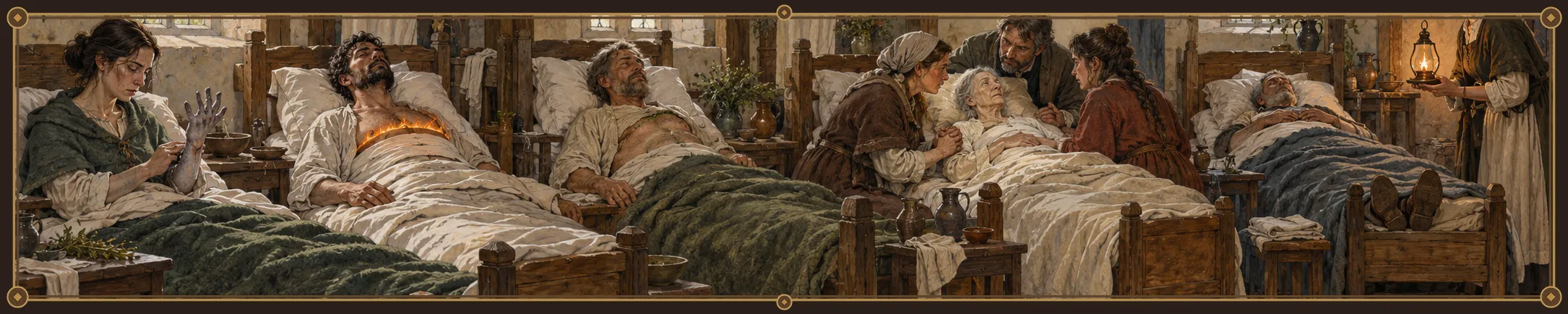
Did it come on the breath, or come at a word?
Did it start in the house, or with one at the door?
If it spreads, it was caught; if it stops, it was sent;
and if it keeps changing, put down the knife and fetch fire.
The Bedside Questions
Most of what fills a sickroom is ordinary, and the healers of the age are right to assume so first. A few cases are not. A guard drops into a sweating fever at his post with no sickness in the house and is well by morning; a courier who rode through a mortal wound cannot rise from bed three weeks after the danger has passed; a child sits up in her bed and speaks with three dead voices; a farmer comes back from a far valley with a green thread growing along a healed scar. These are the unnatural afflictions: the toll magic takes from those who work it and those it is worked on, curses and sicknesses laid by a spell, the harms that travellers carry home from the planes, the Veil, and the Resonant Zones, and the blights of the Dark Entities. Many are known only by rumour. The peoples' explanations of them are often wrong, and the one thing a healer can be sure of is that several of them grow worse under healing. They are also where the era’s darker trades meet the sickroom: the grave-robber with a black hand, the delver who came back from a silent ruin rich and empty, the witch-hunter riding on a village’s fear, and the healer who traced a sending back to its caster.
Caught or Sent
The healers' rule is short: if it spreads, it was caught; if it stops, it was sent. A sickness laid by a working comes suddenly and at full strength in someone who was well a moment before. It strikes one person, or a whole crowd at once, and does not move on through a household over the following days. It often begins when a particular person is near and eases when they leave. And it breaks, usually within the day, when the working runs out, without the slow mending of a true fever. A healer who sees those four signs looks round the room before she looks at the patient.
The rule is sound and seldom used, because the peoples believe in sent sickness far more than the world provides it. The ill wish, the evil eye of many tongues, is the most widely believed affliction in Caeldon and among the least often real. The cow dries, the child falls, the roof leaks, and the neighbour who glared at the market is to blame. Almost every household keeps some charm against it: blue beads, salt, iron, spit, and averted eyes, which give comfort and some caution, and caution is half the cure of the true curse. Villages accuse widows, strangers, and the squint-eyed, and such accusations do far more harm than curses do. Most of what is blamed on the ill wish has an ordinary cause: sickness, bad water, weather, carelessness, and plain bad luck.
The true curse exists, and it is dangerous because it is quiet. An augur who lays one weights a person’s chances towards the worst outcome already open to them, by making hesitation and error likelier; the cursed drop a tool, take a wrong turning, mishear an order, stumble on the stair, and the small failures come closer together and gather at the moments that matter. It cannot invent a catastrophe. It only lets the worst already-possible thing happen more often: a fall from a scaffold, a lost footing in a ford, a missed parry. Its turning point is recognition. Someone who knows they are weighted slows down, checks, and asks for help, and the curse finds fewer openings; the careful and the disciplined are least troubled by it. Wards throw a directed curse back at its sender or take it apart, at the warder’s cost. True luck-cursing is the work of trained augurs, counted a wrong by most peoples even where a lord pays for it. Some peoples treat cursing as an ordinary punishment, and a wronged family may lay one openly. Feuds between houses are often fought as much with curses as with swords, and the songs remember the two families that cursed each other down to the last child, and the hedge-witch who sold curses to both. The Orcs of the Windscar Pacts dread the Curse of Oblivion of Ushkar the Ancestor-Warden, which strikes a breaker’s name from memory.
Laid sicknesses
Rarer and plainer are the laid sicknesses, the "sent fevers" of lords' halls, cities, and wars: a poisoner’s art without the poison. A working drives heat into a body until it flushes and raves; drives cold in until bone and joint lose their give and a fall breaks what it should only bruise; seizes the blood and the muscles so the limbs refuse to move for a few heartbeats; draws vigour out of a weakened body, or breath and stamina out of a crowd; or makes the body feel burned or struck without a mark on it. Assassins, interrogators, riot-breakers, and battle-mages use them, and most peoples punish laying one on a person, when they can find who did it. The songs remember the assassin who laid a fever on a whole wedding feast to reach one guest, and the healer who traced the sending back to its caster and burned his house down around him. Most do no lasting harm to the healthy. Pressed hard and renewed on the sick, the old, or the wounded, they kill. The surest cure is distance: take the patient from the caster, or the caster from the patient. Because they are real, they lend weight to the belief that all sudden illness is sent, and many a true fever has been blamed on a neighbour. Village healers rarely meet them, and when they do they are likelier to blame bad air.
The corpse’s touch and the held word
Two curses are feared out of proportion to their rarity. Grave rot is decay laid on the living: a sword arm goes numb in mid-swing and is black to the elbow by nightfall, because a necromancer’s touch or curse-mark has turned the body’s repair off and its dying on. It spreads towards the trunk, with fever and confusion, and a case not cleansed before the black reaches a joint ends in the loss of the limb or in death. Speed decides it. A temple cure or a burning-out by fire can stop it, and without them a surgeon cuts the black flesh away. Because it looks like ordinary wound rot gone mad, a healer who mistakes one for the other is commonly blamed for the death. It is known mostly from war, from the feuds of frontier lords who hire grave-thieves, and from the hunting of necromancers, where a blackened limb is proof enough to burn one. Grave-robbers are its commonest victims, and in many villages a man with a black, stinking hand is taken for a grave-robber and driven out before he can explain.
Oath-sickness is the one magical ailment the peoples count as just, and much of what order there is rests on the fear of it. A caravan guard who sold the route to bandits wakes choking, with a band of fire across his chest, because the vow he swore was bound to his body. The pain follows the binding’s wording, tightening the throat, weighing on the chest, burning in the hands that signed, and it comes in waves that worsen whenever the breaker moves further from the promise and ease whenever he moves towards keeping it. It does not wear out while the breach stands. The cure is in the vow: keep the promise, late or in part, or have the binding dissolved by a revocation rite, which needs the agreement of the one who holds it, or of a lord or temple strong enough to overrule them, and costs a price as well as the caster’s effort. Most peoples say the oath-sick are "held to their word" and give them little sympathy. Tales tell of oath-breakers who wasted for years rather than yield, and of honest folk who suffered for a promise worded by someone cleverer. Bound oaths underpin trade, service, and testimony wherever Binding Magic is practised: lords and temples keep oathwardens of their own, most towns have a binder who seals bargains for pay, and sellswords sworn by binding to a company are said to be the most loyal in the world and the most dangerous to cross. The songs remember the deserter who rode three days burning with oathfire to warn the enemy he had once sworn to fight. The village meets oath-sickness most often in a returned guard or debtor who cannot stop choking until he makes amends.
The Price of the Art
Every working costs something, and some costs are illnesses (see How Magic Works (FND)). They are the commonest unnatural afflictions by far, because they fall on the healers and casters every village depends on.
The healer’s grey
A healer who has mended too much in a day goes grey at the fingertips. That is the mild end of lifeforce depletion, the healer’s grey of every village: a body that has given away more of its vital reserve than it had to spare. Mild depletion is a pale face, cold grey fingertips, slow thought, and a day of poor appetite, gone after a night’s sleep and a meal. Deeper depletion shakes, chills, sleeps long without resting, and catches every passing sickness. Repeated over years it stops mending: the hair greys early and the body ages ahead of its years. The turning point of a single case is the first long sleep, because a patient who wakes warmer will mend and one who wakes colder, with a slow pulse and no hunger, may collapse. Most peoples revere the greyed healer, and a village that wears out its healer is ashamed of it. The schools of Vital Magic rotate their healers, keep stored reserves for days of mass casualties, and teach when to refuse. In plague years and after battles the hospices of the Red Mercy and the Houses of Mercy lose healers to it as surely as to the sickness.
A depleted body cannot heal another safely, however compatible the two may be, so a village with one exhausted healer is a village without one. Vitality can be given back, from a willing donor, a stored vessel, or a group that shares out what it has, but every gift is a transfer that leaves someone else greyer. Nothing restores years already spent.
When a working bites
Backlash is what a spell does when it gets loose. Control breaks, through panic, a lost word, a smeared rune, or more force than the body can carry, and the force finds the nearest body, usually the caster’s. Every people that works magic knows the sight of a caster on the floor with a bloody nose and shaking hands, and each school leaves its own signature: a crushing chest after the surging arts, flesh that grows wrong after a failed healing, cracked skin and a failing pulse after frost, a hand left a paw after a shape-changing that did not finish, a mind looping on one dread after a reading of chance. Most cases ease into a few days of exhaustion; a case still worsening on the second day is settling into something longer. Villagers say the working "turned" or "bit", and trust a survivor of a bad backlash less afterwards, as if the spell were still in them. Battle tales are full of the war-mage who pushed one blast of fire too far to break a charge and was found in the ash beside the riders she stopped; sellsword companies pay a mage well and watch her hands.
Channel scarring is the wear of a working life, and it frightens casters more than backlash because it comes quietly and does not go away. Each heavy casting does small harm and rest repairs most of it; where the casting outruns the repair, the paths magic travels through the body scar, carrying less and costing more. It begins with signs a caster can hide, more effort for the same working and side effects still there the next morning, and goes on to a tremor that stays in the hands, failing touch and taste and hearing, feeling at half strength, barrenness, and a shortened life. Villagers know it by its plainest saying: healers age early. Its turning point is when the caster stops. Where a school, temple, or warlord keeps a firm hand on its casters, it keeps tallies, orders rest, and stops those who have been warned; elsewhere nothing stops a healer working until she breaks. War and plague years produce a generation of scarred healers at once.
Priests carry their own form of it. Vow-scarring is the long wear of carrying a god’s power through a mortal body: an old priest of thirty years' service who cannot pray to any god but his own, cannot bend on any question his god cares about, and lies two days in the dark after every great rite. Temples track it in three stages and many priests count its first signs as blessings. It turns to harm when the channelling outruns rest, when doctrine is coercive, or when a priest channels through a contradiction he cannot resolve, and a single miracle beyond his tolerance can burn, break, or kill him. Every temple has its old priests who lie in the dark after a feast-day rite, and congregations accept it as the price of the god’s presence. In war and plague the monitoring fails first.
Borrowed years
Blood debt is the bill for life spent before it was earned. Some workings lend a body its own future: they hold off a lethal wound, trade later vitality for present strength, or spend years outright. A courier rides through a mortal wound, delivers the warning, and three weeks later cannot rise from bed; a large debt comes as a collapse in which the patient greys within days and looks years older than the week before. Nothing cancels it. A healer can carry a patient through the worst nights, but every such gift is a second loan from someone else. Gods lend the same way. In the Leeward Folds newborns are given a season of protection by Tamsel the Season-Weaver, and a child so blessed may meet its "long winter" of sickness later; the folds hold that Tamsel takes back only what was lent. "The blood remembers," say Human soldiers. War-camps know the pattern well, and village healers meet it mostly as the elder who aged suddenly after a good summer or the child sickly after a blessed one. Many peoples count a debt-working laid on someone without consent a wrong, and punish it when the worker is weak enough to punish. Songs remember the champion who borrowed ten years of strength to hold a gate for one night and walked off the wall an old man at dawn, and the lords who paid sorcerers to borrow on their soldiers' blood.
Mending that fails, and practice that corrupts
Failed Mending is the case that was saved and came out wrong, the wound that closed too hard and keeps the harm in altered form (its course, and the Trolls in whom it is stable and heritable, are told in Magic in Ordinary Life). Humans of the basins call it "proud healing" and say the wound would not let go; old soldiers keep their knotted scars as proof of service, and some healers refuse a patient who has been worked on too often by another. The schools of Vital Magic teach against it, and a healer known for it loses custom.
Dark corruption is what predatory magic does to those who work it. Sacrifice, coercion, corpse abuse, and curse-work load a caster’s channels with residue and wear them into loops that reward the next taking, and the person bends with the channels: the feelings go blunt first, then the habit sets and the body greys and wastes, and in the late stages the appetite rules. Temples and schools grade it in four stages; before the third, abstention and help bring most back, and after it few return. The Halls of Consecration of Sanctified Magic do most of the cleansing. Most peoples take corruption for a visible sin and believe a corrupt caster can be known by a grey face, a cold hand, or a smell of iron, and many hold that it is catching and shun the households of condemned casters, though the schools say otherwise. Witch-hunters ride on the strength of that belief, and the songs of the hunts are dark ones: the grey-faced sorcerer burned in the market square, and the grey-faced old woman burned beside him who had only been sick. Its inherited form, carried by descendants who have done nothing, is a lifelong trait that shows under strain.
Sicknesses of Place
Some afflictions belong to where a person lives or has been.
Living beside the strange
In a village by a ley-rich spring a child is born with eyes that hold the light, and her cousin with joints that ache from the age of ten. Both are ley-warp, the change that long pressure of strong magic works on a body’s pattern and flesh: sometimes adaptive, a better gift for one current; sometimes unstable, a gift that misfires; sometimes degenerative, with pain in the joints and nerves and a narrowing of what healing can reach. Villages near strong sites call the changed "touched" or "place-marked" and treat them as lucky or cursed, often in the same breath. The one sure treatment is to leave the pressure, and families who can afford it send a suffering child away from the site.
The Pull of Extremes is the same patience on a larger scale: what a thin place or a long-lasting Resonant Zone does, over a lifetime, to the people who live beside it. A village beside a zone of fire runs hot-tempered and feverish; a town on a thin spot to the Scourge quarrels and startles; a hamlet by a still spring heals slowly and changes nothing. Zone-side folk rarely call it a sickness. They call it the place’s temper, and say a child "has the spring in it" or "has the fire in it". Physicians in cities on thin ground know their town’s peculiar complaints and treat them as part of practice; elsewhere it is only a reputation.
The dead who cling
Gravediggers say the cold gets into you and stays. Remnant contamination is that cold, the residue of the dead clinging to the living who handle them: a trade’s ailment in its mild form, a dulled nose and a gloomy temper and a pull back to the graves on a free day; in its strong form a hostile remnant fastened on a living person, who chills and weakens a little more each night and dreams the remnant’s last feeling until they wake with it. The deathbed trades keep their own customs, washing in running water after a burial and never eating at a graveside, and plague years make the sickness common as the pits fill faster than the rites can be said. Battlefield strippers who take boots and rings from the dead before the burial come home sickest of all, and the old soldiers' saying is that a dead man’s ring weighs more than his sword. Rarer is trace possession, a living mind with someone else’s pattern in it: an Echo of the dead, a hardened remnant, a curse-thread, or a false self worked in by magic. It begins with borrowed habits, a gesture the host never made or a memory of a place they never saw, and goes on until the foreign trace speaks. What possesses is never a soul, and the host is still there underneath, which is the horror of it and the hope. While the host still breaks through, frightened and confused, they can be brought back; kin call their name and speak their memories, and the word of those who knew the host before is how healers and priests tell host from occupant. The Halls of Consecration say who may exorcise in their temples, and every case is talked of for a generation; the songs remember the young lord ridden by a murdered ancestor who named his killer at the feast, and the hall that burned the same night.
In one valley of the cradle-web the dead and the living share the fog itself. In the Hushvale the deep fog of an old concealment rite drains the lone and the lost of warmth, breath, names, and the power to know a face, and some of the Held are overwritten for a night by a hunter’s will. The Held watch, bind, and nurse such a one till morning, and nobody goes alone into deep fog (see Sealed and Silent Places). Healers of the cradle-web have never treated a case.
The cures that cost
The waters and planes that cure almost anything are where the worst of the cure-all sicknesses come from, and they are why the great cures leave the sickbeds full (see The Resonant Zones (FND)). A sip from a Blood River closes a mortal wound or ends a disease at once. Within days comes a craving that is not for food, and drinkers who keep a supply can hold for years, looking younger than they should and thinking of little else; when the water stops, the years it held off come due together, and those who drank too long at the bank swell, tight and shining, and seldom come home. Healers call it the Blood River’s Surfeit; those who know the zone call it the Addiction, and its last stage the Bloated. Healers who must use the water give the smallest draught that will serve and wean the patient by smaller and smaller sips. Some healers of the Red Mercy Hospices and the College of White Vessels bargain with the Hemophages for water at a cost paid in other lives, and many refuse on principle.
The Verdant Expanse, across the planes, cures as freely and leaves Verdant overgrowth behind: a fine green line in a healed scar, a rootlet under the skin, a sweet green smell on the breath, and over seasons moss in the creases of the skin, leaves at the fingertips, a contentment that does not want, and in the end a sufferer who goes out, stands in soil, and roots. Many stop at the first stage for life, carrying a small growth they keep trimmed, and the illness they went to cure stays cured. Surgeons who have seen a case keep it to themselves, since a patient cut back too often learns to hide the green. The herbalists of the Drowning Garden, who gather where time runs fastest, come back grey at thirty; in their trade a grey young head is a mark of skill, and a Garden herb is priced by the years it cost. That is time-sickness, which also takes the guardians who walk away from an Ageless Spring after long stillness and age decades in a short walk, and the keepers of sealed things who come home slow of hand and thought to a village of strangers.
What travellers bring home
The few who cross the Veil pay for it (see The Veil and the Outside (FND)). Veil-sickness, the scholars' memory erosion, is the fare: most crossers come out tired, chilled, and a little lost, with a gap, a lost day, and a name they cannot recall, and some pay more, a season blurred or a vow they no longer remember making. A traveller who loses intent drifts, and the Veil keeps many who do. Crossers carry a clear purpose, a companion, and a keepsake, and where a thin place is near, households keep a returning crosser in for a day, feed them, and tell them their name and the date. Many believe a memory freely paid to a Veil-Walker hurts less than one the fog steals. Smugglers who use the thin places as hidden roads come home missing more of themselves every season, and the boundary-road songs remember the one who made a fortune on his crossings and could not remember, at the end, where he had hidden it.
Beyond the Veil each extreme plane has its own harm (see The Planes (FND)). In the Silence the Fade takes memories, then character, then will, and those who come back halfway are gentle and blank in places, recognizing faces without the names; families speak a lost one’s name at every meal, so the plane cannot have all of it. The planes and zones of lack bring the Freeze, a cold that drains a body until it stands as a statue of ice and ash, and the old remedy for one pulled out half-frozen is a living body: dry wool, a companion’s skin, a banked fire, never a roaring one; delvers who brave the cold planes for their relics carry a sealed pot of coals as their most precious treasure. The Parched brings thirst-madness, and its survivors hoard water for years and grow frantic at an empty cup; the cure at home is plenty that can be seen, a full jar by the bed that nobody empties. Soldiers who stumble through a War-Gate in the smoke of a battlefield bring back Blood-Fury from the Scourge, the red fit of the camps, and their villages feed them, watch them, and keep the children away on bad nights; the Red Mercy takes care to tell it from ordinary shock after battle, which is far commoner. Sellsword captains who hire a veteran of the Scourge put him at the front and keep him away from the camp, and the songs remember the berserker who won a battle alone and killed his own shield-brother when no enemy was left. The planes and zones of stillness work stagnation into those who linger, a slowness that looks like grief, and families learn to welcome the first returning irritation. The zones of memory leave memory-fixation, a mind that keeps going back and sometimes a past that never happened; the Crystal Spire’s clashing frequencies leave spire-ring sickness, ringing ears and cracked teeth, in the harvesters of its stored sounds; the Whispering Winds leave wind-madness, a listener who can no longer tell their own thoughts from the voices of the dead. And everywhere people sleep, the Dreaming Veil sends back dream-sickness: the sleeper who will not wake, the one whose nightmares leave bruises, the one who cannot believe the waking world is real, and the one who sleeps all night and rises grey. Many households turn a sleeper’s shoes towards the door so the dreamer can find the way home.
Most of these are rare, and most healers meet them as something else: the faded as a man struck on the head, the stagnant and the fixed as melancholy, the wind-mad as an ordinary madman. Their care is mostly the care of kin, and the same few things recur in it: quiet, routine, food put in front of the sufferer and seen eaten, and the true story told again and again.
The Blights of the Dark Entities
The rarest afflictions of all are the ones the peoples fear most. The Dark Entities are known through fear, taboo, rumour, and protective rite (see What Waits Outside (FND)), and their blights are known the same way: as a traveller’s tale of a town that burned itself, a silent valley where everything stands still, a city that forgot its name. Those three tales are true: they are the three scars the Beyonders' Incursions left on Caeldon, the Wrongwood, the Hanging Vale, and the Paling, and the Beyonders' blights keep to them. Where one does break out, it is remembered for generations, and its customs travel further than the blight ever did.
The blights share one hard lesson. Each entity is a single idea pushed past all measure, and a working that serves the same idea turns under its influence and feeds the blight, while a working of the opposite kind holds. Healing that grows flesh feeds the Changing Fever; preserving magic hastens the bone of the Bone Singer; a ward of quiet laid so a patient can rest would feed the Quiet Plague of the Silence Seed, were it ever to come. The treatment, again and again, is to do what the entity cannot bear, and to do it early, before the turning point that each blight has and that every household near one learns to watch for.
The Beyonders' blights
The Changing Fever is what is left of Qzoth’s Bloom, and it rises when someone digs or ploughs the burned ground of the Wrongwood. It begins as a warm rash that moves from wrist to elbow by noon, and within hours a finger bends where no joint should be; from then on the sick change without end, awake through it, until the bed holds no single creature. Healing makes it worse. A changing patch burned out at the rash may stop, and the sick are told to recite their name, kin, and purpose and hold that shape in mind. The valley below the Wrongwood casts out anyone with an extra joint, rightly and sometimes wrongly, and the plague healers of the Red Mercy come to such a town as burners more than healers. Bounty-takers hired to hunt a changed one in the hills are paid double and burn their gear afterwards, and the fever-country songs remember the hunter who found his quarry was his own brother.
Crystallization under Krystallis is painless and permanent, and is caught now only at the edge of the Hanging Vale. The fear goes out of the sufferer first and onlookers take it for courage; then a fingertip goes clear, flat, and cold, and if nobody breaks it off, badly and without a planned stroke, the clearness runs up the limb until the whole body stands in crystal, aware. Survivors must act unpredictably, weep, shout, quarrel, run crooked, and they come home fond of their own flaws. At the Lastwater Well nearest the valley, households hang chipped crockery at the door and healers carry a hammer beside their knives.
The Unwriting of Mnemosyne Null takes a person’s past in order, this morning first and the fact that they exist last, and looks at first like the forgetting of the very old, so that families are slow to call for help. Memory is the only medicine: the sufferer is told their name over and over and made to say it, write it, and carve it, and kin sit round them telling shared stories aloud. Round the Paling, where a night inside takes the morning’s memories, households keep their names, songs, and genealogies aloud as a nightly habit, and the Wrought, who take no ordinary illness, are not spared it.
The blights the other seven Beyonders would bring, the Quiet Plague of the Silence Seed, the Red Dust of the Rust Flower, the Rooting of Xylos, and the rest, have never broken out on Caeldon, and no custom guards against them.
The Cast-Outs' blights
The fallen gods' blights are stranger in one way: each begins with something offered, and most are let in by love, grief, faith, or loneliness.
The Ember’s Grip is a death that will not come. The Ashen Child comes to a deathbed as a small, sad child and offers to keep the loved one alive, and when the offer is accepted the fever stops and never breaks, the wound stays open and never festers, and hair and nails stop growing, for months or decades. The held are awake and know they are dying. Fine grey ash settles on the sills, the watchers waste, and a street where it has stayed long does not rebuild. Healing cannot reach the held; the Grip ends only when the watcher says the goodbye aloud and means it, and then the held die soon and peacefully. At first a held case is often taken for a miracle. A small ash-smudged child seen near a sickroom is an omen no midwife ignores.
Gilding begins at the shrine. A tear of the Weeping Idol strikes a worshipper, and the gold spreads from where it landed while doubt drains out of the sufferer, until the whole body kneels in gold with its face fixed in bliss. A sincere question asked aloud, above all one the asker cannot answer, cracks the spreading gold, so temple teachers along the Idol’s trail have children ask questions at the altar, and pilgrims are warned not to kneel among old statues. Many faiths take the gilded for saints and build shrines over them.
Inherited Rot is the sickness of a family that cannot let its past die. The Rotting Crown drives its curse down a bloodline, so that an heir greys at twenty and knots at thirty and makes the grandfathers' mistakes knowing exactly what he is doing, while black mould creeps into the cellar and the crypt. Physicians to noble houses see the early greying and blame marriages between cousins. What helps is succession: the heir sets the inheritance down, and something with no ancestors is begun, a seed in fresh soil or a house founded rather than inherited. Farmers say that if the rot begins, one should plant something, and here they are closer to the truth than most lore.
Ossification under the Bone Singer begins like the aches of age, a knee that will not bend in the morning, and runs on until the body is ivory bone that still sees and hears. Because its first signs are age’s signs, many families never know what took their elder until the statue stands. Near the Singer’s trail villages keep their rivers running, wake their old people early and walk them, and sing their work songs loudly and badly; bone-setters there learn to tell stiff bone from a stiff joint by the chill of the skin. Grave-robbers and treasure-seekers who break into the Singer’s fields for the jewels on the stone dead say the statues' eyes follow them, and many leave the jewels where they lie.
The Thread of Dependence binds the lonely. The Shadow Stitcher’s threads catch on the sleeve of a widow or a carer sitting alone with another’s suffering, and soon the bound feel each other’s pain, cannot step apart, and wither within a season when one of them dies. Boundaries are the cure: a door kept locked, a thought kept private, time spent alone on purpose. Wise folk healers send carers home to sleep alone, and some keep a knife for thread among their tools; people who take the wraiths for the ghosts of lost lovers leave lamps at the window for them, which brings them nearer.
The Weaver’s Mending begins as a miracle and sours. A wound closes overnight without a scar, a crooked spine is straight in the morning; then the wound festers under its perfect seam, the new flesh changes and wants things its owner never wanted, and the healed come to need the thread. A sufferer who refuses aloud and declares the body their own, wounds and all, cannot be touched. Healers who have met it keep the hard rule of no mending without permission, and the careful ones ask a patient’s leave aloud before they lay on hands, even with a fever-addled child. A healer of the Red Mercy who finds a wound closed overnight that no one closed cuts it open before anything else.
The weight of the Slumber
One blight comes from the Unformed, from before anything acted. Slumber-sickness settles where the Great Slumber drifts, and begins as the feeling everyone has at the end of a long day: a sweet heaviness and the wish to sit down. It does not lift with rest. It deepens until an arm takes an hour to raise and the heart beats as if through mud, and the sufferer lies awake inside a body that has stopped. It comes when ordinary life is hardest, in the last week of harvest, at the end of a siege, after a long plague, and most peoples put the sufferer to bed, which is the worst thing to do. Village headmen who know of it ring the harvest bell at intervals and keep the reapers singing, captains do not let a column halt in still air, and a folk healer who sees a whole household sitting quiet sends for the neighbours to drag them outside.
Tensions
-
Water from the Hemophages. Some healers of the Red Mercy Hospices and the College of White Vessels keep the Blood River’s water as a last resort for a patient no other care can save, and bargain with the Hemophages for it at a cost paid in other lives. Many healers refuse on principle, and the families of the dying know which healers will bargain and which will not.
-
Saints in gold. Many faiths take the gilded for saints raised into perfect devotion and build shrines over them, and pilgrims pray to be made the same. The Weeping Idol goes to the doubting and the faltering, and a shrine that honours its statues draws exactly the worshippers it takes.
-
Who wished it so. The Ember’s Grip loosens only when the watcher lets the held one die, so a folk healer at a deathbed that neither mends nor sinks must ask the family who has wished it so. The asking reads as an accusation to a mother who has nursed her son for years.
-
A promise worded by someone cleverer. Oath-sickness falls on whoever knowingly breaks a bound vow, and a binding can be dissolved only with the agreement of the one who holds it or of a lord or temple strong enough to overrule them. An honest party bound by cleverer wording must ask release of the very holder who profits from the pain, or find someone stronger.
-
Sent fevers. Laid sicknesses are real, and because they are, many a true fever is blamed on a neighbour, a widow, or a stranger. A lord’s judgement may ask for proof before it condemns someone for laying a curse; village justice seldom waits for any.