Chapter 7. Magic in Ordinary Life
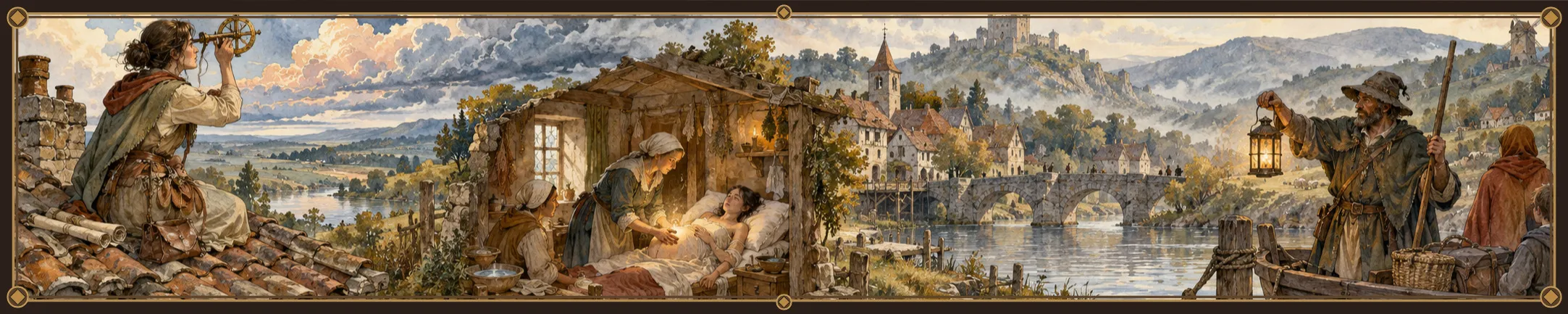
Close the skin and leave the deep;
warm the pot and not the room;
what you mend, you pay for,
and what you pay with is you.
The Book of Small Mendings
In a basin village magic is not a daily wonder. It is the reason the fire catches on a wet morning, the reason the threshold stone has not cracked in forty winters, the reason the midwife’s hands go grey for a day after a hard birth. People have seen it worked, they know roughly what it costs, and nobody mistakes it for something free. But only a few in any village can work it at all, and anything beyond the small charms is rarely seen: a real working, close at hand, still draws a crowd, and fear as often as wonder. The healer who closes a spear-wound in front of the whole market is talked of for a generation, and so is the lord’s caster who brought a raider band’s fire down on the wrong barn. The schools that train mages say what every village knows, only more carefully: magic makes nothing from nothing. It reaches a force that already exists, moves it, changes its form, and loses some on the way, and someone or something always pays for what is lost. The art of ordinary magic is the art of staying where the price is small. Ordinary life is mostly about who decides when it has stopped being small, and who pays when it was not.
The Natural Philosophy of a Kitchen Fire
Begin where most people meet magic: at the hearth, on a morning when the kindling is damp.
The cook who coaxes it to catch is doing, in small, what the greatest workers of the age do in large. The force she reaches is universal. It is not a substance she makes, nor a privilege some people invented; it is part of how the world is, and it runs in ten currents, the currents of the ten Primes: Aion’s time, Aqua’s living flow, Ignis’s change, Imago’s shape, Lux’s revelation, Memoria’s imprint, Terra’s structure, Umbra’s dimming, Verba’s definition, and Zephyr’s motion. The flame that takes on the wet wood is Ignis, the current of change, coaxed a little further than the wood would have gone alone.
She pays for it, and so does the room. Heat drawn into the kindling is drawn from somewhere: the air near the hearth goes cool for a moment, a draught seems to come from nowhere, and if she presses too hard she feels a tremor in her hands and a dull ache behind the eyes. That is the first law of the whole art, and it never bends. Every working incurs loss, and the loss is paid in one of four coins.
-
The caster’s reserve. The commonest price is tiredness, tremor, dizziness, headache, a slowed hand or a slowed thought, and at the end of it collapse. This is the price of almost every small working, and almost everyone who has worked one knows the feeling.
-
Lifeforce. Some workings spend something deeper than fatigue, above all healing, which is transfer, not creation. A healer who mends too much gives up endurance, recovery, health, and in the end years. Healers age early. The village knows it, and is careful about how often it sends for them.
-
The surroundings. Other workings take from the world around them: heat out of a room, moisture out of air and soil, vigour out of the plants nearby, the charge out of a storm. A garden beside a workshop where too much is done wilts in summer.
-
Materials and name. Many workings need chalk, inscribed media, anchors, offerings, or prepared water, and a practitioner without them may know a working perfectly and still be unable to do it. And every working has a social price: suspicion, a stain on a good name, a lord’s anger or a blood-price owed, a debt to whoever gave leave for it. That price is heaviest for workings that conceal, bind, or touch the dead, and it is the price that sends a hedge-mage down the road at night with torches behind.
A practised worker manages all four. She keeps her charms small, works near a good fire rather than a cold one, uses the right tool for the right work, and does not do in front of the neighbours what the neighbours would not like to see.
Bodies and their bents
The second law is that bodies are not neutral channels. Every people took on its own balance of the Prime currents as it arose, and that balance, its lifeforce, shapes which workings come easily to it, which come at a heavy cost, and which are dangerous. It varies along five lines: how easily a body conducts the force, how well it holds a complex pattern without drift, how quickly strain clears from it, how much stress it can take before injury, and how cleanly it exchanges lifeforce with other living patterns. No people is better at magic than another. They are differently made for different costs, and a people more strongly shaped by one current than another will produce, over the generations, more of the workers that current favours: more healers and growers here, more warders and builders there.
Method follows the body. Peoples quick to conduct and quick to react favour direct will and gesture. Peoples that hold a pattern well favour runes and prepared casting. Peoples that exchange cleanly with others favour ritual and group work. And peoples whose bodies tolerate less favour focus objects and liturgy for their safety. These are tendencies, not destinies, and in mixed towns the methods blend: one people’s steadiness worked together with another’s speed.
Within a people, individuals differ again: in the size of their reserve, the quality of their conduction, their sensitivity to the lines where the force runs dense, their pain tolerance, their composure. That is why two equally trained workers can perform very differently, and why the gifted but fragile apprentice and the plodding but steady one end up, years later, in quite different trades.
Where the force runs thick
The third law is that magic is never equally easy everywhere. Along ley lines, the channels where the force runs dense, casting is easier, more efficient, more stable, and capable of greater scale, and where several lines knot together in a node it is easier still. Minor nodes serve local ritual and small works; major nodes are steady enough for cities and sanctuaries; rare grand confluences make region-wide wards possible. Settlements, sanctuaries, and the places where workers gather tend to grow up on them, and lords fight over them as they fight over fords. Lines are not fixed forever. Over decades and centuries they drift, and the old works of a town built on one need recalibrating from time to time.
Living things carry the force too. Plants and animals took on their own balance of the currents as they formed, so medicinal herbs really do restore strength, certain broths and teas really do invigorate, and different herbs act differently on different peoples. Herbalism, husbandry, and the folk medicine of beasts are not mere custom. They are the meeting of one living pattern with another.
The Ordinary Reach
What an untrained or lightly trained person can safely attempt is modest, and it is everywhere. Each current has an ordinary ceiling: the most a worker can do while the strain stays ordinary and nothing done would bring a lord, a temple, or the neighbours down on them. Below it lies most of the magic of medieval life.
At the hearth, Ignis coaxes kindling to catch, holds a gentle heat under a drying rack or a cooking pot, and wakes a sulking forge fire. Anything hotter or larger is a different matter, because fire’s failure is a fire that will not stop, and even ordinary heat work carries a real risk of burns. A village once burned by a raider’s fire-caster remembers it for generations, and the next stranger who coaxes a flame too quickly may hang for it.
In the air, Zephyr clears smoke from a hall, speeds the drying of washing, fills the sail of a small boat with a following wind, nudges a cart along a level road, or works the bellows for a smith. The price at this scale is only tiredness.
In stone, ordinary magic is closest to ordinary work, and Terra is among the most accessible of the currents because it overlaps with building itself. Masons use small assisting charms in the building trades; doorframes, walls, and foundation stones are quietly reinforced; and many thresholds have a small ward-stone set into them, which is why the threshold stone has not cracked in forty winters. The tales tell of a warding that turned a raider band back at a village hedge, and every village with a ward-stone hopes its own would do as much.
In the stores, Aion keeps timber, cloth, and perishable goods a little past their natural span and paces the slow processes of curing, drying, and fermenting. Its price is mostly in materials: the preserving charm is a pattern cut or drawn on an anchor, and the anchor must be prepared.
At the bedside, Aqua is the healer’s current. A folk healer cleans and closes shallow wounds, eases fever and the flow of blood, and works through teas, tonics, poultices, and treated water, drawing on the real virtues of plants and animals. Even here the healer pays from her own lifeforce, which is why a midwife’s hands go grey after a hard birth. Imago, the current of shape, comes in only as a light helper in wound work; on its own it has almost no ordinary reach at all, and any working that sets out to change a body’s shape is out of ordinary practice from the first moment.
In the dark, Lux gives a working light in place of a lamp, a small charm to sharpen attention, and an unreliable folk sense for a lie, of the kind no chieftain would hang a man on. Umbra gives the reverse: a light dimmed, a sound muffled, a scent or trail softened. The same current eases a hard death without erasing what has ended, and that palliative work is honest and welcome. Concealment of any kind, though, invites suspicion even when its use is innocent: the charm-woman who can muffle a footstep is the first name spoken when a granary is robbed.
In memory and word, Memoria lets a token hold a small impression: a face, a recipe, a promise. Verba gives a merchant’s mark, a household’s naming custom, or a spoken promise sworn in folk form a little definitional weight. A household’s mark on its door or its barrels is more than decoration; a promise sworn in the old folk form is a little harder to break than one merely spoken. Neither binds with teeth. That belongs higher up.
Some pairs of currents work well together, and an ordinary worker may lightly use them: shape with flow, in wound work; word with imprint, in a promise given weight; structure with dimming, in a ward. Others pull each other apart. Time with change, light with shadow, and structure with motion should never be combined at the ordinary level at all, and practitioners everywhere are warned off them.
The Trades and the Threshold
Above the folk reach stands a tier closer to a craft than to scholarship, and it is where most of the medieval world’s working magic is done. Four compound traditions are known widely enough to have common names and teaching lineages, and a practitioner who names one will be understood almost anywhere:
-
Storm-Forge, fire and wind in mutual support, is the smith’s: heat sculpting and the elemental work of the forge, common in smithing peoples and weather-working traditions.
-
Oath-Inscription, imprint and word together, fixes a commitment into lasting record, and belongs to oath-keepers, priests, and scholars.
-
Healing-Shift, flow guided by shape, closes wounds and restores form, and is the most widespread compound tradition in the healing arts.
-
Stonelocking, structure reinforced by time, makes walls that resist ageing and anchors that hold across generations, and belongs to masons, warders, and tomb-builders.
Each is open to a trained smith, oath-keeper, healer, or mason and not to an untrained person working alone. They are learned the way a trade is learned, by apprenticeship and practice inside the trade, one burden at a time, and they travel the way trades travel. Dwarven craft teaching comes down the Headwater exchange roads with the metal and dressed stone, and the larger foothill towns have smithies working to Dwarven methods. High Elf garden-craft and teaching go out from the Crownboughs as gifts, and Human lords have long borrowed High Elf ceremony, composure, and magical shaping. At the Understorey Courts, where the embassy road from the basins ends, visitors from below come up seeking a graft, an audience, or a teacher, and wait seasons for any of them.
Where the art is taught
Beyond the trades, the great disciplines are taught in schools of every kind. Practitioners speak of formal academies; guildholds where builders and mages train side by side; forge-schools where smithcraft and magic are held to be inseparable, of which the Nine Hammer Forges are legendary; temple-schools and temple-hospitals; halls where oath-workers train in spoken form; and itinerant road schools that teach travel-craft and omen-reading on the move. On the far-side coast, where Maris is honoured, the Tidelore Hospice of Maris is a harbour hospice kept under the name of Maris of the Tides, famous for healing arts and the magic of surviving the sea. Others are family traditions, guarded inside a lineage and taught at the kitchen table. And some of the best-paid casters in the medieval world learned nothing in any school: the burnt-out war-mage who lives on as a sellsword company’s charm-maker, and the conjurer a lord keeps because he knows how to send back what bad conjuring calls.
Every people also keeps its own art in its own houses, and this is where a writer finds the texture of it.
-
The Crownboughs teach shaping in the houses. A young High Elf learns a craft by continuing shaping begun by a grandparent’s grandparent, and is presented at court carrying a piece of shaping they have carried on themselves. The courts' halls, gardens, and garden-walks are grown, coaxed by magic and centuries of patient shaping into forms no forest makes alone. Shaped growth does not stay shaped: a boughway left alone for a few seasons sags, and a trained hall closes its own doorways with new wood.
-
The Wood Elves tend rather than shape. The Rootcrown groves work with the living world and do not redesign it, and they remember the Crownbough branching as a leaving.
-
The Gloamroot Covenant is defended by its survival and warding orders, which first rose to hold back what the Roothollow catastrophe left loose in the dark and remain the deep world’s swords and its guards on the ways. A house that cannot draw on their protection is brittle.
-
The Stonewake Deeps run on warded vault routes and warded corridors from hold to hold, opened by the custodians' word rather than sold.
-
The Wrought depend on repair, and repair is a craft with its own houses: the repair houses and sanctuary workshops of the Mending Orders, and the trusted artificers individual Wrought keep.
Above the Threshold
Every current has a notable threshold, the point where further practice stops being ordinary and the powerful take an interest. Past it a worker needs caution, a master’s eye, the leave of whoever holds the place, or all three, or has crossed into what is forbidden outright.
-
Deep healing, the direct transfer of lifeforce to repair what lies below the skin, is where a folk healer’s competence ends and a trained caster’s begins, and a failure there can cascade. The healer who can cross it is the one lords send for and raiders carry off.
-
Binding oaths, oath magic with real teeth, belong to temples, oath-keepers' halls, and lords' oath-mages, because a broken binding rebounds on everyone it touched.
-
Foresight that can be relied on, and true scrying, are kept close by temples and lords, who want no one else foreseeing their wars.
-
Fire as a weapon is the work of a lord’s casters, a temple’s, or a war-band’s, and weather worked at scale starts feuds and wars, since a rain drawn off a neighbour’s fields or a storm called on an enemy’s harvest is never forgotten.
-
Great structures, load-bearing magic, large fortification, or anchors meant to hold for generations, are the work of master casters, and done only with the leave of whoever holds the place, because a failure brings down walls on their people.
-
Stillness that halts a living process, changes of a body’s shape, and true concealment or anything near a corpse belong to schools whose names alone make people uneasy.
Because overcasting can maim bystanders and bring down walls, whoever holds a place tends to forbid it there, and makes the forbidding stick with whatever force they have. The rules are few and plain, and rarely written down: a caster may work great magic only with the leave of the lord, the temple, or the elders; a caster who has burned out once must rest before casting again; a master pays for an apprentice’s backlash; whoever damages a hall, a field, or a well with a failed working pays for it, in coin, in service, or in blood; and a caster pushing into the worst of the strain may be stopped by force, if anyone nearby is strong enough to try. A lord watches the casters in his hall and his war-band, captains watch their own on campaign, temples watch their priests and sworn casters, and craft masters watch their journeymen. Overuse is a condition healers can see, not only a rumour: more input needed for the same result, exhaustion that lingers, familiar forms going unsteady, side effects that do not clear. What moves the watchers is usually fear for their own walls and people, not the caster’s soul, and a lord’s favoured caster rarely pays the full price while a wandering one often pays more. A sellsword company under siege lets its war-mage go past all safety, because the alternative is the wall coming down; the companies that survive such nights tell of it ever after, and those that do not are remembered by the scorch on the stones.
The Healer at the Door
Healing is where ordinary life meets magic’s hardest edge, and the healer is the worker ordinary people most often need.
Her first difficulty is compatibility. Healing within a people is the cleanest. Between related peoples it is workable, with noticeable loss. Between very different peoples it is possible but costly and wasteful, and the healers of mixed towns know the difference by heart. A basin healer who treats a Human child, a Reedfolk pilot, a Dwarven smith, and an Ogre hauler in the same week pays a different price each time. Plant and animal sources ease the cost: plant lifeforce is gentle and steady, good for long slow recoveries; animal lifeforce is denser and quicker, good in a crisis, and riskier if used again and again. Both are less efficient than a clean transfer between two members of the same people, but they are safer, easier to come by, and far easier to justify than drawing on another person.
Her second difficulty is her own reserve. Two people may be perfectly compatible and the healer still too exhausted, hungry, wounded, or overextended to heal safely, and a village that sends for her too often can wear her out before her time. Lifeforce is not a soul and not a measure of virtue, but it is finite. And a healer whose touch draws a crowd in the market soon draws the lord’s men too, because a lord at war wants her in his train and a lord at peace wants her where he can find her.
Her third difficulty is that healing can go wrong in a way that lasts. Restoration forced again and again on the same injury can tip into Failed Mending, in which repair overcorrects and the harm is kept in altered form: wounds closing too strongly, tissue regrowing unevenly, scars that remain physically meaningful, a body left tougher, stranger, more knotted. In most peoples it is an occasional misfortune. In Trolls it is stable and inherited, written on their ridged, knotted, asymmetrical bodies, and nobody knows why. Healers and scholars blame, variously, healing magic itself, Verdant force, the memory carried in Echoes, mutation, failed restoration rites, or a regional catastrophe. Troll body-law treats the scars as sacred record and makes the closing of a wound a matter of rite as well as care, so that a healer of another people called to a Troll’s bedside meets a patient whose kin may not want the wound closed at all. A crossing house whose own mender’s hands have gone wrong keeps that mender far from travellers, because one bad mending at a crossing becomes a hunting party within the year.
Repair of the Wrought follows the same rules of care as healing, and the Mending Orders insist on it. A Wrought who receives needed repair is being cared for. A Wrought who chooses refitting is choosing for their own body. A Wrought altered without consent is being harmed, even if the work makes them more useful.
Gods and Hands
Some magic is not paid for by the caster alone. In divine working the force comes, in whole or in part, from beyond the worker: from a Prime’s current reached through alignment, from a god able and willing to give, or rarely from a Steward acting within its office. The laws do not change. Divine magic still channels and converts and loses; the body still carries it, the mind still interprets it, and a miracle beyond the channel’s tolerance can still burn, break, or kill the one who carries it. But it is often safer and steadier than learned magic, less dependent on the worker’s own reserve, and better at blessing, consecration, protective rites, and the cleansing of corruption.
Its weakness is dependence. The Primes are not patrons: a Prime’s current is open to whoever is aligned with it, and it neither chooses, refuses, nor withholds, so when Prime-aligned casting falters the fault lies in the caster, the conduit, or the place. A god is different. A god’s support is a relationship, and it may be steady and bound to doctrine, conditional on vows and obedience, intermittent and given only at the moments that suit the god, or withheld altogether. Silence does not always mean refusal. It may mean distance, a quarrel between gods over whose domain this is, a damaged channel, or a deliberate choice not to act. Years of channelling leave marks of their own: greater throughput within narrower limits, a stiffness of mind around whatever was sworn, dreams that are not quite one’s own, crashes of exhaustion after a great working, and a growing difficulty working anything without the god. In disciplined clergy these marks can be healthy adaptations. Where doctrine is coercive, or throughput outruns rest, they are not.
Divine sponsorship does not make a working good. A cruel god or a tyrannical order can feed sacrifice, domination, curse-work, or holy war as readily as healing. That is why the temples distinguish carefully between three things that can look alike. A miracle is a working whose decisive cost was carried by a god. Liturgy is a temple’s formal rite, sponsored or not. Spellcraft is technique fuelled from any other source. A miracle can happen outside liturgy, liturgy can happen without a miracle, and spellcraft can imitate either. When a miracle is doubted, the temples that care to test it ask where the decisive force came from, whether the temple’s own rite was used, and whether the worker had the temple’s or the god’s leave over the matter touched. The quarrel is settled less by the questions than by which temple, lord, or crowd stands behind the worker, and a hedge-priest with a real miracle can still be driven out by a temple with none. The bones, rags, and rings of a proven miracle-worker are worth more than gold: relic-thieves break into shrines for them, rival temples raid each other to carry them off, and forgers sell their fakes on every pilgrim road.
The Rare and the Strange
A few people are more than ordinary without being workers at all. Mythic traits are rare exceptional gifts that appear in otherwise ordinary members of any people: uncanny luck, kinship with beasts, a sense for dreams or for death, an affinity for storms, an ear that hears truth, a feel for the way through, an unusual memory. They are real, rare, usually narrow, and distinct from trained magic. Some are inherited and recur in a family; some wake only under stress, maturity, ritual, or crisis; some are imprinted by exposure to a divine event, a cursed place, or a zone where the cosmos runs wrong. A trait never appears from nothing. A person may be a trait-bearer, a trained worker, both, or neither.
Trait-bearers attract prestige and fear, taboo and recruitment, a lord’s interest and a priest’s suspicion, and now and then a family’s attempt to breed the trait true. A child who always finds the way through is worth a great deal to a delvers' company, and some companies do not ask the parents. Rarer still are demigods, the mortal children of a god and a mortal: exceptional, long-lived, still mortal, and unable to pass their gifts on, so that a demigod’s children are ordinary. Peoples often confuse a strong trait with demigodhood. The world does not.
Dark Practice
Dark magic is not a separate substance or a separate school. It is a way of using the same force, and what defines it is who pays the bill. A working is called dark when it makes the unwilling pay, violates body or mind, desecrates the dead or a shrine, drains its surroundings on a large scale, hides a price paid by others, or corrupts its maker over time. Some schools attract suspicion more than others, those of blood, the dead, sacrifice, command, and traces above all, but each of them contains acceptable practice as well as forbidden. What villagers and delvers meet of it are the marks left behind: a ring of dead grass where a field was drained, a cellar of sealed jars, a cult house with a Hunger Engine still upright in the dark, dry and grinding, waiting to be fed.
Few peoples forbid a school by name. They forbid harm, and whoever holds the place does the forbidding: a lord, a temple, the hold-elders, a clan’s custom. How hard it falls depends on who did the working and to whom. A lord’s own caster is let off lightly, a hedge-witch dealt with harshly, and a stranger worst of all. Across most of Caeldon dark acts fall into four rough grades: restricted, done only with the leave of whoever holds the place and under their eye; conditional, tolerated in war, in great need, or in a rite a temple blesses; prohibited, forbidden whatever the reason; and atrocity, an outrage against the person and the people, for which the caster is hunted and every hand is turned against them. Forced extraction of another’s lifeforce is an atrocity anywhere, at any scale; so are coerced sacrifice and remaking a person past recognition. Altering another person’s memory without consent is prohibited, and coerced oath-binding with it. What counts where differs, and the difference is real: one people puts the dead to work at a lord’s order while another burns whoever tries, without either being wrong about how the world works. A dark caster who flees across one river may become a lord’s honoured servant on the far bank, and the hunters who follow are then the outlaws.
Where someone takes the trouble to look, an accusation of dark casting needs signs, not only an evil name: what the working left at the site, what the victims share and the marks on them, contamination a skilled caster can find, the word of those who knew the victim before, and the accused watched under guard as they attempt the working again. Careful elders and temple-priests want two kinds of sign before they maim or kill. A frightened crowd wants none, and the witch-finders who ride from village to village for the bounty want only a body to show. Punishment runs from a blood-price paid to the victim’s kin, a branded or broken hand, loss of place, or exile, to long confinement under a temple’s watch; an atrocity caster is killed where they can be caught, by fire, drowning, or the sword, as local custom has it. The powerful, or those with powerful patrons, buy their way down more often than not. Catching them is dangerous work. A necromancer on the run leaves Burst-Dead on the road behind, a blood-witch has the village’s own sons for a shield, and a cornered dominion-caster turns the hunters on each other; temples and lords hire mage-hunters for the work, sellswords with a gag, a binding cord, and a hedge-priest along, and pay them by the head. Cleansing a corrupted caster is a slow course in stages, stabilize, unload, re-attune, verify, and it does not always work. Its failure proves damage, not wickedness.
Dark practice can leave heritable marks on a lineage when the alteration persists. The wiser healers and elders separate a lineage’s condition from its conduct: descendants of a corrupted line are not guilty for what their blood carries, and the separation exists to stop the hunting of whole bloodlines while still allowing watch where it is needed. Fear does not always listen, and a family with a tainted ancestor is still driven out of many villages.
Tensions
-
The lesser houses. Saerith’s standard of finished form travels further than his worship, and in lesser Crownbough halls it shows as dangerous rites of self-perfection, magical self-reshaping, and quiet despair.
-
The dead graft. A Crownbough graft given to a basin lord has died in basin soil, and the lord’s envoy has come to the Understorey Courts to ask for another. Replacing it concedes that a Crownbough gift can fail; refusing it says the lord was never worthy of the first.
-
The gauge that stuttered. A clerk at the Counted Lee moved a window on a clear morning because an old gauge stuttered, and the window failed that afternoon; a craft that ignored the signal went onto the rocks. The fold bench will not accept a prayer as a declaration. The harbour bench says the clerk was right, and the drowned crew’s kin agree.
-
Repair held by others. A damaged Wrought may need parts, patterns, or craft traditions that still belong to former owners, workshops, guilds, or commands. Each repair refused or offered on terms is a grip of ownership in another form, and the Mending Orders' rule of consent joined to necessity holds only where someone strong enough will back it.
-
The fading clock. Quennet the Clockmaker fades as the far-side coast carries timing in custom instead of prayer. Sounding families who still keep his observances say a harbour that times its tides without him has forgotten why timing was holy; calibrators say a timing that needs a god to be trusted has not yet been calibrated.
-
The smooth keeper. A Troll crossing keeper came back to her crossing after a winter in a Human town with every scar gone and no memory of the healer. The house will not let her stand on the span; she says nothing is wrong with her, and her kin have sent for anyone who can tell a clean healing from something worse.