Chapter 8. Common Ills, Poisons, and Plagues
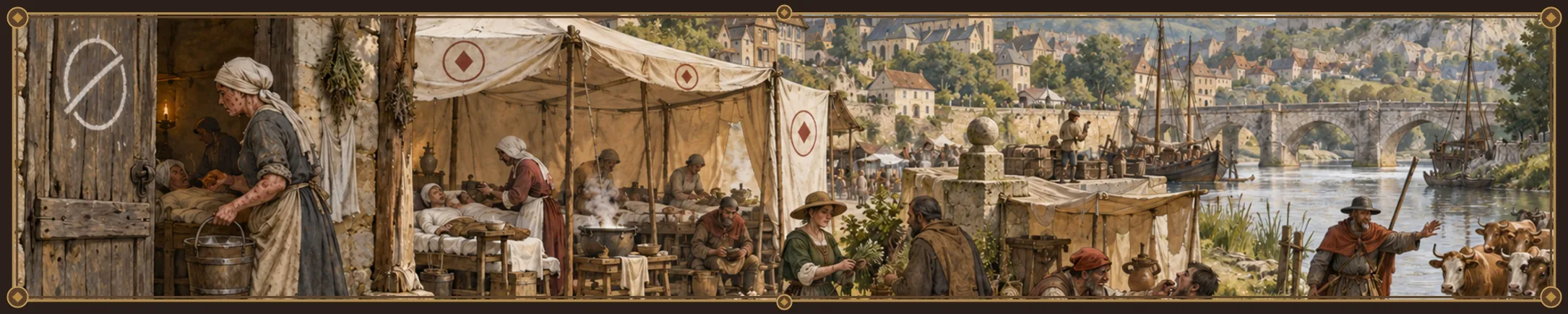
Boil the cloth and wash the hand,
and never ask me why;
keep the lamp till the fever turns,
and keep the water by.
The Book of Small Mendings
Every household in the medieval world keeps a sickroom, even if it is only the bed nearest the fire. Most winters someone lies in it with the cough, most summers with the flux, and once or twice in a lifetime the whole house sits up through a night with the lamp lit, waiting to see whether a fever will break. The people who nurse them know a great deal. A village healer can tell marsh fever from the summer flux at a glance, name the night on which a lung fever will turn, and smell a festering wound before the dressing is off. What she cannot say is why any of it came. The ordinary contagions pass on the breath, by touch, in water and filth, and by lice, fleas, and biting flies, and what passes is a living thing too small to see; no people of the era knows it. So the peoples blame bad air, the season, the stars, a neighbour’s eye, a disorder of lifeforce, or a god’s displeasure, and fight sickness with a mixture of remedies that work, remedies that work for the wrong reason, and remedies that do nothing at all. Sickness is the commonest danger of all, and it runs with the others: famine fills the roads with bandits, a plague year empties villages for outlaws to take, the flux and camp fever break more sellsword companies than battle does, and grave-robbers, delvers, and travellers to the planes and zones carry home sicknesses no village healer has seen.
Signs Without Causes
The medieval healer is a reader of signs, and a good one. She knows that the winter cough which turns on the fourth day, with a fever that climbs again instead of falling and a stab in the side at every breath, has become lung fever. She knows that the quiet child is the one to fear in the flux, that a wound which drains thick and pale will mostly mend while one that weeps thin and stinking will not, and that a patient of the swelling plague who lives to the end of the first week will probably live. She keeps the crisis nights, the counted days, and the signs of the turn as a sailor keeps the tides.
Causes are another matter. The peoples' explanations are many and mostly wrong, and they are wrong in instructive ways. Fevers that rise off still water at dusk are laid to the evening air off the marsh, not to the gnats that bite at the same hour. The flux is blamed on heat, green fruit, cold drink on a hot day, or the stink of the midden, and the last is closer than anyone knows. Lice are taken for children of sweat and dirt, a sign of poverty rather than a carrier of anything. The red pox is blamed on red stars and on the family of whoever sickened first. Behind all of them stands the oldest explanation, that a sickness is sent: by a god offended, by a curse, by the dead, or by the evil eye of someone at the market.
Because the remedies grew up beside the signs and not the causes, many of them do real good under false names. Boiled water, burned bedding, a shut door, a washed hand, a shaved recruit, and a camp that breaks for sweet water all prevent more sickness than any healer cures, and nobody who practises them can say why. A midwife who washes her hands in hot water and strong wine before a birth loses fewer mothers; her neighbour, who thinks the practice fuss, loses more, and both are respected. Other customs do nothing. Households shut the windows of a sickroom against bad air, keep a child with the spots wrapped and hot to sweat the heat out, sprinkle the dying with blessed water, and hang red cloth at the window of the pox-sick to draw the red out of the skin.
The world has no souls, and the healers of the age do not need one. Sicknesses of the mind and the memory are sicknesses of the body’s pattern, whatever a people calls them, and a fit, a madness, or a long melancholy is nursed in the same bed as a fever.
Who Nurses the Sick
The household
Nearly all sickness is nursed at home. The grandmother keeps the teas: bitter fever-bark for the shaking fevers, herbs for the chest and the bowels, willow for the joints and the aching tooth, honey in hot water for the cough. The household’s tools are warmth, broth, a basin of steam, a cool cloth, a darkened room, and patience. A patient with lung fever is propped upright and not allowed to rise too soon; a child with the flux is given boiled water, thin ale, or broth with a pinch of salt, a little at a time and often; a sick bed is turned, washed, and watched. On the crisis night of a lung fever a lamp burns until the fever breaks, and many households hold that whoever watches at the turn must not sleep, or the sick will slip away with them. The drenching sweat of the breaking fever is welcomed as the sickness leaving, which is close to the truth.
Households also carry the knowledge that keeps sickness off, mostly without its reasons: which fish may be eaten raw and which must be smoked, that a well is kept above the midden, that a fine comb and a pot of sulphur ointment belong in every house, that a returning soldier’s shirt goes into the boiling pot. A mother’s weekly search of a child’s scalp for nits is as ordinary as sweeping.
Folk healers, midwives, and the market
When the household’s care is not enough, it sends for the folk healer. She knows the shallow wound, the fever, and the bleeding, and the teas, poultices, and treated water that answer them, and she pays for every working from her own reserve (her reach and its price are told in Magic in Ordinary Life). Every village knows the sign of that price, the healer’s grey. Villages ration how often they send for her, because a healer sent for too often ages before her time.
Beside her stand the other trades of the body. The midwife attends most births with the women of the household. The tooth-drawer works the markets and fairs beside the herb-sellers, and where none comes the village smith pulls teeth. Bone-setters set limbs and take off frozen toes once the dead part has shown itself; barber-surgeons drain, cut, and cauterize, and shave and wash a whole camp when its captain will pay for it. Herb-sellers carry the medicinal herbs of the Elderweald and the Briarreach outward to buyers who may not know their strength, and are blamed when a fool dies of a dose.
The schools and the temples
Above the folk healer stands the trained healer of Vital Magic, whose workings reach below the skin, and above the household’s charms stand the priests. A trained healer can bring down a dangerous heat with Fever Ease, keep a sickness from reaching the blood with Sickness Gate, wash a wound deep before it is closed, drive worms and gnat larvae out of a body, and hold breathing for a night. A priest’s prayer of healing, worked through a god’s support, can turn a case outright: burn plague-sweat out of a patient, clear a poison, drive back a wasting cough. None of it is free, and it works best within one people (see How Magic Works (FND)); and it does nothing for a patient sent back to the same well, the same lice, or the same lead-glazed jug.
These healers gather in a few kinds of house. The Red Mercy Hospices, the battlefield and plague-care schools of Vital Magic, follow armies, keep fever tents, and send healers to the worst quarters of a plague town. The Gardens of Returning Breath, a quiet healing order, keep rest-houses where the coughing are given air, food, rest, and slow transfers of vitality over long seasons. Healers trained at the Hall of Living Pattern study which herbs suit which peoples, and their tables of dose by people are among the most copied texts of the trade. The temple hospitals of Sanctified Magic, the Houses of Mercy, fill their wards in a pox year. On the far-side coast the Tidelore Hospice of Maris, kept under the name of Maris of the Tides, is famous for its healing arts and takes in the sick of the shore hamlets. Most of the sick never see any of them. A village that has to choose between sending a cart to the river town and keeping the money for seed corn usually keeps the money, and nurses at home.
Why the sickbeds stay full
Healers know of waters and planes that cure almost anything, and why that changes nothing for most of the sick: they are far, and each takes its price from the body it heals (see Unnatural Afflictions). At home the arithmetic is plainer. A village has one healer, whose reserve runs out; a plague has a thousand patients.
Fevers, Fluxes, and Coughs
The summer flux
The summer flux is the sickness of hot weather and crowded water. A household takes it from its well, a town from its river, a camp from its own latrines: what passes out of the sick in their filth passes back in through the mouth, in water drawn below a midden or a retting pool, in food handled by a sick cook, on flies and on hands. The peoples speak of two kinds, the watery and the bloody, and treat them as one sickness at two strengths. Most grown adults are through the watery kind in a week. The danger is drying, the sunken eyes and slack skin and the quiet that comes over a child who has lost more water than anyone has poured back in. The bloody flux, with its fever and its straining, kills grown fighters in a siege, and in a crowded camp it can take one in five and more fighters than the enemy does. Soldiers say the flux kills more than the sword in a summer siege, and the songs agree: the great siege of the old river wars is remembered for the army that sat outside the walls until the flux had done the defenders' work for them.
Drink is the cure, and it works. The river towns of the Confluence Basins and the Lower Serath meet the flux every summer at low water, and every army in the field meets it all year. Most towns keep their wells above the middens by custom, quarrel over where a retting pool may foul the water, and pray to Serovan the River-King, who cleanses the Serath only slowly and only when the people stop fouling it.
Marsh fever
On summer evenings the low wet ground of the Confluence Basins and the backwaters of the Lower Serath give up clouds of biting gnats and thin, whining flies, and with them marsh fever. Its bouts come every second or third day: a cold that shakes the bed, a dry burning fever, a drenching sweat, and an exhausted sleep from which the patient wakes weak but clear enough to work, badly. After some weeks the bouts thin out. In many cases that is not the end. What the bite left in the blood goes on working towards the spine, and within a season or a year the back stiffens, the legs weaken, and the feet go numb; once the legs fail, they rarely come back. Lamed survivors are called marsh-taken, and in some villages a summer child is not named until its first fever season is over.
Everyone knows the fever comes from the marsh at dusk, and almost everyone blames the evening air. The prevention works anyway: smoky fires at dusk, nets and shutters, sleeping high and away from still water. Village healers treat the bouts with fever-bark and cooling. Driving out what lies in the blood before it reaches the spine is work for a trained Vital healer, and families save, borrow, or travel to the river towns for it before the second summer. Reedfolk bear marsh-fever country better than any other people, and say the river spares those it knows. Marsh outlaws are said to be spared too, having had it young, and lords' riders who chase them into the fens in summer come home shaking; the Reedfolk tell it as the marsh taking their side.
The winter cough and lung fever
Everyone has the winter cough, most years, and nobody fears it. The peoples give one name to a crowd of small sicknesses of nose, throat, and chest that pass round a single fire with the shutters closed, and they blame wet feet, a draught on the neck, or hair washed in the evening. It costs a few days' work. Its danger is the turn after the third or fourth day in the very old and the very young, when the fever rises again and the breathing goes quick and shallow, because that is lung fever beginning. Lung fever is the winter’s killer: the chest fills, a cough brings up rust-coloured phlegm, and between the fifth and the seventh day the patient either breaks into a drenching sweat and sleeps, or grows confused and rattling and dies within a day or two. Most fed, nursed adults live. Among the very old it kills perhaps one in three who take it, and among infants more.
The wasting cough
The most patient killer the peoples know is the wasting cough. A young woman in a damp room in town begins to cough one winter and is thinner the next; she flushes in the evenings, sweats at night, and her cheeks take on a brightness strangers mistake for health. Three or four years later she coughs blood in mouthfuls and dies, and by then her sister is coughing too. It passes on the breath, but slowly, over months in a shared room or bed, and so whole households fall to it one by one and many believe it runs in the blood. Others say it is laid by something that feeds, a remnant or a curse, and families have dug up their own first dead to burn the heart. Grave-diggers who open a wasted family’s graves are hired by night and paid well, and some villages have driven a whole family out on the suspicion that it carried a feeding dead thing with it. What helps is what the poor cannot get: rest, good food, a warm dry room, and country air. Those who can afford it go to the country or to a rest-house of the Gardens of Returning Breath. It kills the young adults of poor households more than any other age.
The childhood spots
Every parent expects the childhood spots. The red spots begin like a bad cold with eyes that cannot bear the light, and on the third or fourth day a dusky rash rises behind the ears and runs down the body; the water spots come in crops of itching blisters that crust over a week or two. Neither is taken twice, which is why both fall on the young: every few years a new crop of children who have never had them gathers in a village, and the sickness runs through them all. The water spots seldom kill. The red spots kill few children in a fed village and perhaps one sick child in ten in a hungry year, mostly through the lung fever or flux that follows, and leave some blind or deaf in one ear. Many households keep the room hot to sweat the spots out, which does no good; some send their children to play with a spotted neighbour to have it over young, which is sound. In isolated holds, where the spots come rarely, they strike the grown and the young together, and the long-lived peoples who reached adulthood without them take them hard.
Birth, Wounds, and the Wear of Life
Childbed fever
Childbed fever comes two or three days after a birth, when the household has begun to breathe again. The mother shivers, the fever climbs, the belly swells tender, and the flow turns foul; in the better cases the fever breaks within a week, and in the worse it reaches the blood and she dies grey and quiet a few days later. It is the commonest death of young mothers. It passes not on the breath but on hands, cloths, and tools, and so it runs through a district behind one midwife, or through a town lying-in house, while a lone farm birth escapes it. The peoples blame a chill in the birth room, milk gone to the head, or a mother who rose too soon. The custom of hot water and boiled cloths travels from midwife to apprentice, unexplained and unevenly kept, and the women who keep it lose fewer mothers.
Wound rot
On a battlefield wound rot kills more in the weeks after than fell on the day. A dirty wound swells hot and red, and from there it drains and mends, or goes on into the blood fever, with red streaks creeping up the limb, or into blackening, the grey and then black flesh with its sweet unbearable stench that only the knife or the saw will stop. A small dirty puncture forgotten for a week can bring the locking jaw, the face fixed in a grin and the back arched in spasms, which kills most who take it. Every healer knows the rule it taught: clean before you close. A healer washes out dirt and rot, flushes a puncture clear, and only then closes the wound, because closing a dirty wound seals the rot in. The Red Mercy Hospices clean, drain, cauterize, and cut, and the best of them wash their hands and boil their linen out of a habit whose reason nobody knows. Many healers hold that thick pale matter is the wound cleaning itself, and leave dressings on for days to bring it on. Sellswords fear a festering cut more than a clean death, and the camp surgeon who will cut off a rotting arm without being asked is the most valued man in a company; the songs remember the captain who took his own leg off with his sword rather than wait for one.
Troll flesh closes so strongly that a dirty wound can seal over the rot inside it, and Troll kin, who decide by rite which wounds may close, are wary of any healer who closes fast (see The Bridge Peoples (FND)).
Small torments
Some ailments kill almost no one and torment nearly everyone. Worms live in the gut of nearly every child at some time, taken in where dung reaches water and garden, and households purge their children with bitter herbs, often on a fixed day in spring timed to the full moon, when worms are said to stir; the fish-eating peoples know the fish-worms and flukes best and keep firm rules about what may be eaten raw. Tooth rot is the commonest pain of grown life and ends most often at a market stall: honey and sweet fruit are the treats of the well-off, and so are their aching teeth. Many peoples hold that a small worm eats the tooth from within and smoke it out with seeds burned over a candle; the "worms" that fall out are the husks. The itch, lice in the seams, the burrowing mite that sets the wrists on fire at night, and the scaling rings of ringworm and scald-head, marks a camp, a ship, a prison, or a poor house, and a lousy stranger is turned from the door. Soldiers say lice leave a man who is about to die, and watch their comrades' collars; they are right that lice leave a cooling body, and wrong about what that means.
The trades
Each trade has its sickness, and each takes it for the ordinary wear of a hard life. A miner who has cut stone for twenty years climbs a stair like an old man: miner’s lung scars the chest with dust year by year until a winter fever finishes what the dust began. Dwarves call a deep cough "the mountain in the chest" and many miners believe the dust is clean and only bad air dangerous, so they fear the dead pocket and ignore the dust. A hold keeps its broken-chested old miners at the lift-houses, the stores, and the chronicle-rooms, and hold songs honour the old miner who coughed his way back down into a collapsed working to lead the trapped crew out by memory, because no one younger knew the old seam. Smiths go deaf, high sounds first, and take it as a mark of mastery.
The metal trades pay more slowly. The smelter’s gripe of lead brings colic, a blue-grey line on the gums, and in the end hanging wrists, fits, and failing wits; the gilder’s shakes of quicksilver ruin a gilder’s close work and change his temper; smoke-sores mark the skin of those who roast certain ores. In the Ironspine the Dwarves roast ore downwind of the holds and turn smelters to other work after some years. In the towns the gripe also comes from wine kept in lead, which tastes sweeter for it, and from jugs and dishes glazed with lead; healers treat the colic and seldom name the cause.
Among the poisons, bad air is the quiet killer of the underground: foul airs that seep out of rock and lie along a floor, air used up by breath and lamps, and heat that builds in the lowest levels. A lamp that burns low and blue, a dull headache, and a calm sleepiness in which the worker stops caring to leave are its signs, and a worker who sits down to rest in it seldom rises. Crews haul the fallen out by rope rather than follow them in. Ruin-delvers who break into a sealed Dwarven working for its old treasure carry a candle ahead of them on a pole, and the tale of the band that found a vault of gold and lay down beside it to rest is told in every hold. Kobolds feel trapped air through skin and stone before anyone else, and much of the vent work of the Stonewake Deeps is theirs (see Stone and the Deep). On the ruin edges of the Glassbelt Interior, salvagers who dig, camp, or drink on the glassed ground of the old ash-furnace belts take furnace-ash sickness: grey skin, loosened teeth, sores that will not close, and the barren years of salvage families. Many of them take the sickness for Ozhar the Pyre-King’s hunger, still feeding (see The Windscar), and the salvagers' grimmest songs are of treasure-seekers who carried slag-gold out of the scars against the warnings: the crew that came home rich and died one by one through the next year, coughing ash.
Hunger, cold, and heat
Famine sickness is the oldest dread of every farming people. It follows a failed harvest, a failed river rise, a siege, or a road cut in winter, and it kills more through the fluxes, coughs, and camp fevers of the hungry crowd than through hunger alone. In the swelling hunger children’s bellies and faces puff with water, so that a swollen child can look fed to a stranger. The long-starved who are given a full meal can die of it within days, and healers fight hungry families over every bowl, giving broth and thin gruel first and bread over a week. Magic can do little here: a body without food cannot hold the life a healer gives it, and a starved healer cannot safely heal at all. In the Lower Serath a failed spring rise means hunger and no town can prevent it. Lords may open their stores or hold them; Ogre camp-custom, remembering the Long Hunger, still feeds the vulnerable before the strong. In a famine year the roads fill with bandits who were farmers the year before, granaries are guarded with spears, and the songs of the hungry years are songs of raids on the lord’s stores and of the outlaws who fed whole villages from them.
The black gums are a sickness of the larder. They come at the end of a long voyage, in the last weeks of a siege, at a deep posting supplied by lift and stair, or in a winter when the cellar holds only grain, salt meat, and dried goods: gums that swell and blacken, old scars that open as if the wound were new. Fresh food mends them in days, and every cook knows it, though the reason is taken to be that fresh food carries the spring in it. Careful houses keep onions, roots, and hard apples through winter and sprout grain in the cellar, and the station keepers of the Soundchain Roads put greens aboard with the water. Siege songs remember the garrison that held out a whole winter on salt meat and lost its teeth before it lost its walls, and the besiegers who brought baskets of green onions to the gate to taunt them.
Cold-bite takes fingers and toes on the passes of the Ironspine, the Stormcrown, and the High Scars, and the creeping chill takes whole travellers: they stop shivering, grow sleepy, throw off their cloaks as if they were hot, and lie down to rest. Mountain folk say the cold is gentle at the end and the frozen dead smile; guides carry spare wool, keep their parties moving, and let no one sit alone (see Stone and the Deep). Heat sickness is its summer twin, the cramp and faint of the harvest field and the forge, and at its worst the burning collapse, when a worker stops sweating and falls. Basin field work stops at noon, crews rotate at the forge, and caravans on the Glassbelt travel by night. Pass songs remember the guide who carried a frozen child down from the High Scars inside her own coat and lost three fingers doing it, and the raiders caught by a storm in the pass they meant to ambush, found in spring still crouched behind their rocks.
Fits and the madness of the bite
The falling sickness drops a person where they stand, stiff and jerking, and lets them rise with no memory of it. Some are born with it, some take it after a blow to the head or a high fever, and some after a working that the body could not carry. It is common enough that every village has known someone with it and strange enough that every people has a story for it: a priest is called oftener than a healer, a few households of augurs keep the fallen as seers, and in the Basins the moon is blamed. Those who have it are often barred from oaths, smithing, and the sea.
The biting madness is feared beyond its numbers. A dog that turns strange, a fox in a yard in daylight, or a bat on the ground at noon may carry it, and whoever it bites waits through weeks or a season of fear before the sickness shows or does not. Once it shows, with the water-fear that throws the sick into choking terror at the sight of a cup, nothing known turns it. A household meets a bite with a hot iron at the hearth; the bitten keep a vigil at the nearest shrine until the season of waiting is over. In a mad-fox year villages pay a bounty on every fox brush, and the songs remember the boy who killed a mad wolf at the fold gate with a hay-fork and was bitten doing it, and the vigil the whole village kept for him through the season of waiting.
Poisons and Venoms
The field and the larder
Most poison is an accident of field and larder. Food sickness, the cramps after the meat that smelled a little off or the purge after half-cooked beans, falls on everyone who shared the dish and is over in a day or two; households say meat turns in thunder and milk sours under a full moon. Its rare kin, the stillness, breeds unseen in a sealed jar or close-wrapped meat and comes a day or more later, blurring the eyes and thickening the speech while the mind stays clear, until the breath grows shallow. It is often taken for a curse because it strikes so long after the meal, and an unlucky cook has been accused of poisoning. Halflings, who smell a turning barrel across a storeroom, catch spoilage before it reaches the table, and the store-keepers of the folds are trusted to say which barrel goes to the pigs.
In a wet year the rye and the poor barley grow hard purple-black spurs in place of grains, and the spurs go to the mill. Weeks later the village begins to burn: hands and feet aflame, then cold and blackening, children in fits, old women seeing things in the rafters. This is burning bread, the holy fire, Anvelle’s burning, and because it falls on a whole village at once it is treated as a plague. Pilgrims who go away and come back mended credit the shrine, not the change of bread. Some old millers know to throw out a dark-speckled sack, and say so; in a year with little else to eat they are not always heeded.
The wild plants kill the untaught. Hedgerow children learn "black and shiny, leave it be" for the shining berries of shady hedges; foragers mistake the poisonous spotted umbels of damp ground for wild parsley; heart-leaf, a healer’s herb for a failing heart, kills at a little more than the dose. In the deep weald, roots that look and smell almost like the good tubers kill within hours, and the edge settlements call them all deathroot: the Wood Elves name each root by kind and teach their children the poisonous ones before the good, Elven guides are paid for the lesson as for any other passage, and a settlement with no such teacher learns from its graves (see The Forest Heartlands). Poisoners of the basin towns buy deathroot from weald-edge diggers who ask no questions, and the Wood Elves have hunted down more than one root-seller who sold their knowledge to a murderer. Among mushrooms the pale cap is the slow betrayer: a day of violent purging, a false recovery in which the eater gets up and eats, and then the yellowing and the end. The fungus-eating peoples of the holds and the root-houses are raised knowing each good kind by name, and lose few; most deaths come in surface woods in hungry years, where village healers seldom know the false recovery. In the root-houses of the Roothollows the pale cap is called the guest’s cap, and a siege tale tells of townsfolk who sent a basket of them out to the enemy camp as a peace gift; whether the tale is true, no army since has eaten mushrooms sent from a wall.
On the coasts a mussel holds whatever its water holds. In some still, warm summers the sea turns rust-brown along a stretch of shore and the shellfish take up a numbing poison that boiling does not destroy: the lips tingle, the face goes numb, the eater feels as if floating, and in a bad case the breath falters. Some call it Maris’s grief. The harbour families say who may gather, and in such a summer a harbour closes its beaches on its own word; wreckers who plunder a ship on a rust-water shore are said to die of the shellfish they eat while they wait for the next wreck, and the hamlets think it fitting. Near some river mouths of the Tidelace Coasts a newer fouling turns the water black and sour, and the hamlets nearest it no longer gather there; the far-side atlas follows it to the shore.
The poisoner’s craft
Made poisons are prepared on purpose by someone who knows what a root or a cap or a venom does, and the craft is close kin to the healer’s, for the same knowledge of dose and kind makes both. A skilled poisoner chooses for the people as well as the person, since herbs act differently on each, and a mixed table may see one guest sicken and another shrug. The art is to make a poisoning look like something else, a seizure of the heart or a wasting illness, and what gives it away is pattern: a sickness that eases when the patient eats elsewhere, or returns with a particular visitor. Poisoning is a crime of houses where inheritance, office, or debt is worth a death. Lords call poison the coward’s knife and trust in stones that cloud and rings that warm, none of which work. Great households keep tasters and watched kitchens, and where magic was used to make or deliver a poison it is reckoned dark practice by the harm it does, though a lord who wants a culprit seldom waits for proof. The songs are full of poisonings: the bride who poisoned the cup at her own wedding feast to avenge her brother, the taster who drank and said nothing so his lord would die beside him. Poisoners caught are boiled, burned, or drowned according to the place, and the most famous were never caught.
Stings and bites
On warm days the adders lie out on heath and stone, and a bare foot in the bracken finds one. Viper venom rarely kills a grown Human, but it lays the bitten limb up for weeks and can kill a child within the day, and the dose that sickens a Human gravely endangers a Kobold, a Halfling, a Goblin, or a Gnome. Folk cut the bite and suck it, bind it hard, or lay the split snake on it, and none of it helps; the patients mostly live anyway. Assassins' tales tell of an adder slipped into a lord’s boot, and every great household on adder ground has a servant whose task is to shake out the boots each morning. It is the venom every field healer is expected to know, and the healing schools teach the drawing of venom on it first. The lesser stings and bites, bee and wasp, hornet and spider, jellyfish and the buried sting-fish of far-side beaches, are the small change of every summer. What the peoples fear is the rare person who swells at a sting until the throat closes; beekeepers say such a person is marked by the bees, and tell the hive of every death and marriage in the house so it does not leave in offence. Halfling tales tell of the fold that threw its bee-skeps over the wall onto a band of raiders, and of the raiders who ran back the way they came, swelling.
The Plagues of the Peoples
The red pox
The red pox comes to a town every generation or so, runs through every child born since it last came, and leaves. A pocked face in a corridor town draws no remark. About ten days after it is caught a high fever breaks the back and splits the head; then spots rise in the mouth and on the face and hands, swell into blisters, and harden into deep pustules, and in that dangerous week the face swells shut. Where the pustules stay apart they crust and fall away in the third or fourth week, leaving pits; where they run together, most die. It kills about one in five of those it takes, and more where it falls on a remote valley that has not seen it for two generations and takes the grown along with the young.
Its great fact is that it is never taken twice, and the towns build their whole answer on it. Pocked nurses tend the pox house, and nobody else is sent. A pox house is marked at the threshold before stronger quarantine is laid, a ward-maker walks a boundary round a quarter that has shut, and in a pox year the pocked are hired to nurse, bury, and carry, because they alone may come and go. The towns' ruling houses shut pox houses, mark their doors, and post watchers at the gates. Looters strip the marked houses all the same, and the pox goes with them from town to town; the songs of the pox years tell of bandits who took a dead merchant’s silks and carried the red to every village they robbed. Mothers in some towns send a child into a mild pox house on purpose, to have it over with young.
The swelling plague
The swelling plague is the great dying. It comes every few generations to the corridor towns, ports, and granary country of the cradle-web, by ship or grain barge, and each coming is remembered by the town it struck. Dead rats in the streets come first. A few days later the sick are struck down by fever and a crushing head, and a hard, hot, agonizing swelling rises in the groin, the armpit, or the neck and darkens towards black; at the end of the first week it bursts and drains and the sick slowly mend, or they die. About half of those who swell die. In some the sickness settles in the lungs, and from then on it passes on the breath at the bedside and kills nearly everyone it takes within two or three days. A bad year takes a third of a town between spring and the first frost.
Most of what the schools know of mass healing and containment was learned against it, and a plague town is a town reorganized. Plague houses are marked; quarters are closed by walked and spoken boundaries; a chamber is slammed shut by an emergency seal the moment containment fails, often with someone still inside. In the fever houses and plague wards of the Red Mercy and the Houses of Mercy, healers slow the plague’s spread through a body without curing it, draw the fever into steaming bowls, and burn the plague-sweat out of one patient at a time, and because there are never healers enough, an augur’s touch at the bedside sorts before dawn who can still be turned. A quarter that gives a little blood and breath from each household can keep its fever house standing; a poor district pledges years of shrine labour to hold its wards through winter, and owes it afterwards. The dead go to the trench carried by corpse-servants, or are burned within a ring of disciplined fire, or are sealed in crypts of blue ice until a cure is found. Rushed plague pits breed hostile remnants, so the dying goes on haunting a town after the plague has left it. In the Stonewake Deeps whoever holds a reach may seal a way first and answer for it afterwards when contagion threatens, if anyone can make them answer. In a plague year towns shut their gates and archers keep the roads, and the songs remember the outlaw bands that took over the emptied villages, the corpse-carriers who robbed the dead, and the one healer who walked into the shut town and did not come out.
Almost nobody thinks of the fleas. That rats carry filth and sickness is common knowledge; most blame bad air, the stars, or the gods, and burn sweet herbs against the reek. Crows gathering over a district are read as the plague’s herald. At the pyres the people invoke the Steward of Purifying Fire, who burns disease without hating the sick, and when the lantern of dawn glows in a ward chapel the ward stops panicking.
Camp fever
Camp fever follows crowds that cannot wash: an army a month on the march, a town under siege, a cellar of prisoners, a ship’s hold, a road full of the hungry. It is carried by the body louse. A headache comes on hard, then fever, then a rash of dull-red spots across the trunk and the muttering stupor that gives it one of its many names, the mutter; near the end of the second week the fever breaks or the sleep deepens into one the sick do not come back from. In a siege, a gaol, or a famine camp about one in five of the grown die. Delousing is the real cure and few know it as one: clothes boiled or smoked, straw burned, heads shaved. Wise households boil a returning soldier’s shirt. The fugitive camps and crowded repair quarters of the Broken Marches know it as well as any army (see The Basins and the Marches). Sellsword companies are said to scratch their way through a campaign, and a town that sees a lousy company at its gate shuts it, which has started more than one siege. More companies have been broken by camp fever than by any enemy, and the songs remember the siege that both armies abandoned in the same week, each thinking the other had brought the spotted fever on it.
Plagues of the Herds and Fields
A household can bear a wet year that rots the hooves. A murrain takes the plough team, and with it next year’s bread. The cattle plague the basin villages mean when they say one "can empty a village’s meadow in a season" passes along the droving roads with bought droves, hired oxen, and the hides of a dead herd, and within a week of the first sign most of the byre is dead. No drench cures it, and a healer’s life poured into one prized ox at heavy cost does nothing for a meadow; what works is separation, droves turned back at the boundary and the dead burned or buried deep. When word comes up the road, villages of the Basins and the Headwater Marches close their droves and set watchers at the fords, and a lord may forbid the cattle markets for a season. Ox-carts stop, and grain waits on the threshing floors for teams that are not there. In a murrain year the march-country raids for cattle to replace the dead, a whole valley’s feuds can be dated to the murrain that started them, and drovers whose herds carried it are sometimes hanged by the villages they passed.
Shepherds of the Headwater valleys name sheep rot and fly-strike together because they come together in wet years: liver rot that takes a flock slowly through the winter, foot rot that sets it grazing on its knees, and the blowfly that eats an unwatched sheep alive in a summer week. Shepherd families keep the knowledge of which meadows rot, and a newcomer who grazes them in a wet year learns the hard way. In the Windscar Expanse a camp that stays too long at one well fouls it, and first the herds and then the children fall to a scouring flux: soured-well sickness. The kindreds tell of it in the tale of the Still Well, in which Rakhal the Storm-Caller tore the shelters down and drove a stubborn camp on to sweet water, and the answer they keep is the tale’s answer: break camp. A camp that moves at the first sign loses little (see The Windscar). Raiders are said to throw a carcass down a rival stronghold’s well to sour it, and the kindreds count it among the deeds that are never forgiven; they can name blood-feuds of three generations that began at a soured well.
The fields have their own plagues. Grain blight, the red rust of leaf and stem and the black smut of the ear, rides the wind from field to field and takes hold worst on wheat sown again and again on tired ground; a bad blight year can halve a basin harvest, and the hungry winter after kills the old, the young, and the poor. A blight year fills the basin roads with hungry men and the woods with outlaws, and the songs remember the lord who hanged the first villagers to break into his granary, and the second winter, when there were too many to hang. Basin villages take it for the displeasure of Anvelle the Harvest-Mother, and in the failing districts they are not far wrong, for the fallow her rest-year demands is the best defence there is. Granary mould takes a store from inside when grain goes in damp, so that a village that kept a granary against the bad year finds nothing in it when the bad year comes, and many keep the granary doors shut against night air in the very weather that needs them open. A granary-keeper whose stores go grey is suspected of selling the grain and blaming the mould, and more than one has been beaten or driven out by a hungry village before the truth was known. Warders who lay workings against rot and rats on village stores are among the most ordinary paid casters of the countryside. The wet-year rots take roots in the terraces below the Ironspine holds and grapes on the vine terraces of the Leeward Folds, and they are often taken for darker things: a village that cries the black mould of the Rotting Crown over ordinary rot is a common nuisance to those who must go and look. A grower can tell the difference: wet-year rot follows water and stops when the rain does. Witch-finders do their best trade in a wet year, when a field gone black can be laid at a neighbour’s door and the neighbour burned before the next rain.
On the far side one plague of young is older than any of these: the egg blight that closed the First Nesting Confluence to ordinary return, and taught the Thaluren that sanctity does not protect. No working, herb, or rite has ever saved a blighted clutch; its answer is watching a water, closing it, and sending the runs elsewhere (see Peoples of the Water (FND)).
Peoples, Places, and Odds
The peoples are different bodies, and they do not fall sick alike. A contagion passes most easily within one people and less readily between peoples; many never cross at all, and the great plagues are great because they do. Humans are struck by nothing in particular and by the crowd sicknesses of their towns and corridors most. Elves are spared many of the crowd sicknesses by living in small households far from the towns, and take the red pox seldom, but the long-lived peoples who reach adulthood without the childhood spots take them hard. Dwarves bear hunger and scarcity and the dust of their own trade better than others, and are hurt by bad air, to whose going wrong their steadiness makes them slow. Reedfolk are spared marsh fever and most wetland disease. Halflings are spared much spoiled food, which they smell, and suffer the crowd sicknesses of close folds; Goblins bear hunger and eat almost anything with little harm, and take the crowded-warren sicknesses of ruin edges and town fringes; Kobolds sense bad air first and suffer cold and the venoms that kill a small body. Ogres bear cold and hunger and heal and rot ordinarily. Trolls shrug off the lasting harm of most wounds and are threatened by starvation, which a body that regrows must be fed against.
A few ailments belong to one people alone. A Thaluren kept from water for more than some hours begins to crack and fester with the drying sickness, and every land people that deals with them learns to keep a trough or a wet cloth at the meeting house; a Thaluren left to dry by another people takes it as an insult to all their kin. Kavari young die in their gravel nursery beds of small changes of warmth or silt in the nursery-water sickness, which stands behind much of Kavari nursery custom. Elves thrown out of step with kin, place, and season by grief or exile fall into the Elven fading, a slow dimming of colour, scent, and appetite that other peoples mistake for a broken heart, and which nothing helps in an Elf who cannot go home and will not take a new place. The Wrought take no fever, flux, poison, or bad air of flesh at all; their one sickness is the pattern-fray of a Wrought kept from rest or refitted against its will, and where the Wrought have kin or patrons strong enough to press it, a fray is treated as a harm owed care and a fray caused by forced work as a wrong to be paid for; elsewhere it is still called wear.
Places change the odds as much as peoples. In the Confluence Basins one child in three dies before five, more in a hard winter; in the crowded corridor towns of the Lower Serath two in five, of warm-month fever and whatever else passes through a crowded quarter; in the folds, whose stores carry them through most bad years, only about one in five, mostly of winter coughs. The Goblins of the Broken Marches lose two children in five to crowded-warren sickness, cold, and collapse; the Orcs of the Rimward Basins lose one in three to fevers and fouled water. A writer who wants to know what a family has lost need only ask where it lives.
Tensions
-
The mild pox house. Some mothers send a child into a mild pox house on purpose, to have the red pox over with young, while the ruling houses of the same towns mark and shut every pox house and post watchers at the gates. A house kept open for the purpose is a remedy to the mothers who use it and the start of the next outbreak to the council.
-
Who can still be turned. In a plague ward an augur’s touch sorts before dawn who is likeliest to die, so that the healers' reserves go to those who can still be saved. The families of the passed-over see their dead chosen, and a quarter that paid for its fever house in blood and breath expects its own to be turned first.
-
A debt of shrine labour. A poor district that pledged years of shrine labour to hold its plague wards through winter owes it after the plague has gone, with fewer hands to pay it, while a richer quarter kept its wards with a little blood from each house and owes nothing.
-
Sealed first. In the Stonewake Deeps whoever holds a reach may seal a way first when contagion threatens and answer for it afterwards, if anyone can make them answer. Those caught on the far side of the seal, sick or well, wait on an answer that comes only once the danger is judged, if it comes at all.
-
The stronghold well. The strongholds of the Rimward Basins cannot break camp when their wells sour in the dry months, and send their herds out early under escort instead. Rakhal’s following, growing as the Pact world settles, takes every soured stronghold well as proof that a people which will not move has stayed too long.
-
The sweet wine. Wine kept in lead tastes sweeter for it and is prized, glazed jugs are in every house, and the healers who treat the colic and the dulled children seldom name the cause. A glaze-potter’s trade and a household’s health rest on the same silence.