Chapter 16. The Tidelace and the Soundchain Roads
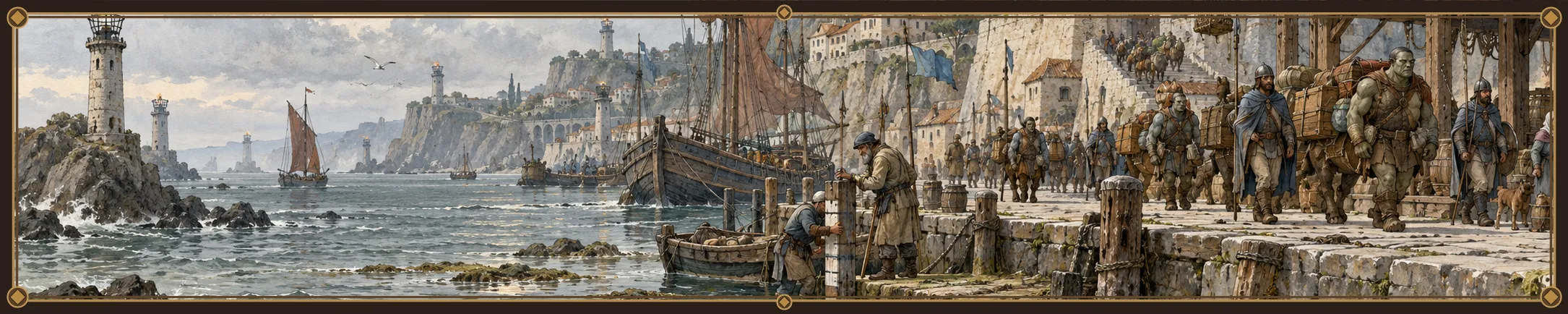
Read the water, write the reading,
date the writing, show the date;
precise and true are not one word,
and the mark that lies is the mark that’s late.
The Lacework Primer
Seen from the sea, the Tidelace is frayed rather than drawn: fingers of rock, long inlets, island chains strung offshore with straits between them running like rivers at mid-tide, and behind it all the sea-cut terraces climbing to the cliffs. Hardly any of it is open water and hardly any is soft shore. Nearly all of it is water a hull can use only with knowledge: channels threaded between shoals, harbour mouths safe for an hour and wreck-ground for the next. It is a beautiful coast and a hungry one. The fog hides drowned crews, the shoals hide drowned harbours, and on the darkest nights there are fires on the headlands that no Gnome lit. The Gnomes of the coast have spent well over a hundred and fifty thousand years learning that water exactly, sounding it, marking it, beaconing it, and arguing on the open quay about whether the marks still tell the truth. Their league of harbour towns, the Gaugeward Leagues, has no king and no capital. It is held together by lights on headlands and by shame, for a town that lets its beacon fail or its marker drift is disgraced the length of the coast. Along its outer, Windscar-facing edge runs a second world: the Soundchain Roads, a chain of roadsteads and stations where Orc escorts come down off the cliffs and are fed, counted, held, or sent on, without ever being let in.
The Tidelace Coasts
The Tidelace Coasts are the first homeland of the Gnomes and the heartland of the Gaugeward Leagues, a league of harbour towns that keeps the coast usable through soundings, beacons, breakwaters, and old harbour families who say who may come in and when. The far side has three homelands, and each meets dangerous ground its own way. The Orcs of the Windscar cross it by escorted passage and hard covenant; the Halflings of the Folds hold it by bounded plenty and reserve custom; the Gnomes of the Tidelace chart it closely enough to live on without ever calling it tame.
Made, Not Found
The Tidelace is the far side’s north coast between the Soundchain Roads in the west and the river mouths of the Tidebound Reaches in the east. Island chains lie offshore, and beyond the outer isles to the north lies the Unrun Sea. South of the coast the terraces climb to the Leeward Folds, and short rivers come down from them to the estuaries; the coast road comes down from the Folds to the Counted Lee. Fathomstair, behind the Sounding Gate, is four or five weeks by pilot craft from the Turnwater Quays and Truesound ten days or so further along the inner channels; the Split Reed Mouth is about three weeks' sail east of Fathomstair, and Lastlight stands on an outer isle north of the coast. The harbour towns with their hamlets and coves are the settled cores; between them lie open water, fog, and the fogbells that come inshore with the Long Grey, and craft go between harbours only on called runs with a pilot.
Liveable coast here is made, not found. Breakwaters close the mouths of the best inlets; channels are cut, cleared, and marked; sounding houses keep the depths, tides, and marker positions of every approach; and beacon lines on the headlands pass warning from harbour to harbour. Behind the islands, the marked inner channels that run west to east from harbour to harbour are called the Lacework the length of the coast, and a harbour child knows its marks before the names of its towns. What looks inviting from offshore can kill a crew without local knowledge, while ground that looks too broken to settle becomes liveable through generations of patient sounding.
What the Coast Does to People
| Fog |
The great fog belt of the outer coast, which pilots call the Long Grey, rolls in off open water with little warning and can lie on the straits for days. Beacons are lit, bells rung, and nobody moves who does not have to. In it row the Grey Crews, drowned sailors who hail living boats onto the rocks where they were lost, and with it come blooms of fogbells whose sting can stop a swimmer’s heart. |
| Storm |
In the storm season, gales drive surge into the inlets and break what the breakwater crews built in the calm months. Some harbours close their mouths entirely until spring. |
| Moving ground |
Shoals shift and channels silt, so a mark true last year may be false this one, and the shoals are paved with the hulls of crews who trusted an old one. A reading is only as good as its last check, and every sounding house keeps the date of each. |
| What lives in the water |
Congers as long as a man lie in the breakwater gaps and wrecks and take the fingers of anyone who reaches in; rays with venomous tail spines lie buried under the shallows; around the outer isles, blackfin pods hunt seals and will take a lone swimmer. |
| The false fire |
A beacon lit in the wrong place is a wrecker’s fire. Wrecker bands work the empty headlands between harbours, luring craft onto the rocks in storm and stripping what comes ashore, the living included. Harbours pay a bounty for them and hang them on the breakwater. Gnomes fear the false sign more than weather, because weather does not pretend. |
| Drowned harbours |
Old breakwaters lie under the water, signal towers stand in the sea, and lost ports sit at the heads of silted inlets, left by earlier Gnome lines. They are a hazard to every keel, a haunted ground to pilots, and a treasure-ground to divers. Pilots' wives tell of a gauge house under the Long Grey whose brass instruments still tick, and of a drowned tide hall where the old families sank their plate rather than give it to the storm. |
A Town Built Upward
A Tidelace harbour town is built upward. The breakwater and quays sit at the waterline; on the first terrace stand the sounding house, the gauge house where tide gauges and timing instruments are made and kept, and the tide hall; above them the stone houses of the harbour families climb the cliff with walled terrace gardens between them; and on the headland stands the beacon tower. Stairs join the levels more often than streets do, and a stranger’s legs know they have arrived before the stranger does. Larger towns gather several inlets behind one breakwater. The smallest are a single quay, a beacon, and a few dozen households.
Gnomes are small, deft, and fine-handed, built for close work rather than heavy work. They are sure on stairs, quays, and wet rock, at ease in small boats and fog, and seldom live out of sight of the sea. Their eyes are trained from childhood rather than born keen: a Gnome learns to read swell, cloud, and the marks on a gauge the way other children learn faces. Most work is harbour work, and the skilled part of it belongs to families. Sounding, pilotage, beacon keeping, gauge-making, and breakwater masonry pass down households for generations, each with its own marks and its own pride, and a family’s name rises or falls with the honesty of its readings. Around those crafts work fishers, net-menders, boat-builders, ropewalk crews, and quay hands. Food comes from the sea and the terraces: fish, shellfish, kelp, seabird eggs, and small crops from the terrace gardens, with stored grain and orchard goods brought in from the Leeward Folds by counted exchange.
A Household That Answers
What the Leagues add to ordinary harbour life is the way a household answers for its readings.
| A first reading |
A Gnome is born into a craft family and named with the family’s mark, the sign its readings carry in the sounding-house ledger. A child of a sounding or pilot family is counted in the craft when their first reading is declared at the tide hall’s bench and nobody can prove it wrong. Families keep the date as others keep a naming. |
| Family marks |
Each sounding family cuts its own mark on the posts and markers it sets, so that every mark on the coast says who will answer for it. |
| Tide-hall day |
The tide hall’s elders sit at slack water, so that pilots and fishers can attend between tides. A day’s quarrels run from a closed fishing ground and a breakwater nobody will mend to a moved marker nobody will own, and the oldest sounding families' word weighs heaviest. |
| Beacon nights |
In the storm season every household of a beacon district owes a share of nights at the tower, whatever its craft. A missed night is entered in the beacon ledger beside the family’s name. |
| Marriage |
A marriage between craft families is entered in the harbour ledger, and the incoming spouse learns the new family’s marks before they may set one. |
The Tide-Table Year
The year runs on the tide tables and the weather. In the calm months the breakwater crews rebuild, the sounding houses resurvey the Lacework, and traffic moves. In the storm season the tide halls sit, the families mend, and the beacons burn through the long nights, with every household of the district taking its turn at the tower. Each season closes at the sounding house, where readings are compared and markers moved with half the harbour looking on. Once a year the Festival of the Tides brings the whole harbour down to the quays with flowers, shells, and stories for Maris of the Tides; it is said that if the offerings are sincere, the year’s catch will be good.
Wards and Wreckers
The Leagues have no king and no harbour-capital. Each town rules itself, and the towns are bound to one another by shared beacons, common approach marks, and the duty to keep up what other harbours' lives depend on. A town that lets a beacon fail or a marker drift is shamed before the whole coast and finds its craft turned away at its neighbours' quays, and that, more than any council, holds the Leagues together. Between towns, quarrels over fishing grounds still end now and then in rammed boats and cut nets, and one feud between two Lacework harbours over a herring ground has outlasted every family that began it. Inside each town, the old harbour families divide the power between them.
| Harbour wards |
They keep the harbour and its quays, receive traffic, and reckon what the harbour can bear this week. |
| Tide halls |
The elders of the harbour families, sitting together, settle quarrels over entry, fishing grounds, and repair duty. What they decide usually favours the families that sit on them. |
| Sounding and gauge houses |
They hold the readings every other decision rests on. Since the Sounding Gate Quarrel their word is no longer enough on its own: a moved marker must be seen moved, and a sounding can be challenged before the tide hall. |
| Beacon wardens |
They keep the lights and the signal lines, and hunt the wreckers who light false ones. The coast calls them wrecker-hunters. A warden’s company that brings in a wrecker band’s lamp is feasted by every tide hall on the Lacework, and the lamps hang in the beacon towers as trophies. |
The Tidelace carries more of this weight than any other part of the League world. Since the age of the calibration orders, the mainland sounding houses check one another’s marks on a fixed round, while island Gnome lines on the outer chains keep lighter customs of their own. The two do not entirely trust each other: mainland towns still tell of island raiders who came over the straits in the hungry winters, and the isles tell of mainland harbours that shut their mouths on starving island craft. The old quarrel inside the Leagues is between receiving wards who want harbours kept open and sounders who want them kept right. From outside, Orc escorts push at the outer edge, Halfling partners at the Lee, and Thaluren run-watchers at the estuaries, and each knows the Gnomes' fondness for exact readings well enough to accuse the coast of hiding behind it. To harsher peoples Gnomes look delicate or fussy. On a coast where a wrong mark drowns a crew and a false fire is somebody’s livelihood, that fussiness is what keeps the edge liveable.
The coast honours keepers, not conquerors, and cuts their family marks into the beacon stones. There is the beacon-keeper of the Tidelace Answering Custom (c. 137,000-c. 135,000 BR), who kept her fire lit through a raid with her tower burning beneath her; on beacon nights the youngest of the district carries the first stick up the stair for her. There is the pilot who answered a Grey Crew’s hail on purpose to follow it in, and found the reef that had been killing boats for a century; no one has dared copy him. And there is the old sounding-master who walked out along the wreckers' headland alone at night and put out every false fire with his hat, which harbour children still play with a cap and a row of candles.
Harbour Towns
With no harbour-capital, the harbour all the others are measured against is the one behind the Sounding Gate, Fathomstair: a Tidelace town in its plainest form, climbing its cliff in flights of stairs from breakwater and quays to the sounding house on the first terrace, the families' stone houses and walled gardens above, and the beacon tower on the headland. Some eight thousand Gnomes live there, many of them in old sounding families, and every reading made there is called aloud on the quay.
Truesound, some twenty thousand strong, is the largest harbour town on the coast, gathering three inlets behind one breakwater on the Lacework. Its quays take most of the coastwise traffic between the inner harbours, its gauge houses make timing instruments for half the coast, and its tide hall sits through the whole storm season and hangs the wreckers its beacon wardens bring in on the outer breakwater, where every craft entering can see them. At the other end of the scale, Lastlight is an outer-isle harbour of a single quay, a beacon, and a few dozen households of an island Gnome line. Its beacon is the last on the coast before open water, and its families fish, keep the light, log the Long Grey as it rolls in, and gather what the Unrun Sea drifts onto their rocks. Not all of it is weed. On the beacon stair hangs the carved head of a beast no one can name, broken from some unknown hull’s prow and cut in a wood no Gnome shipwright knows, and island children dare one another to touch its teeth.
The Hamlets
The coast has a second people. In timber hamlets on the beaches and outer coves between the harbours live a few coastal Humans, descendants of bands that drifted along far shores in the Unrecorded Age, over tens of thousands of years, on a journey nobody recorded. Their hamlets stand on ground the towns have little use for. Saltrack, on a shingle cove between two harbours, is typical: a dozen timber houses above the tide line, boats drawn up on the shingle, drying racks, and a shrine to Maris at the water’s edge. They fish from small open boats close inshore, gather shellfish and weed, and sell their catch at the nearest harbour quay, and some Human crews hire on to Gnome craft or work the quays. They are also the first to find what the sea throws up after a storm, and harbour wards suspect, not always wrongly, that a few hamlets keep a wrecker’s lamp behind the drying racks. Saltrack’s elders swear the hamlet never has, which is exactly what a wreckers' hamlet would swear, and the harbour ward who buys its fish has stopped asking. Human swimmers hire on as divers for the drowned harbours, because the Gnome families will pay well for an old family’s plate and do not care to swim for it themselves. The Humans have their own sea-stories and weather-lore, but no story of where their people came from. Their oldest tales begin on this shore, and none of them mentions the basins of the cradle or any land behind the sea.
The Humans live inside the harbour custom, not at its edge. A hamlet is not an arrival to be answered: its boats are written in the nearest harbour’s ledger, bound by the same beacons, closures, and sailing windows as Gnome craft, and its quarrels over nets and grounds go to the tide hall like anyone’s. What the Humans lack is a hand in that custom. The crafts that make the readings are Gnome family crafts and the tide halls are Gnome families, so a hamlet usually speaks through whichever harbour ward buys its fish. In calm years most hamlets think the arrangement fair. In hard years they notice who decides when a cove is closed.
Of everything on the far side, this is the thing I have least known how to write. Below the third harbour along from the Lee there is a cove called Saltrack, with a dozen timber houses above the shingle and the boats drawn up below them, and the people who came down to look at the craft I was on were Human. Not Human as a Gnome harbour hand is Gnome, by trade and habit, but Human as I am: my height, my colour near enough, my hands. A barefoot boy sold me a string of dried fish for a Gnome copper and counted my change back with his lips moving, and the words were not my words, but the counting was.
I sat that evening at their fire, by leave of the oldest woman there, and listened. Their stories begin on that beach. There is a storm in them, a long one, and a lady of the sea who answered it, and boats, and a great many fish, and grey oarsmen in the fog whom nobody must answer. There is no river in any of them, no barge or bridge or toll, no basin, no road inland, and nothing at all behind the sea. When they asked me where I came from, I said from inland, which was true, and they nodded as though inland meant the Halfling folds, and I let it.
I have spent my life among people who can tell you which house their grandmother’s ferry paid its toll to. These people are written in a Gnome ledger and cannot tell you anything older than the storm, and they seemed to me neither poorer nor richer for it, only finished, the way a song is finished. Behind the drying racks, when I went to relieve myself, I found a lamp with a shutter on it, a long way from any house, and I did not ask. I did not tell them about the Serath either. I am not sure they would have had anywhere to put it, and I am not sure it was mine to give.
Marks, Gauges, and Bare Feet
About 180,000 people live on the Tidelace. Some nineteen in twenty are Gnomes, and Truesound and Fathomstair are the largest of their towns. Coastal Humans, perhaps 10,000, live in the hamlets between the harbours; the Thaluren come to the estuaries in return season and do not live on the coast.
Harbour dress is wool and felt from the Windscar trade, oiled against spray: short coats, close caps, and sea boots, with the family mark worn as a brass or stitched badge, and sounding families carry their gauges on a cord. The island Gnomes are darker and more weathered than the Gnomes of the harbour towns. About one child in six dies young. Adults commonly live a century and a half, and a newborn can expect about a century; most die old, and of the rest the sea takes most, by fog and storm, and the stairs, ice, and winter coughs the others. The family mark is spoken as a family name, given names are short, and when a Gnome is named before others the craft follows: Isset Sondrel, sounder. Others on the ledgers: Mirabet Quarrine, Tobrel Teskel, Vannet Abenot, Rissard Sondrel, Ellisande Quarrine. The island lines keep a lighter custom of name and isle, Lenn of Lastlight or plain Abbet.
Hamlet Humans dress in oiled wool and hide and go barefoot on the shingle. They look like the Humans of the cradle, weathered by spray. One child in three dies before five; the sea takes about one man in four, and fever and childbirth most of the rest, so few reach seventy. A hamlet Human has one name, and the harbour ledger writes it with the boat and the cove: Maelo of Saltrack, Ressa, Tobe, Inna, Seska, Pirro.
Highways of Water
The Tidelace has almost no roads worth the name. Its highways are water, and every one of them is marked.
| The Lacework |
The inner channels behind the islands carry nearly all coastwise traffic from harbour to harbour in sheltered water, aboard Gnome coastal craft. Each stretch is surveyed by the nearest sounding house, and its marks are moved only in the open. |
| The outer roads |
Open water seaward of the islands is faster and takes heavier craft, but it closes first in fog and storm, and the Long Grey can shut it for days. |
| The beacon lines |
Signal towers on the headlands carry warnings, closures, and sailing windows along the coast far faster than any hull, and a harbour that misreads a neighbour’s light, or trusts a wrecker’s, pays for it. |
| The river mouths |
Short rivers come down through the terraces to the estuaries. Upstream they lead towards the Folds by way of the exchange grounds such as the Counted Lee; seaward they open into waters the Thaluren share. |
What moves is mostly the coast’s own: fish dried and salted, shellfish, cordage, lamp oil, worked metal, and the gauges and timing instruments of the gauge houses. From the Folds come stored grain, orchard goods, and preserved stores in counted loads; from the Windscar, by way of the Soundchain Roads, come hides, felt, and wool. Human hamlets bring their catch to the harbour quays and take back cordage, tools, and grain. At a harbour mouth the pilot families take the helm of any stranger’s craft, and a stranger who refuses a pilot is assumed to be a smuggler, a wrecker’s scout, or worse. Human boats work their own coves without pilots, but at a harbour mouth they wait on the window like everyone else. Offshore, the island chains thin into outer isles and then the open water of the Unrun Sea; no harbour holds water past its last beacon, and what comes in from beyond it is nobody’s to explain. No road or sea-lane known on this coast leads to the cradle-web on the other side of the world.
Memory
The Tidelace remembers being Gnome long before it was Gaugeward. Old Gnome harbour lines across the inlets and island chains bound themselves into a league in the Founding of the Gaugeward Leagues (c. 165,000–c. 146,000 BR), when shared beacons, common marks, and the duty of repair tied separate harbours together. The coast’s first great argument followed at the Sounding Gate, in the Sounding Gate Quarrel (c. 155,000–c. 149,000 BR), and the Tidelace Calibration Orders (c. 148,000–c. 132,000 BR) turned its lesson into the rounds by which every mark is checked. The outward memory is a run of hard meetings: with the Orcs, the Tidelace-Windscar Approaches (c. 148,000–c. 138,000 BR) and everything the Soundchain Roads remember after them; with the Halflings, the Counted Lee Timing Feud (c. 139,000–c. 136,000 BR) and the Leeward-Tidelace Timing Oath (c. 136,000–c. 134,000 BR), which taught the harbours that a moved window must name who bears the loss; with the Thaluren, the Estuary Terms (c. 144,000–c. 138,000 BR).
The Humans are absent from all of it. They reached the coast later, and none of the League’s founding quarrels or old bargains mentions them. The memory they share with the Gnomes is the Decade of Storms, a time the coast keeps without a date, when gales sank boats, surges swallowed harbours, the fish vanished, and both peoples prayed on the same shore for calm and guidance. At the Festival of the Tides both peoples still raise a cup to the beacon keeper of an outer isle who kept her light burning through three nights of the Decade with the timbers of her own tower, and was found at dawn with the last plank in her hands and a fleet safe in the lee below. Three of the great threads of Caeldon’s history touch the coast. Under Who Counts and Who Records, counting begins in the ledger and the reading called on the quay, and the Humans show how a people can be counted without being consulted. Under Water and Who Keeps It, the estuaries are where the Gnomes first had to accept a claim on water they could not sound. And through the Soundchain Roads the coast touches Roads and Crossings.
The Lady and the Clockmaker
Maris of the Tides was born of the Decade of Storms, from the shared plea of Gnome harbour towns and coastal Humans who did not pray for the sea to stop, knowing they would starve without it, but for a mother to soothe it and a guide through it. She still belongs to both, and her worshippers often call her Lady Maris. Her shrines stand on Gnome quays and on Human beaches. Shrine carvings show her tall and pearl-skinned, her hair a fall of living kelp, her robes forever dripping salt water. A pilot back from a hard passage through fog or a bad approach tells it aloud at her shrine, paying her toll of story, and sailors who forget to tell it are said to find her protection withdrawn the next time. The springs along the coast are said to be her tears, healing only those whose hearts are pure, and harbour children hear of the Drowned Bride, saved from a storm at the price of her voice, who sings sailors home. She is said to be trying to calm a blood-feud between two harbour towns over a fishing ground, before it ends in burned harbours. For the Humans she is nearly the whole of religion: they keep local cults of the shore and know nothing of the Sworn Accord that organizes Human belief in the cradle.
Beside her shrines the Gnome harbours keep Quennet the Clockmaker, their own god of measured moments. He is fading, as the coast keeps its timing by gauge and beacon instead of prayer, though harbour wards still say his name under their breath when a sailing window has to be moved, half in thanks and half in apology to whoever will bear the lost time. In old gauge houses the timing instruments are said to stutter or run backwards for a few beats before a window fails, and some say his voice can be heard in the ticking. Pilots pray to both gods and thank Maris when a window holds. Beneath both runs the coast’s own alignment custom, in which an unmaintained beacon or a falsely read mark is close to sacrilege, and a false fire is past it. The curse a beacon warden lays on a wrecker at the hanging is always the same: may a false light be the last you follow.
The Sounding Gate
The best known of the coast’s measured approaches is the Sounding Gate, the marked mouth of a Gaugeward harbour, with the sounding house, beacons, and Open Bench that decide who may pass it and when, under the harbour families who hold them. It was the first great site of the Leagues and the scene of their first great quarrel, in which Gnomes had to decide, over the bodies of drowned crews, whether their exactness still protected the coast or only flattered it. It is still where that quarrel is carried on most loudly: the harbour every other harbour is measured against when the old charge of vanity is made.
The Place
From the sea, the Gate is a narrow entrance between rock and shoal, with a current that sets hard across it at mid-tide and lies still at slack. A marked channel threads it. Its posts and beacons are the most watched marks on the coast, and the beacon tower on the headland above passes the Gate’s state along the signal line. The shoal on the seaward side is called the Proud Bank along the whole coast. Its sand covers the ribs of the craft lost on the false marks of the Quarrel, and at the lowest spring tides the masts of one of them still show. Divers from the Human hamlets go down on the bank at slack water after the treasure that, by the hamlets' telling, went down with the richest of those craft, a sounding house’s silver gauges and the dowry of a harbour heir; some come up with a coin or a fitting, and every few years one does not come up. The pilots say the bank does not like to be crossed in fog: when the Long Grey lies on the entrance, Grey Crews have been seen rowing over it, calling the old channel. Gnome children are told that one of the Quarrel’s sounding families had a silver gauge that read true only for its own blood, and that it lies on the bank in its drowned master’s hand, still reading; whoever raises it, the tale goes, will steer the harbour wrong for a generation.
Inside lies Fathomstair behind its breakwater, built upward in the Tidelace way. Beside the sounding house, in the open air, stands the Open Bench, where readings are called aloud. It sits outdoors by custom, so that anyone on the quay can hear a reading given, a marker move announced, or a closure stated with its reasons. To get in, a craft must take the channel in a declared window, with one of the harbour’s pilots at the helm. A stranger who tries the entrance without one is likely to end on the Proud Bank, and in bad years wreckers have shifted a channel post by night to help a stranger there, then plundered what washed ashore before the harbour’s boats could reach it. The water is the lesser obstacle. The greater is the reading behind it: a window rests on the latest soundings, and at the Gate everyone knows the date of each.
Nothing of the harbour that fought the Quarrel still stands. The entrance has silted, scoured, and shifted many times since, and its marks have been moved in front of the quay more often than anyone could count. The older Gates lie under the newer one: quays and steps that sank or silted as the entrance moved, reached at low water down slimed stairs below the present breakwater. Congers den in their doorways, and smugglers use them to land what the declared windows would tax, until the harbour’s watch finds the stair and floods them out.
Keepers and Users
The sounding house and gauge house hold the readings of the approach and the instruments that make them, and since the Quarrel their word does not vouch for itself: a reading counts only once called aloud at the Open Bench. The receiving wards keep the harbour and its quays and decide what traffic it can bear; they are the Gate’s oldest party in its oldest quarrel, pressing for wider windows when the sounding house wants narrower ones, because traffic is wealth. The tide hall and the Open Bench are where the eldest harbour families settle quarrels over entry, and where a moved marker or a closure is made to stick by the families gathered to hear it. A reading can be challenged there by any family the harbour counts as its own, or by a rival sounding family strong enough to be heard; a fisher or a stranger can speak, but is seldom listened to. The beacon wardens and the pilot families keep the lights and ledgers and take the helm of every stranger’s craft at the entrance, and the families remember which of their own lie on the Proud Bank.
The harbour also keeps a wreck-watch, its own small company of hired spears, Human and Gnome, paid from the tide hall’s chest to walk the headland in the storm season and to hunt down wreckers for the price on their heads. The hall pays more for a live one, because a hanged wrecker on the beacon tower keeps the next band away longer than a dead one in the surf. The users are Gnome coastal craft working the Lacework, fishing boats, and boats from the nearest Human hamlets, which wait on the declared window like anyone else. Rarely, a Windscar party that the harbour masters have let inward comes in from the outer receiving grounds under a pilot, and such an arrival is always watched, with the quay guard close at hand.
Slack Water and Arguing
The Gate’s year turns on its readings. In the calm months the sounding house sounds the approach again on a fixed round and after every storm, and each result goes to the Open Bench before any mark is touched. A moved marker is announced there, entered in the beacon ledger, and then moved. In the storm season, when the entrance may be shut for weeks, the tide hall sits more often and fights out what the summer left unsettled. At the Festival of the Tides the harbour comes down to the quays for Maris and reads out the names of everyone the Proud Bank has taken.
An ordinary day is slack water and arguing: sounders out at the turn of the tide, a craft holding outside for its window, a fisher shouting about a closed cove at the bench, a ward arguing that a window could be an hour longer, a pilot telling a drowned crew’s passage at the quay shrine so that they will not come rowing back. Beside Maris’s shrine stands one to Quennet, fading here as everywhere; the gauge-makers still say his name when a window has to be moved. Two sounding families still will not sit at the same end of the Open Bench, over a feud from the Quarrel for which no blood-price was ever paid, and when one challenges a reading, the other’s hired swords are on the quay before the bench has sat.
We lay outside the Gate for most of a morning, the craft swinging on her anchor in a grey swell, while the current ran across the entrance like a river in spate. The pilot who had come out to us sat on the thwart with her hands folded and would not be hurried. "Slack at the half-bell," she said, as if it were the word of a lord, and it was. When the water went still it went still all at once. The posts stood up out of a sea gone flat as slate, each one carrying its marks, and the pilot took the helm and brought us through between them so close to the shoal I could see weed lifting on it, and, under the weed, the black ribs of something that had not been so lucky.
Inside, the harbour climbed the cliff in steps, quays and then grey stone and then houses one above the next with little walled gardens between them, and stairs everywhere. On the first terrace a bench stood out in the open with a handful of elders seated on it and a crowd on the quay below. A woman in a sounder’s leather apron was reading figures aloud, plainly and slowly, each with its date, and a scribe beside her was writing them down. A man in the crowd called out a question about one of the figures. Nobody hushed him. She answered him, and the scribe wrote that down too. I noticed that two men with swords stood at the foot of the bench, and that they belonged to neither the sounder nor the man who had asked.
On the Serath I have read a toll out to a bargeman who did not believe a word of it, and I have never once had to say on what day I last looked at the reach he was paying for. At the Gate the date is the first thing said and the figure the second. I asked the scribe afterwards whether anyone ever challenged a reading in earnest. Every season, I was told, and the families are proud of it, and when I said that pride seemed a strange thing to take from being doubted, the scribe laughed and said that was exactly what the Quarrel had said, and that the drowned on the Proud Bank had said it first.
At the quay shrine our pilot stood a while and told the story of our passage to the sea, aloud, to nobody I could see. Beside that shrine stood a smaller one, the stone worn smooth, carved with something like the face of a gauge, and as she turned away she touched it once without looking.
Precise and True
The Gate was already one of the most trusted approaches of the young League world when heavy traffic and wild weather set its receiving wards, who wanted broader windows and bolder sailings, against its sounding houses and signal keepers, who were accused in turn of keeping old readings as current and markers unmoved for their family’s pride. The Quarrel split the harbour families, sent crews onto the Proud Bank on marks one family swore by and another called false, and ended only when the strongest houses forced a peace. Exactness that could be trusted was split from vanity: soundings, marker changes, and declared risk now had to be called aloud and could be challenged. The calibration orders carried that peace into marker rounds and open benches across the coast, and the Gate stayed the harbour all the others copied. When Windscar parties began reaching the coast, the Gate became one of the inward thresholds behind the outer receiving grounds, and had to show that exact harbouring could also take in outsiders honestly.
Every harbour child on the coast learns the saying this place left behind, precise and true are not the same word. Pilots raise their cups to the false light cut down, in memory of the pilot who rowed out alone in a gale to cut one from a headland and drowned doing it, and a stranger who will not drink to it is watched until he sails. At the Gate the saying is not a proverb but a way of life, and the families who keep the approach are proud of being the most challenged harbour on the coast, which is the very kind of pride the Quarrel warned against.
The Soundchain Roads
Escorted parties of the Windscar Pacts first reached this coast in numbers during the Tidelace-Windscar Approaches, and the line the coast drew then has held ever since: the outer shore is not the inner harbour. The Soundchain Roads, the first named Orc-Gnome exchange corridor, are what grew along that line: a chain of roadsteads, lee sounds, transfer quays, and pilot stations strung along the outer edge of the Tidelace, where a party that has crossed the dry country can be met, fed, held, or sent on before it ever sees an inner harbour. Most of the people who live on the Roads are Gnome station crews; most of those who pass through are Orc escorts and the parties they bring. A party on the Roads has reached a real exchange field, but not the protected interior of the coast, and both peoples know the difference to the yard. The danger here is less a quarrel at the quay than the fog, the Bare Shoulder, and what waits on the wreck-ground.
The Outer Edge
The Roads are the western stretch of the far side’s north coast, where the dry country of the Windscar ends in sea cliffs. The chain of sounds runs west to east along the foot of the cliffs, with the open water of the Unrun Sea to the north and ordinary Gaugeward coast beyond it at both ends. The Gullstair comes down to the Turnwater Quays towards the western end, two to three months from Oldcairn by the longest escort routes, with the Patience below it; the Bare Shoulder lies further east, Shoulderlee in its last lee, and the calmer Lantern Reaches beyond, and eastwards again, behind the headlands, the pilot channels lead to the inner harbours of the Tidelace. The stations are the settled cores, with bare cliff and open water between them, and nothing moves safely between stations except by pilot craft or on the escorted coast run.
The corridor follows the broken outer coast. Its links are the lee sounds, where a headland or an island chain breaks the swell and craft can lie in quiet water. Between them run exposed roadsteads, marked transfer water, and pilot channels threaded through shoals that only a sounding house can keep honest. Old hulls lie on every one of those shoals, and some still hold what they carried. Divers swear that a Gaugeward strongroom hull lost in the closure years lies off the Bare Shoulder with its hatches still sealed, and every few summers a crew goes out after it; the ones who come back say the fog came in early, and that something hailed them by name. No two links are built alike; some are little more than a roadstead and a signal fire, others carry quays, store sheds, transfer yards, declaration houses, and pilot watch-posts. What makes them one corridor is the traffic, and the Gnomes keep it deliberately short of welcome: everything a party needs to be fed and answered, nothing that would let it in.
Landward, the shore rises fast. Escort routes coming out of the dry Windscar country reach the sea at the tops of cliffs and terraces and have to come down to the water, and the busiest descent is the Gullstair, a stepped and ramped path cut down a sea-cliff to the beach yard of the Turnwater Quays. Fog belts can stop movement between sounds for a week, so that a party sits within a morning’s sail of its next station and never sees it; in the fog the Grey Crews row, hailing in voices that sound like a pilot’s own kin, and a crew that answers an unplaced hail is not seen again. In the storm season the worst of the open stretches, the Bare Shoulder, a long headland coast with no lee at all, is closed to heavy loaded craft for months at a time, and its rocks are thick with the ribs of craft that tried anyway. Fogbells drift inshore in thousands, congers take the fingers of quay crews who reach into the breakwater gaps, and shipworms eat the quays from underneath. When too many parties arrive together, holding grounds fill, water runs short, fever runs through the shore camps, and tempers go to knives.
Worse than any beast of the water are the people of the shore. On the emptier stretches, in the storm season, wreckers light false fires for craft caught between beacons and strip whatever washes up, the living included. Stations pay a bounty for them and hang them on the breakwaters, and still they come back. The worst of them are remembered by their lights: the Two Lamps band showed a pair of fires like a station’s harbour mouth, and a whole convoy ran onto the rocks between them before a Shoulderlee crew hunted the band down in its own cove and burned its boats on the beach.
Station Life
Life on the Roads is station life. Each sound has its station: a few quays, a declaration house where parties are counted, store sheds and cisterns, a sounding house, beacon towers on the headlands, and the stone and timber houses of the crews who keep them. Gnome families hold station work for generations. Pilots, sounders, beacon keepers, quay crews, provisioners, and tally-keepers make up most of the people, and a station child learns to read a tide table and a signal line about as early as letters.
The corridor’s rhythm is the rhythm of arrival. An Orc escort nearing the coast sends word ahead by runner or by fire from the cliff-tops, as escorts do on any Windscar route. At the beach yard the party is met and counted, and its captain says aloud who travels, what they carry, and where they mean to go. The keeper takes them in for transfer, feeds them and sends them on under a pilot, holds them until a named day, or points them down the coast. At his own quay the keeper’s word is the end of it, and a party that dislikes it can wait or climb back up the stair. Held parties wait in the holding grounds, lee anchorages where loaded craft ride at their moorings, with shore camps pitched above them in the same places year after year.
The Orc side of corridor life is seasonal. Escort companies work the coast run in the calmer months, when the High Scars passes are open and the sea between sounds is kind, and some kindreds keep camping grounds above the beach yards that they return to as reliably as Gnome crews return to their quays. On the way down they fight off the beasts of the high passes and the raiders who wait for a party weakened by the crossing. Every kindred on the coast run drinks to the captain who brought her people down the Gullstair with raiders on the stair behind her, holding each turn of it with a dozen spears while the herds went down, and the cairn at Gullhead has one stone for each of her warriors who stayed on the stair. In the storm season the corridor thins to messengers, a few hardy parties, the crews repairing what the weather breaks, and the wreckers. Food is coastal, fish, shellfish, seabird eggs, terrace-garden crops, and stored grain brought out from the inner harbours, with herd meat and milk when escorts drive stock down the stair.
Who Answers
No single hand holds the Roads. Several powers each hold a piece of every passage, and the corridor stays quiet only while none of them reaches for more.
| Station keepers and harbour masters |
The station keepers are Gaugeward families who hold a sound’s quays, stores, and holding water, often for generations, and say what it can carry this week. They give their answers aloud, with a reason and a day to ask again, as the Tidelace Answering Custom demands, and everything else is theirs. Harbour masters further in say who goes deeper. |
| The sounding houses |
They say which channels can be run. A pilot who runs against their warning, and lives, is turned away at every station at once. |
| The Answerward officers |
Officers of the Answerward Pilotage carry the stations' answers in the same words from one station to the next, and are there when a party is held or sent on, so nobody can say later that it was not. Since the Answerward Overreach Feud, fought out in burned watch-posts and pilots who would not sail, the station families have kept them out of everything else, and remind them of it often. |
| The escort captains |
On the Windscar side, the captain who brings a party down answers for it by escort custom and the good name of the High-Scar escort orders. A captain’s word at the beach yard carries the weight of the captain’s kindred, and a false count follows a line long after the party has gone home. |
Since the closure years the stations close what they like, by season, cargo, or stretch, but must say each closing aloud, and when many closings together shut a trade out, the escorts may add them up and press every station at once. They rarely get much for it: the Gnomes hold the water. Orc captains say a refusal in fine words is still the coast keeping them out; parts of the inner harbour world hold that the Pilotage is always reaching for more. Station crews, who deal with both every day, tend to trust whichever has misled them least recently.
Water, Stairs, and Lights
The corridor takes its name from its roadsteads. Its routes are sea-lanes and cliff stairs, not built roads, and the only fresh water on most of it comes from station springs and cisterns, which is why water is the first thing every station counts. The descents bring parties and their herds down from the Windscar routes, each ending at a station’s beach yard. The inner lane, the pilot channels behind the headlands and islands, links sound to sound in quieter water, and most transferred parties and cargoes move along it aboard Gnome coastal craft with a pilot at the helm. The outer roads take heavier craft and faster passages when the weather allows and close first when it does not. And the beacon line carries closings, fog warnings, and wrecker sightings along the chain far faster than any hull: a closing called at one station is burning on the next headlands by nightfall, and a fire where no beacon stands means wreckers.
Down the stairs come hides, felt, wool, herd stock driven for provisioning and sale, and escort service itself, along with the parties: kindred delegations, traders, messengers. Back up go dried and salted fish, cordage, worked metal, lamp oil, and fine Gnome craft-work, the coastal goods that reach the High Scars by escort trade. Most cargoes change hands at the quays and never see the inner channels. Cargo draws thieves, and the coast has bred a trade to meet them: Orc sellswords who guard a camp’s herds by night, Gnome quay-wardens who hunt pilferers through the store sheds, and bounty-takers who follow a stolen cargo up the cliff routes for a share of it. Over it all sit the closings called by the strongest stations, which is why Orc captains read a station’s beacons as closely as Gnome pilots read its tide table.
The Lantern Reaches
The calmest stretch of the corridor is the Lantern Reaches. Beacons stand on nearly every headland, so close that pilots boast a craft is never out of sight of a light, and the transfer waters between them are shallow enough to work and sheltered enough to forgive. Smaller escorted parties, messengers, light cargoes, and steady seasonal provisioning move through the Reaches more readily than the heavy convoys held under Turnwater’s eye, and wreckers keep away from water this well lit. The Reaches are known for being where nothing goes wrong. Pilots say it as a toast and as a warning, because their calm is kept by beacon keepers who have been known to put out a wrecker’s false fire with an arrow through the man tending it, and it has a price that nobody on the Roads yet wants to name: every heavy convoy they decline goes on to Turnwater.
Stations and Camps
No station is the Roads' capital; the busiest, the Turnwater Quays, is the nearest thing to a centre, and the rest of the corridor’s settlements are stations, camps, and holding grounds. At the head of the Gullstair lies Gullhead, the camping ground where Orc kindreds pitch their camp-rings above the beach yard. In the calm months it holds several escort companies and their herds, loud with beasts and drovers' calls, and the hire-fires where captains short of spears take on sellswords for the descent; in the storm season, only a cairn and the wind.
Shoulderlee is the station in the last lee before the Bare Shoulder, where heavy craft wait out the months the shoulder is closed. A few dozen Gnome families keep its quays, store sheds, cistern, sounding house, and the beacon towers on its headland, and its crews know the shoulder’s moods better than any pilot further in. They also know where the wrecks lie, and a Shoulderlee diver can name what each one carried. Wreck-divers from all along the coast come to Shoulderlee to hire a guide, and the station’s elders forbid them only one wreck, a hull from the crisis years whose crew is said to row the shoulder still. In the Lantern Reaches, Ninebeacon is a small station of one quay, a declaration house, and nine beacons on the headlands within sight of it. A dozen Gnome households live there by light traffic, steady seasonal provisioning, and a good name for dependability that they do not want examined too closely.
Oilskins and Kindred Names
About 12,000 people live on the Roads, nearly all of them Gnome station families. In the calm months Orc escort companies, their herds, and the parties they bring add five to eight thousand more, and the Patience alone can hold a thousand or more; in the storm season the Orcs are nearly all gone. Station crews dress, live, and are named as the Gnomes of the Tidelace are, with oilskins over everything for the open roadsteads, and fog, the Bare Shoulder, and the Grey Crews take more of them than anything else. A station family gives its mark with the station: Teskel of Shoulderlee. The Orcs of the coast run are High-Scar and Open-Steppe kindreds, dressed and named as in the High Scars, and at a beach yard a captain gives the kindred’s name first, then the party’s count.
Two Memories of One Coast
The corridor’s history runs from blood to habit. Windscar parties first reached this coast in numbers during the Approaches, and in the Answering Sound Crisis (c. 141,000–c. 137,000 BR) they waited on a cold shore, raided by wreckers and harried by shore-beasts, while the old and young died. Orc grandmothers still use the crisis to frighten children to sleep: be still, or the cold shore will hear you. What followed taught both sides to say delay aloud; the Answerward Pilotage (c. 135,000–c. 129,000 BR) carried the custom from one receiving ground to many; and after the Overreach Feud (c. 126,000–c. 122,000 BR) cut the Pilotage back, the Tidelace Coastward Exchanges (c. 121,000–c. 112,000 BR) turned staged arrival into the routine that the Roads give a geography. Both peoples call what followed the quiet years, and both mean it half as praise.
Its later memory is of narrowing. In the Soundchain Selective Closure (c. 109,000–c. 104,000 BR), stations closed particular seasons, cargoes, and stretches, each for reasons it could defend, until Windscar escorts said the sum was a wall built one stone at a time. Escort companies camped on the cliff-tops above shut stations, beacons were thrown down, and a Gnome pilot was killed on the Gullstair before the stations agreed, in the Soundchain Closure Terms (c. 104,000–c. 102,000 BR), that every closing must be said aloud and could be added up against the rest. The Gnomes kept the quays; the escorts got the right to count. The Turnwater Reopening Accord (c. 100,000–c. 98,000 BR) then reopened the trade piece by piece.
Each side keeps its own version. Orc captains keep answer-memory: which stations answered in time, which held a party honestly, which named a day to ask again and kept it. Station families keep threshold-memory: which escorts declared their parties truly, which pressed a hold as if it were a refusal. Captains sing the closure years as the time the coast tried to shut without saying so, and the war-chants of the cliff-top camps are still taught to boys who will never need them; station families tell them as the time the escorts tried to take the quays by threat. Gnome stations keep shrines to Maris on their quays and headlands, and Orc escorts who have shared a hard crossing sometimes stand to listen when a pilot pays the toll of story. The escorts bring their own gods down the stair: kindreds camped above the beach yards recite their coast-run dead to Ushkar the Ancestor-Warden at the season’s end, and followers of Rakhal the Storm-Caller are the first to call an old closure stale and the first to sail against the Bare Shoulder’s season.
The Answering Sound
Older than the corridor and not counted among its stations, though the corridor’s ways descend from it, lies the Answering Sound, a sheltered lee in the outer approaches. It was the first great Orc-Gnome threshold, the place where the line between the outer shore and the inner harbours was first strained by storm, hunger, and spears, and nearly broke. The two peoples who use it do not remember the same place. Orc escorts remember where the coast first had to answer them before their people drowned at its door; Gnome keepers remember where they first had to prove that a delay was not a lie.
The Lee and the Last Mark
A headland and a short chain of islands break the swell off the outer coast, and behind them lies the Sound: a broad lee where craft can ride out weather that would sink them on the open roadsteads. Ashore stand a beach yard where parties are met and counted, a pilot shed, a sounding house, store sheds and cisterns, beacon towers on the headland, and a shrine to Maris on the quay, hung with the names of crews the Sound did not save. At the inner end of the lee, a narrow pilot channel leads away towards the harbours behind the coast, among them the inward approaches of the Sounding Gate. Its first marker is the edge of everything the Sound can give. Escorts call it the Last Mark; the pilots call the same post the first mark of the inner channel. Past it, only the word of the harbour masters lets a party go, and they give it to whom they please.
Getting in is the first danger. The lee is safe only once a craft is inside it, and finding the gap between the islands in fog or gale kills as surely as the open water. The outer islands are wreck-ground, littered with ribs of hulls and the stumps of a breakwater older than any harbour family’s memory. In bad years wreckers camp on them and light false fires for craft feeling their way in, Grey Crews have been seen rowing between the islands in the Long Grey, and after a storm the lee can fill with a bloom of fogbells that closes the beach to anyone who must wade. The wreck-ground is also why some come. The craft that went down feeling for the gap carried escort silver, kindred gifts meant for harbour masters, and Gnome instruments in brass, and hamlet divers go down off the islands in still weather for whatever the sand gives up. They say that in the stumps of the old breakwater a vault older than the harbour families lies with its door to the sea, which no one who has gone looking at low water has found twice. Nothing built at the time of the crisis survives; the quays, the yard, and the beacons have been rebuilt more often than anyone has counted. The name and the quarrel have lasted.
The Sound in an Ordinary Year and a Hard One
In an ordinary season the Sound is quiet. Its keepers re-sound the lee after every storm, keep the beacons lit, and meet a few parties through the calm months: a count at the beach yard, a captain’s word given at the table, a pilot or provisions handed across, and the party gone along the coast or back up to the cliffs. Answerward officers come to watch holding and redirection, and walk the beach yard as people walk a battlefield their grandparents fought on. The keepers pay beast-hunters to clear the sea-things that follow a storm into the lee, and in a wrecking year they pay escort spears to burn out the camps on the islands; the keepers cannot always tell a divers' camp from a wreckers' until the fires are lit. Hard weather turns it over, as it always has. When the open coast closes, parties that cannot reach their stations make for the nearest lee, and the Sound fills faster than any station. Held parties ride in the lee or camp above it, water runs short, tempers shorten with it, and in those weeks a keeper who names a hold works under the eyes of armed escorts who know what happened here the last time delay began to look like abandonment.
That happened in the Answering Sound Crisis. Seasons of storm drove more parties into the lee than it could feed while the inner harbours were already strained. Escorts accused the coast of leaving them to drown one warning at a time; keepers accused the escorts of using the answer to force their way into harbour space. Parties starved on the cold shore while wreckers raided their camps, a few Orc war-leaders tried the inner channel by force, and crews went down on the outer islands feeling for a way in. Neither side could break the other, so the end kept the line and made delay something spoken aloud, short, and named to a day, and the Tidelace Answering Custom (c. 137,000–c. 135,000 BR) carried that to the whole coast. Coast inns still tell of the war-leader who tried the inner channel with three boats and came back with one, and who swore the harbour masters kept a storm-caster on the beacon tower to call the gale down on him; the keepers say it was only weather. Escort captains coming down to the Sound name the old answers aloud, who was taken in and who was left seaward to drown. Station families sing the other side: the pilot who took a party in through the Long Grey by lamplight and did not come back, the keepers who held the beacon tower against a mob of starving crews and would not light a false lee. Follow no oar in the grey is the first thing a station child learns. A captain and a keeper who have known each other for years can still be singing two different songs about the same tide.
The Turnwater Quays
The busiest station of the Roads is the Turnwater Quays, a cluster of quays, sheds, and declaration tables in the corridor’s largest sound. If the Answering Sound is where the coast was forced to answer, Turnwater is where it does so every day. It carries the heaviest convoys and the closest watching, and the memory of having been first the place where the corridor narrowed hardest, with kindreds coming down the stair in arms, and then the place where it learned to reopen.
The Place
Most Windscar parties first see Turnwater from the head of the Gullstair. It is a long way down, cut steps and ramps on the open face of the sea-cliff, and every season it takes someone: a herd beast that panics on a ramp and carries its drover over the edge, a loaded mule on wet stone, a child. Crag eagles nest on the face and stoop on kids and lambs on the open ramps, and drovers carry slings down the stair for them. Escorts say the stair takes one, so walk second, and mark each death with a cut in the rock beside the step where it happened; the lowest flights are scored like a tally. The escorts' word runs down the stair to its foot, and the station keepers' takes over in the yard.
The sound below takes its name from its tidal water, which turns with each tide and sets the times craft can come and go from the quays. Around it stand the quays, a declaration house with its tables, store sheds and cisterns, a sounding house, and beacon towers on the headlands. Below the stair lies the corridor’s largest holding ground, a lee anchorage of moored, loaded craft with the held parties' shore camps on the slope above, which every Orc escort calls the Patience. Held parties wait there, sometimes a week and sometimes a season, and its camps grow and shrink with every closure on the beacon line. It has seen fever, hunger, a fire that took half the camp, and more than one feud between kindreds that began over a water-share and ended in the water; a held party’s goods draw thieves from both peoples, and the Patience at the end of a long hold is the most dangerous ground in the sound after dark. At the foot of the cliff, east of the stair, the sea has cut caves that fill at high water, where flotsam from the outer roads washes in and stolen goods are hidden until the thieves can row them away.
A party must get past three things here: the stair, with its loads and herds; the count in the beach yard, where its captain’s word must match the party; and the station’s answer, which never by itself means the inner harbours. That is the difference from the Sounding Gate on the Tidelace proper: at the Gate a stranger whose craft and business the harbour masters have let in is brought through at slack water under a harbour pilot, while at Turnwater an outsider is answered on the quay and, unless a harbour master further in lets the party go deeper, stays there.
Keepers and the Roll
The station keepers have held Turnwater’s quays and stores for generations, and the station’s answer is theirs to give. The sounding house and pilots keep the turning water and the inner lane readable and take every transferred cargo along it. Answerward officers keep a heavier presence here than at any other station, weighing the reasons for a delay, rowing out to holds in the Patience, and vouching for what answer each party was given. And declaration clerks keep the Turnwater Roll, the list of kinds of traffic reopened since the closure years, each with its burden, season, and the day it is looked at again. The Roll is read aloud in the beach yard at the start of each arrival season, and Orc captains listen to it as closely as Gnome pilots read a tide table. The users are Orc escort captains and their parties, and above all the heavy convoys and driven herds that the lighter stations decline. The station pays beast-hunters to keep the moorings clear, and young Orcs hire on as stair-runners, carrying loads down the Gullstair for a share of the price and racing each other on the ramps for wagers; the station posts a bounty on Patience thieves, which the runners collect more often than anyone.
An Ordinary Dignity
Turnwater’s year is the escorts' year. In the calm months, when the High Scars passes are open, parties come down the Gullstair on most days. Most are received for transfer and their goods change hands on the quays without going further; some are given a pilot and sent on along the inner lane; some go into the Patience to be held, with a day named to look at it again; a few are sent to stations that can bear them. An ordinary day is busy rather than tense: herds coming down the stair at first light, cargoes sorted on the quays, provision handed across, a named day falling due in the Patience and an Answerward officer rowing out to hear it, beast-hunters rowing in with the conger that has been taking fish off the moorings, a pilot waiting on the turn of the tide. When a bloom of fogbells comes in with the fog, nobody wades, and herds that must swim to the transfer lighters wait on the beach, bellowing. In the storm season the stair is nearly empty and the station belongs to its crews, and to the wreckers who work the emptier stretches beyond the headlands.
Turnwater’s dignity is ordinary. It is not famous because the custom nearly failed there but because it keeps working there under heavy use, and the station families take more pride in a season without a drawn blade than in winning any quarrel. The custom holds because both sides need it: the Gnomes need the hides and herds, and the escorts are too many to turn away. The closure summer is still told on the cliff-top. Kindred fires keep the tale of the drover who took her starving herd down the stair by night, past the pikes at the foot, and was met not with spears but with fodder by a keeper who could not watch the beasts die; the station families tell the same night as a raid turned back. Keepers and captains close a good season with the same toast, a summer without pikes, and mean different things by it.
The Gullstair is the only stair I have ever seen with a toll-house at the bottom and none at the top, and that is the whole of the Soundchain in one sentence. Our escort brought us down it at first light with a herd ahead of us, the beasts going sideways on the steps and the drovers calling to them in long falling notes, and the sea came up at us out of the grey a flight at a time until there was nothing below but the sound, the quays, and the anchorage beyond them, crowded with craft lying very still. On the lowest flights the rock beside the steps was cut with short marks, dozens of them, and our captain did not need to tell me what they counted.
At the foot of the stair our captain stopped, and I understood without being told that from the next step on the captain’s word was one voice among several and no longer the last one. At the table a Gnome clerk in oilskins took the count, our captain giving the kindred’s name before anything else: how many of us, how many beasts, what loads, whither, and who answered. When the clerk came to me there was a pause. I was entered, in the end, under the escort, as goods are entered under a bill, and I have rarely been so pleased to be a line in someone else’s book.
It was the first day of the season, and before any answers were given a clerk stood on the yard steps and read the Roll: kind by kind, the traffic reopened on the Roads, each with its season and the day it would be looked at again, in a voice that did not hurry. Every captain on that beach stood and listened the way bargemen listen when the spring tolls are cried at home, which is to say with their whole bodies, waiting for the one line that touches them. Ours was read, and our captain let out a breath.
We were received for transfer. The hides went across the quay and were struck off, and fish and cordage came back and were entered, and nothing of ours went one step further inward than the quay. Out in the anchorage a dozen loaded craft rode at their moorings with camps on the slope above them, and an officer was rowing out to one of them with a book on her knees. That night there was shouting in the Patience and a torch went into the water, and in the morning a station crew was hauling something up the beach under a sheet. Nobody I asked would say how long that party had been held. They said only that it had been told why, every time, and that it would be told again.
Narrowed and Reopened
Turnwater grew into the corridor’s first routine site in the Coastward Exchanges, when staged arrival became habit and the trimmed Pilotage found its work tied to ordinary transfer. Here the Leagues became keepers of a dependable trade and the Pacts expected traders rather than desperate parties. Routine then made Turnwater the sharpest test of narrowing. In the Selective Closure, closures by season, kind, and route bore hardest on its heavy traffic, and escorts said that many small closures added up to a blockade. Some kindreds came down the stair in arms that season, and the beach yard was held against them with pikes for a summer while their herds starved on the cliff-top. The Soundchain Closure Terms made the station the place where each closure had to be said aloud and answered for, and the Reopening Accord reopened chosen kinds of traffic here, one at a time. The Roll is that Accord’s descendant. Every quay and table has been rebuilt many times since; the ways have not changed much.
The Split Reed Mouth
Where a Thaluren return river reaches the sea in Tidelace-facing water, on the coastward edge of the Tidebound Reaches, it breaks around a field of reed-shelves into braided channels that shift with every tide: the Split Reed Mouth. Neither people owns it, because neither has been able to drive the other out. Gnome pilots sound its channels and keep its hazard marks; run-watchers of the Returning Concord guard the return-water inside it; and under the Estuary Terms neither may close the mouth to the other. Of all the mixed estuaries on the coast, it is the one where the old bargain is tested most often and watched most closely, and where it has come nearest to a fight.
Reed, Silt, and Posts
A short way above the sea, the river breaks around the reed-shelves into several channels that braid, rejoin, and shift their beds with the tides. Between them the shelves stand just clear of high water in most seasons: dense reed on silt, firm at the heart and deadly at the edge, where the silt takes a leg to the thigh and the flood tide comes in faster than a mired man can dig himself out. Runs bound for the river come in from seaward and cross from salt into brackish water in the outer mouth. They do not come alone. Run-followers, the grey sharks of the estuary mouths, gather off the outer shallows when a run is due and when the young come down, and lampreys latch onto the slow and the wounded in the brackish water. Gnome craft come in along the coast and must find a marked channel before they reach the shelves. Upstream the channels gather into one river again, and the ascent belongs to the Thaluren.
A visitor sees channel posts at the head of each marked channel, carrying hazard marks and, when the channel is closed, the sign of what the closure protects. Tide stones stand in the outer shallows, where the water’s height is read. The broadest shelf, the Saltline Shelf, lies at the inner edge of the brackish water, and the mixed circle of both peoples meets on it. On the Tidelace-side bank stands a small pilot station with a shrine to Maris, its piles eaten by shipworms and replaced every few years. Nothing Thaluren is built above the water. Inland, at the heart of the reed, the black stumps of an older pilot station still stand on a shelf of their own, burned in the raiding years. Thaluren war-bands carried off that station’s brass soundings and gauges and sank them somewhere in the shelves, the pilots say, so that no Gnome could ever read the mouth with them again, and every generation some pilot’s son goes into the reed to find them. The silt keeps what it takes, and it has kept a few of them.
Two Rights in One Water
The mouth has two sets of keepers, each holding what the Terms leave it and watching the other for any reach beyond. Gaugeward pilots work from the station under the nearest harbour’s sounding house; they sound the channels, keep the hazard markers, and take in ordinary coastal traffic, and a sounding gives them no leave to search return-water. Thaluren run-watchers name the windows when the ascent is closed to craft, name the return channels for the season, and keep disturbance away from the young; that gives them no leave to close every approach or to make the pilots' work impossible. Sickness in the water is not theirs to call: a closure on that ground belongs to the Sanctuary Custodians of the Reaches, and draws them down to the mouth. The mixed circle on the Saltline Shelf is where both say what the water is being used for, and where quarrels over the mouth are argued first, in the old set words rather than by accusation, before anyone reaches for a spear.
The boats of coastal Humans from the nearest hamlets fish the outer shallows, counted at the station and bound by the circle’s closures like any Gnome craft. No Human sits in the circle, and when a closure costs the fishers a season’s catch, nobody pays them for it. Some fishers earn more as reed-guides than by fishing: they know which shelves will bear a man at which tide, and they will take anyone onto them, Gnome treasure-seekers and run-poachers alike, for the right price and no questions. Thaluren escorts guard the mouth against the sharks in season, and the best of them are shark-hunters whose kills are sung along the coast.
Two Calendars
The mouth keeps two calendars. The pilots keep the tide table: every tide moves something, so the channels are sounded again on a fixed round and after every storm, and no marker is moved until the move has been stated on the shelf. Outside return season the circle sits seldom, and the mouth is mostly pilots' water. Return season turns it over. Messengers arrive ahead of the run and give word at the shelf; the run’s elders say which channels are kept for return this season and for how long; the pilot station hangs the signs on the channel posts and passes them to the beacon line, so that craft along the coast know before they come in. Coastal traffic keeps to the channels left open, fishing boats work the outer shallows among the sharks that follow the run in, and the run crosses into brackish water at its appointed time, its escorts ringing it with spears, and is gone upriver. Later the young come down in their own time, and the pilots keep craft out of their way by custom, though no channel is closed for them. The escorts are busiest then, and they lose young to the run-followers every year. The best shark-hunters among them take the jaws of their kills home, and an escort whose jaws hang in the settlement hall never wants for a place at the mouth.
The pilots keep their devotion to the station bank, and a pilot back from a hard passage tells Maris the story of it aloud at the shrine. The Way of Return, the faith of the Thaluren, accepts a god in another people’s water only so long as nobody calls on one over the ascent. The mouth still runs on the Estuary Terms, which came out of the first lasting contact between Thaluren and Gnomes here, after the Closure of the First Nesting Confluence (c. 178,000–c. 162,000 BR) had taught the Thaluren how easily careless passage kills a run. Before them the two peoples met here as raiders, with fouled nets, cut marker-lines, drowned pilots, and Thaluren war-bands in the reeds. Old pilots still point out the shelf where a whole station crew was found floating face down; it has no name on the charts, and pilots' children dare each other to row past it at dusk. The Thaluren tell the same years from the other side, of the war-band that held the reeds for a whole season against the station’s crossbows and came home without one of its spears lost. On the thread of Water and Who Keeps It, the mouth is where Gaugeward measurement first had to accept a claim on water it could not measure.
Tensions
-
The honoured mark. An approach marker kept by one of the oldest sounding families has not been moved in living memory, and the family says it has never needed to be. The receiving wards want it checked before the storm season; the family hears an accusation, and everyone on the coast knows what happened at the Sounding Gate when nobody asked.
-
A closed cove. A tide hall has closed the approach to a cove for resurvey after a winter of silting, by every proper form, with a day named to look again. The Human hamlet on it says the fish are running, that its weather-lore reads the water as safe, and that nobody asked it; it has no seat on the tide hall, only a harbour ward who buys its fish and is in no hurry.
-
The black water. Near some river mouths the water is turning black and sour, fouled by something carried down from inland. The sounding houses can chart where it spreads but not say what it is, Maris is struggling to cleanse it, and the Human hamlets nearest the mouths are the first to haul up empty nets.
-
The bench that waits. After a storm the Gate’s sounders know a channel mark is false, but the Open Bench cannot sit until the weather clears, and by the Gate’s custom the mark may not move unannounced. A craft is lost on the old mark, with all hands. The wards say the bench has become the vanity it was meant to end; the sounding house says a mark moved in secret is how the Gate went wrong the first time. The drowned crew’s kin have stopped arguing and started watching the sounding master’s house.
-
The Two Lamps again. For the first time in a generation a pair of fires has been seen on the empty coast east of the Bare Shoulder, and a provisioning craft has gone missing. Shoulderlee wants an escort company to march the cliff-top and root the wreckers out; the escorts want the bounty doubled and the right to keep what they find in the wreckers' caves.
-
Turned from the Roads. A captain whose convoy is turned away on the Soundchain Roads has brought it round to the Answering Sound, which is not one of the stations and which no station’s closing binds. He says the Sound’s duty to answer is older than any station’s word, and his escorts have made camp above the beach yard. The keepers fear becoming the corridor’s back door, and the Answerward officer must say which word holds there, knowing the stations can starve the Sound of pilots if they dislike the answer.
-
The channel that moved. Over several seasons a return channel at the Split Reed Mouth has wandered across a shelf and now runs partly through water the pilots marked for coastal craft. The Thaluren say the closure follows the water the run actually uses; the pilots say a channel stays where it was marked until the circle says otherwise. Each side calls the other a thief of water, and two Human fishers have been found drowned on the shelves this spring.