Chapter 6. Faith in Practice
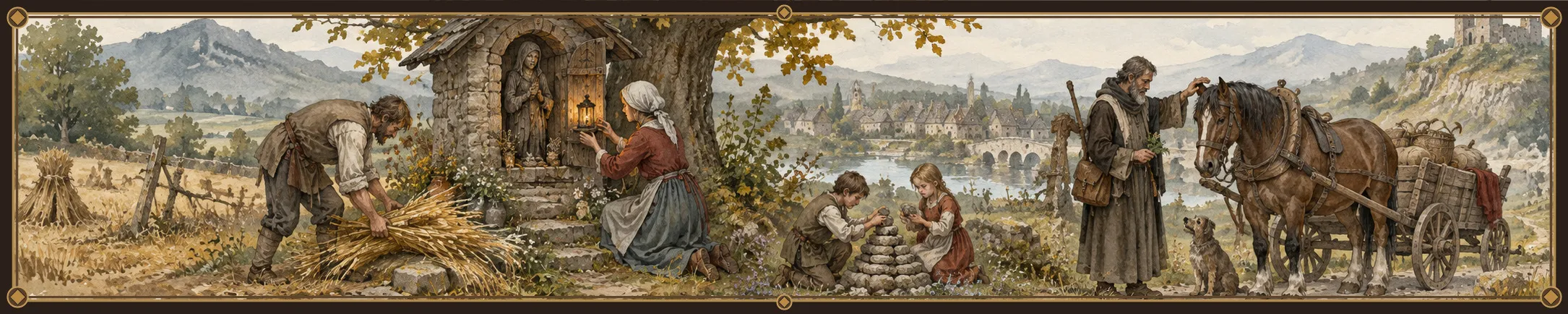
Sworn where the god can hear it,
witnessed where the town can see it,
written where the river cannot reach it,
and kept, as long as we are kept.
The Book of Accorded Forms
Most people on medieval Caeldon would not say they practise a religion. They light the fire the proper way, cut the first stalk for the right god, leave water running where it runs, return or mourn or seal their dead as their parents did, and, if they work a furnace in the old crafts, never say a certain name near it. That is simply how things are done. Above it, nearly every community keeps its own gods of a river, a mine, a hearth, or a road, honoured at shrines rather than temples, and for many peoples that is the whole of religion, and in no way a lesser one. Only in the most crowded, most record-keeping lands does devotion harden into doctrine, clergy, and temple, and there are four such faiths in the medieval world. The gods themselves are real, and close, and made: born where enough people need or fear the same thing, fed by worship, and able to fade when the worship stops. Faith is not quiet for it. Shrines are burned when a god is struck, oaths are tested with hot iron and the river, pilgrims walk roads that bandits watch, thieves come for the silver in the oath-chests and the steel inside sacred trees, and heretics are cast out of their runs. The Primes behind everything are honoured through alignment rather than prayer, and the rare beings who appear at binding oaths and dangerous deaths are called saints, heralds, judges, or gate-keepers by people who seldom understand what they are. This chapter is about what all of that looks like on an ordinary day, and on the days that are not.
Three Floors of Belief
Medieval religion is layered, and the layers are best pictured as the floors of a house. Everyone lives on the ground floor. Most people also use the floor above it. Only a few societies have built a third.
The ground floor is alignment custom: ordinary life lived in alignment with the Primes through seasonal rites, planting and harvest observance, fire-lighting customs, oath forms, burial practice, and taboos whose breaking counts as sacrilege. Nobody prays to a Prime. The Primes are not persons and do not answer; they are the currents that run through everything, and a life in keeping with them is simply a life done properly. Alignment custom varies more by land and way of life than by people, so that a Human hamlet on the Tidelace has more in common with its Gnome harbour than with a basin village of its own kind.
The second floor is the local cult. Nearly every community keeps devotion to particular gods tied to a place, a craft, a people, or a danger: a river’s god, a mine’s guardian, a hearth power, a road’s protector. Local cults are many, embodied, and bound to place. They have shrines and keepers rather than churches and clergy, and a household may honour several without contradiction. Small and middling peoples keep religion this way because their gods are close, particular, and near enough to answer.
The third floor is organized religion: shared doctrine, trained clergy, temples, pilgrimage, and a faith that claims to speak for more than one place. It needs crowded lands, lasting records, and houses able to train and keep a clergy, and on medieval Caeldon only four civilizations have built it: the Human corridor world of the Confluence Marches and the Serathic League, the Dwarven holds of the Ironspine and Stonewake, the High Elf Crownbough Courts, and the Thaluren of the Returning Concord. Organized religion never replaces the floors below it. It absorbs, tolerates, or suppresses local cults, usually with a lord’s armed men behind it when it suppresses: a shrine burned, a keeper hanged, a sacred grove felled for timber. Most religious violence in the medieval world happens at exactly that edge, and the hill-shrines that survived a temple’s zeal are remembered for the blood it cost to keep them.
Running through all three floors are two more threads. One is the steward traditions: stories of the rare beings who appear when an oath binds past breaking, when a death is dangerous, or when one of the world’s laws is fraying, called saints, heralds, judges, watchers, or gate-keepers. They are Stewards, the great offices of the Primes, and they are neither sustained nor much moved by worship, which is why the stories about them are so various and the prayers to them so seldom answered. The other is dark fear: protective rites, taboo, and the dread of the Dark Entities. Organized faiths write that fear into doctrine and hunt for its signs; local cults keep it as warning stories and charms.
What a god is
Writers need one fact above all others about Caeldon’s gods: they are made by their worshippers. When enough people focus belief, fear, devotion, or desperation on something that lies within a Prime’s reach, a river’s moods, a gate’s holding, a debt that will not close, the Prime’s current gathers there, as light gathers under a lens, and a god is born: self-aware, with a face, a name, and a temper shaped by the people who called it. A god’s power rests on how deeply its worshippers feel and how many of them there are, and fear feeds a god as well as love does. Without worship a god fades: its powers grow erratic, its memory slips, it forgets its own name, and at last what it was returns to the Prime it came from. The gods know this, and some of them are afraid of it. Their worshippers do not: each faith tells its own story of what its gods are and where they came from, and only a few mystics guess at the truth.
That is why medieval gods have histories as particular as any people’s. Each was born somewhere, out of something, and most of them can be dated to a crisis, a long need, or a place where people kept asking the same thing.
Alignment Custom
The ground floor of every faith is mostly invisible to the people who keep it, and mostly obvious to a stranger.
In the Elderweald the Wood Elves take only fallen wood, walk paths open, leave water where it runs, name a child only when it has emerged, and return their dead to the living forest. They keep the old grove reverence from which the High Elf faith grew, but as custom, with ritual keepers who hold memory and rites and are not clergy. In the Briarreach the Thornbound keep the same reverence harder, and return their dead in the circle’s own ground, never in any shared or open grove. A visitor who cuts a living tree, turns a stream aside, or sets a fire in the wrong place has committed not a small offence but a wound to the forest, and the grove’s hunters will follow him for it.
In the Leeward Folds there is no Halfling church and no clergy; belief is household and commons custom, the alignment custom of bounded plenty, and its first commandment is never to spend the reserve on plenty. On the Tidelace Coasts an unkept beacon or a falsely read mark is close to sacrilege, and a wrecker’s false light the worst sin the coast knows. On the Windscar, escort custom is its own alignment custom of held passage and answered betrayal, so that breaking an escort is felt as a wrong done to the world as well as to the party. Troll houses keep body-law, in which wounds and scars are sacred record and the question of which injuries may close is a matter of rite as well as care. The Salvage Peoples write their alignment custom on the stones: a ruin left no more dangerous than it was found is a ruin honoured.
Some customs survive long after anyone remembers what they were for. In the remnant furnace crafts that inherited fragments of ash-furnace technique, saying the name Ozhar near a furnace is taboo; most who keep the rule know only that it belongs to the Pyre-King, and many not even that. Salvagers in the Glassbelt keep the same rule over the dead furnaces, and add a second: do not carry ash or slag out. Upland custom around the Headwater Marches and the outer Ironspine warns against digging too deep beneath the high peaks, lest the Mountain-Father wake: he would not be angry, the warning goes, but he would be confused, and a confused mountain can bury a valley with one stumble. Miners in those uplands leave the deepest seams alone.
The commonest custom of all is the one at the grave. Every people on Caeldon buries, burns, returns, or otherwise finishes its dead, and many peoples set lights at graves or places of return in the nights after a death, each at its own season and in its own way. The rites differ more than anything else people do, and where they are not kept the dead do not rest. That difference is where the next floor begins.
The Local Cults
The gods themselves, where each was born and what it looks like and wants, are portrayed in The Gods of the Medieval Era. Here they are met where their worshippers meet them.
Shrines, fires, and songs
A local cult is a practice, not a doctrine, and it is best described by what people do.
-
The passed flame. An Ogre camp keeps Ghessa the Hearth-Mother at its fire. In deep winter many camps light a single flame and carry it from fire to fire, so that no household under the camp’s burden is left in the dark; while the flame is kept alive, it is said, the Hearth-Mother keeps the camp another year. Ogre religion has no clergy. The burden houses keep its customs beside the camp’s work counts.
-
Shuttered lamps. Those who have been hidden leave small lamps in the ruins for Varn, shuttered so no hunter can see them. Anyone praying to Varn is, almost by definition, someone a lord wants found: an outlaw in the reed-beds, a runaway, a poacher, or a thief.
-
The torn warrants sung. At Iron Compact gatherings, after the living warrants are read, the torn ones are sung: seams, warrens, and duties no lord still honours. The songs belong to Tavi the Bard of the Broken, and they are often sung in places only Varn’s worshippers can find; a Goblin caught singing them in a corridor market can lose his tongue.
-
A lantern at the road out. At kindred gathering-markets, kindreds setting out leave a lit lantern at the edge of the site, facing the road out, for Corrow. At waymarks along the circuits they stack the stones from which their marks were scraped, as offerings, and cut the marks again nearby.
-
The toll of story. In Gaugeward harbours a pilot back from a hard passage through fog or a hard approach speaks the account aloud at Maris’s shrine, paying her toll of story, and Orc escorts who shared the crossing sometimes stand to listen. Once a year the coast offers flowers, shells, and stories to the sea at the Festival of the Tides. Several springs along the coast are said to be her tears.
-
The Reciting of the Names. When Orc kindreds gather at the treaty-grounds they recite the names of their ancestors and tell the crossings they held, under Ushkar the Ancestor-Warden, who keeps the names of those who held passage and strikes the names of those who broke it. The oldest cairns of the High Scars, their names worn past reading, are called his tears.
-
The First Gale. As the windy season rises, Orc camps light fires on high ground and dance in the wind for Rakhal the Storm-Caller, who breaks whatever has gone stale. Lone thorns struck by lightning along the escarpment routes, and not burned, are taken as his marks. Dust storms off the Rimward pans are his too.
-
The Festival of the Turn. In the Leeward Folds Tamsel the Season-Weaver keeps the turning year: spring planting rites, the thanks of autumn storing, and a festival said to bring a good harvest if it is kept with true joy. Children are told the tale of the Long Summer, when Tamsel held the summer for a year and the winter after it emptied a fold to its last measure.
-
The stone on the wall. Once a year in the holds each household lays a single stone on its hold’s walls at the Festival of the First Stone, for Kerrund; laid with true intent, it is said, the stone strengthens the wall another year.
-
Unnamed water. Kavari households keep small shrines to the unnamed powers of their own pools and nursery reaches, and bury their dead along their burial reaches. No great god speaks for Kavari water, and Kavari custom prefers it so.
-
Unasked. The Mountain-Father, Haurûm, is honoured by title alone. Dwarves ask him nothing and leave his colossal remains untouched; the Giants, who alone still know his name, keep his sleep; and the Troll houses swear their crossing-oaths under his title on both sides of the Glassbelt, which makes them one of the few peoples who still swear by a sleeping god.
Each of these cults has its stories, and the stories do work. The basin’s tale of the Starving Winter, when the people refused to rest the land and Anvelle withdrew her blessing, is told more often wherever levies rise. The Serath’s tale of the Dry Year, when a town built a dam without Serovan’s leave and its elders had to walk into the empty riverbed to beg, is told whenever a town talks about building one. The Windscar’s tale of the Still Well, when Rakhal tore down a camp that would not leave a souring well, is told against any stronghold that seems to keep its reserve past its purpose.
One god, many names
When different peoples worship the same power in the same place and know one another, their devotion feeds one god, who answers to every name. Humans call the Headwater god of the in-between Abrel, frontier Dwarves call it Durrask, and Goblins of the mixed crossings Ziv, and the same god answers all three; in some old frontier shrines there are mirrors said to show a different face at every look. Ennor the Grave-Watcher has a Human name and many others, because the dead of the cradle-web have long been buried side by side at borders and crossings; mourners of different peoples sharing a burial ground sometimes discover that they have been calling on the same watcher by different names, and at a mixed graveside it is often the one thing they agree on. In the Stonewake Deeps Kobold underhouses honour the Last Chamber under a name of their own at the same small shrines the Dwarves use, so that two peoples pray in one place to one god without sharing a word for it.
Where similar worship arises separately, among peoples who never meet, it condenses into separate gods, who may later be mistaken for one another. Far-side peoples finish their dead under gods of their own: Orcs keep theirs under Ushkar, and Ennor is known beyond the Glassbelt only where the road peoples of the one crossing carried him.
Gods that faded
The medieval world is full of gods that are no longer there, and their absence is part of its religion.
Haggun the Wall-Breaker, god of the Ogre chain-camps, faded once the Hearth-Weight Compacts made refusal a custom other powers had to bear; on chain-camp roads at dawn, Ogres say, the sound of cracking stone can still be heard, and Ogre outlaws still chalk his crack on the storehouse doors they raid. Hesserin the Shattered Saint, the Reedfolk god of unbroken identity, broke apart once the Floodkeeper Houses accepted service, and in some old crossing shrines her broken mirrors, mended with gold, still hang above the water: look into one, it is said, and you see your own cracks, and the gold that holds them. Sessik the Tongue-Taker, whom older Kobold lines feared as a punisher of noise in the tunnels, faded once shared sound codes made silence a skill, and in abandoned underhouses there are stones that make no sound when struck. Ithaere the Drowned Mother condensed briefly out of the flood terror of the Drowning Bloom and faded when the waters receded. Nobody prays to her. Her name is spoken in the laments sung when water rises in the root-year, and in the warning every Dark Elf child hears: stray too close to black water, and Ithaere will take you as her tithe.
Some fadings are older still. In the basin valleys the First Man, the god of the first Human self-awareness there, is long faded, with no name left to pray to, though many Human peoples keep a story of a first man or first woman who taught Humans how to be Human. The name of Calvesh, god of the vanished archive-law world’s rolls that admitted no new entries, survives only inside the swearing-forms its keepers passed down, spoken as part of the old wording and rarely prayed to. And one god is fading now: Quennet the Clockmaker, the Gnome god of measured moments, as the far-side coast carries timing in custom rather than prayer, and a harbour that can name who bears a lost moment, and make them pay, no longer needs to beg a god for one. Harbour wards still say his name under their breath when an approach window has to be changed, half in thanks and half in apology to whoever will bear the lost time, and old gauges are said to stutter before a window fails. Some pilots fear the fading god has begun to close windows a moment too soon, so that someone will need him again, and the wreckers of the outer chains watch for a window that closes early.
Gods are being born too. Some Wrought and their artificers believe a god is gathering among them now, out of shared mending and remembering: the first god of a made people, still without a name.
The Sworn Accord
The Sworn Accord is the faith of the Human corridor world, the Confluence Marches and the Serathic League, and it treats the gods the way the river towns treat strangers. A god is honoured in common once the town has sworn to it and entered it on the roster; until then it is someone else’s god, kept at someone else’s hearth, and nobody will defend its shrine when the raiders come. The Accord took shape during the rise of the corridor orders, as the river towns' habit of swearing oaths before witnesses was carried from bargains between men to the gods themselves, and its shape is usually dated to around 15,000 BR, when the first river towns swore a shared roster of the gods they would honour in common.
The accorded gods
The roster is long and varies by town, but a core of gods is entered everywhere the Accord is kept.
-
First among the accorded are Anvelle, power of the basin fields, and Serovan, power of the Serath and of those who hold its fords. Field and river are the oldest powers in the corridor, and the Accord’s calendar follows their seasons.
-
The gods of oath and truth are Iskel, by whom oath-breakers are cursed; Annoth the Keeper of Scrolls, who remembers what was promised; and Ostrin, who drags hidden wrongs into the light. Iskel and Ostrin are entered side by side and oppose each other constantly, which the Accord treats as the gods doing their work.
-
The god of the dead is Ennor, entered on the roster under his Human name, though most of the cradle-web’s other peoples honour the same god under names of their own. The Accord does not claim to own him.
-
A frontier god, Abrel, is entered in the Headwater Marches but not everywhere downriver, where some oath-houses think a god of in-between people too unsettled to enter.
Oath-houses and witnesses
The Accord’s temples are oath-houses: squat stone halls by the landing, with the town’s roster cut into the lintel and its oath-rolls kept in iron chests below the floor. Every march-town has one, as it has a mill; a corridor town keeps one beside its toll-house and record-house; Highbank’s faces its Bridge Hall across the square. Its priests are witnesses, sworn to attend and remember rather than to command. They are feared more than loved. A witness’s word can hang a man, disinherit a widow, or turn a whole town against a neighbour’s god, and the proudest boast of any house is that no lord has ever made its word give way.
It is a boast few can make. The oath-houses are fed by the lords and the rich river houses, and a witness tends to remember what the strong would like remembered. Every town has a story of the honest witness: the old priest who would not unsay an oath when the lord’s men came for the roll, and was found in the river after the spring rise. The songs make such priests martyrs; the lords' halls call them fools. The oath-chests are treasure in their own right: an old roll can win a manor or lose one, rival houses pay thieves to lift a roll or burn it before a claim is sworn, and old witnesses sleep on the chest. An oath-house robbed in the night rings its bell until the town turns out with torches and dogs.
Around the witnesses stand the devout of the oath gods. The clerks and witnesses who seal bargains and keep sworn secrets honour Iskel, vowing never to reveal what they keep and never to swear falsely, even to save a life; they are trusted, and widely disliked for their silence. Scribes and record-keepers across the corridor swear in Annoth’s name to read, write, copy, and keep, and to save the roll before themselves when a record-house burns, and many keep a copy of every important roll in a second place for her sake. A few ascetic Lantern-Sworn follow Ostrin, vowed never to speak a lie, even to save a life; lords trust them as witnesses and dislike them for their bluntness. At some toll-houses and oath-house doors hang iron lanterns that give a faint, colourless light, and people say they are Ostrin’s eyes, watching for lies.
When an oath is denied and no witness can settle it, the Accord lets the entered gods decide by ordeal: hot iron, the river, or combat before the oath-house. A rich man may name a champion, and corridor sellswords make a trade of it; the towns still talk of the hired sword who won three ordeals in a summer and drowned in the fourth, the river ordeal, with every coin he had earned sewn into his coat.
The corridor year
For corridor Humans the Accord shapes the ordinary year, and most of its members never think about the roster at all. The year opens at the spring rise with Serovan’s Festival of the First Flow, when bread, wine, and flowers are offered to the river and the god is said to walk among the people in disguise, accepting their thanks; on the Serath, river traffic stops for it. At the beginning of harvest comes Anvelle’s Festival of the First Sheaf, when the first stalk is cut and offered to her. After the harvest levy is counted comes record-day, when the oath-house reads the year’s entries aloud and anything nobody dares speak against then holds. Through the winter come the oath-days, when the great houses hear oaths sworn and settle what they please, sealing bargains under Iskel and calling Ostrin down on the accused. At the great oath-days barges and carts carry the corridor to the oldest oath-houses of the Serath to swear what matters most, and river-thieves work the landings. And at every death come the rites of the dead: a sworn death and a remembered name, which is what Human mourners want of Ennor. Where a death goes unsworn, the dead do not rest: the Unsworn Dead crowd the back of the oath-house after every plague year and feud, and the witnesses who lay them earn their bread.
A household meets the roster itself only when something must be sworn. A marriage, a bargain, an inheritance, or a boundary needs an entered god, and a stranger is asked early whose god they swear by and whether that god is entered here. An oath under an unentered god is a private matter, not a bond.
Entered, tolerated, struck
The Accord sorts local devotion by its roster.
-
Entered cults are honoured in common. Their shrines are kept openly and defended by the town’s spears, their festivals fill the town calendar, and an oath sworn under their gods is one the town will hold a man to, with a rope if it must.
-
Tolerated cults are not entered but are left alone: household gods, country shrines, and the devotions of neighbouring peoples that ask nothing of the river towns.
-
Unentered and struck cults count for nothing in the towns, and their shrines are fair game. Some were never entered because entering them would concede something the corridor’s lords do not want to concede. Others were entered once and later struck, usually when their keepers lost a quarrel with someone stronger, and a striking is often followed by a war-band blessed at the oath-house door and sent to burn the god’s shrines. The defaced idols of struck gods still turn up in river mud and ruined chapels, sometimes with their offerings of silver intact, and some struck shrines were defended so hard that the town quietly entered the god again a generation later.
The bloodiest quarrels come from unentered devotion that refuses to stay private. Reedfolk grant that Serovan exists and refuse him the water: in their telling the river belongs to those who remember it correctly, not to the god of whoever holds the ford, and much of the Law of the River is flood-keeper knowledge with a Human seal on it. Their remembering is older than the Accord’s own. Goblin songs to Tavi keep the memory of torn warrants and broken promises alive in a religion that has no place for them. In the Broken Marches the Accord reaches only as far as the Headwater oath-houses do, so the region’s own gods count for nothing in the halls that carve up its ruins. On the far side, the coastal Humans of the Tidelace know nothing of the Accord at all; for them Maris is nearly the whole of religion.
The Accord’s buried shame is that it is a religion of the sworn word built on oath-forms it did not invent and on a river its lords took from others by the sword. Some witnesses know this. Fewer say it.
The Held Covenant
The Held Covenant is the faith of the Dwarven holds, the Ironspine Holds and the deep Stonewake Compact. It grew from the closure rites of Stonewake custodians and the hold oaths of the Ironspine, and took shared form around 305,000 BR, in the long aftermath of the deep wars between Dark Elves and Dwarves, when Stonewake’s way of sealing what must close spread into the wider Dwarven world. Its premise is that whatever holds must be able to answer for itself. A wall, a seal, a refuge, an office, and a person are all held, and all must be able to say aloud, before their kin, that they still deserve to stand. Dwarves have died for that faith: gate-wardens who held a door against Dark Elf raiders long after the hall behind them was empty, because the question had been asked and they had answered yes. Outsiders take the Covenant for the holds' rulebook; in truth the hold-elders decide, and the Covenant gives their decision the weight of the gods and the edge of the axe.
The questions
The Covenant’s great gods are honoured as questions rather than as patrons, and worship is the act of answering them honestly.
-
Will you hold? is the question of Kerrund. It is asked of every oath, wall, gate, and office, and answered by keeping them.
-
Must this close? is the question of the Measured Seal. It is asked before any passage, chamber, or reservoir is sealed, and whoever answers it must later answer to the hold-elders as well. Its triple-mark shrines and tally-stones stand at closure sites in the Deeps, and behind every seal the Covenant ever made, something may still be knocking.
-
Can this still bear? is the question of the Last Chamber. It is asked of every refuge, store, and shelter, and of every hold that claims to protect its people, at small shrines in route-houses, cisterns, and escape vaults. Where a refuge is held past mercy, the keepers who would not let it fall are said to become Burden-Stays, grown into the stone, and no custodian will free one, for the roof comes down with them.
The three pull against each other. Kerrund asks a hold to keep its gate; the Seal may require it closed; the Chamber may find that what is behind it can no longer be borne. The Covenant does not settle the quarrel. It demands only that each question be asked aloud.
Rites of holding
The Covenant’s central rite is the Proving of the Unbroken Line, in which a person proves they still belong to the hold. It is held before the gods as well as before the hold-elders: the person whose place is doubted, a returned exile, a changed survivor, a contested heir, answers the questions of holding for their own life, and kin and craft-mates speak for them. The elders decide, and one with strong kin behind them is heard more kindly than one who comes alone; an exile who comes back with no kin at all has sometimes been sent back out of the gate into the snow. How the Proving goes is told in The Elder Peoples (FND). The rite is the faith’s deepest link to Dwarven origins: a people whose ancestors survived a bodily change that some refused to accept treat proof of belonging as sacred. A young Dwarf’s first oath is sworn at the gate before a custodian who asks Kerrund’s question aloud. And burial is a final hearing in miniature, in which the dead are named as having held and are then sealed with care. A grave sealed carelessly is not quiet: the Seal-Knockers are heard behind such closures, and whether the knocking is the dead or someone sealed in alive is the custodians' oldest dread.
The Covenant has no priests in the Human sense. Its clergy are custodians: keepers of seals, tallies, and the rolls of the Proving who stand with the elders when a place is doubted, stand by at closures, and speak the questions at the rites of oath and burial. A custodian is trusted only as long as their own work holds. One whose seal fails and lets the deep in, or whose closure is later found to have walled up the living, may be cast down under the same questions they once asked of others, and the old songs of the deep holds are full of such falls. In hold archives the oldest oaths of the hold are cut into stone tablets, and it is said that if an oath is unjust the stone will crack.
Every closure the Covenant made shut something in: the stores of a hold that fell, a treasury its last elders would not leave to the deep, the graves of a plague gallery. Hold-children are raised on the warning a seal keeps two sides, and seal-breakers, outlaws to every custodian, still go in after the treasure with picks and lamps, past the danger-marks the custodians cut at every closure. Some come back rich. Others bring back the sickness the gallery was closed on, or open a door the knocking stops behind and do not come out of it, and custodians hunt a known seal-breaker from hold to hold.
Gate practice and seal practice
The Covenant is kept in two practices that share its questions and weigh them differently. Gate practice, in the Ironspine holds, leans on Kerrund: outward-facing, oath-centred, used to bargaining with Human corridor lords and Elven embassies, and readier to accept a place won by bargain. Every hold tells the Legend of the Unbroken Gate, of the god standing in a breached doorway until the attackers could not pass, in its own version, and honours the gate-saints, the wardens who held a door to the end, with an axe-head hung over the lintel and a name cut in the threshold every oath-taker steps over. Pilgrims cross the Ironspine passes to touch them, through the snows and the country of the pass bears, and Human lords pay well for a gate-saint’s axe; most such axes are forged, and the holds have hanged the relic-thieves who stole the true ones. Seal practice, in Stonewake and the deep holds, leans on the Measured Seal and the Last Chamber: severe, slow to reopen what has been closed, and haunted, sometimes literally, by seals that should never have been set. Each regards the other as a lesser form of the same faith, and the quarrel has drawn blood more than once, mostly at doors: a seal-practice custodian walled into a gallery by a gate hold that wanted it open, a gate-warden’s oath-company barred out to die on a bridge by a deep hold that would not unseal for them. Both sides keep the names of these dead, and both call them martyrs.
The Covenant also shapes how Dwarves see other faiths. The Sworn Accord enters gods by sworn roster, which looks to many custodians like trusting a door before anyone has leaned on it. And the custodians have noticed that some Dwarves drawn outward by corridor trade now pray for open roads rather than held gates.
Beyond the holds the Last Chamber is a different god in practice. Its organized cult exists only within the Covenant; elsewhere its worship is fought over and scattered, kept by lonely refuges rather than by any order of custodians. The Dark Elves of the Roothollows honour it as true but severe, kept by houses and route keepers rather than by any priesthood, and the question put to it at their threshold shrines is the host’s: can this house still hold one more? The same god is asked to justify a closure in the Deeps and to stand by a refusal in the Roothollows, and both peoples know it as real while arguing bitterly over what it wants of them.
The Ordered Bough
The Ordered Bough is the faith of the High Elf Crownbough Courts. It is older than the courts in substance and younger in form: its roots are the grove-reverence of the Wood Elf world, and it became an organized religion as the courts were founded, around 390,000 BR, when the habit of shaping living growth became a calling with its own houses, teachers, and rites. Its premise is that life, the world, and the self are living growth, and that growth should be tended towards its intended form. Nothing is born finished. Everything worth honouring is being grown.
Temple-gardens and tenders
The Bough’s temples are temple-gardens: living halls, groves, and terraces shaped over generations, where trees are trained into architecture and the work of one tender is continued by the next. A temple-garden is never complete, and its incompleteness is part of its sanctity. The oldest hold things the trees have grown around: a gate-guard’s sword left in a sapling and swallowed by a trunk a dozen arms round, a war-horn in a bough, a queen’s ring in the heartwood. Tenders say these grew where a life was given for the garden, and pilgrims of every Elven people come to lay a hand on the bark. Twice in living memory thieves have come with saws and wedges for the steel inside; one of them still hangs, the tenders say, from the tree he cut.
Its clergy are tenders, whose word carries by patience and by what long care has visibly grown: a grove that has flourished under their hands, a household grown into its proper shape, a student who has emerged well. Senior tenders guide the courts' great gardens; lesser ones serve houses, villages, and roadside groves. A tender also fights for the garden: against the hall canker that runs bough to bough through a careless cut, against the bears roused from the hollows in a wet spring, and against the thieves who come for the heartwood of a sacred tree, which sells in the corridor towns for its weight in silver. Heartwood thieves work fast, at night, with a cart waiting on the corridor road, and tenders hunt them with bows down every road out of the Crownboughs.
Its rites follow the Elven way of guided emergence. Birth, naming, coming of age, and the taking of a house role are each a stage, marked when the person has grown into it rather than at a fixed age. Death is the last stage. The dead are returned to a living whole larger than any one life, in the temple-gardens and family groves, and for this the Bough honours the god Humans call Ennor under an Elven name of its own, as the guide who sees the returned onward. For High Elves the Bough is present in nearly everything: the shaping of homes and halls, the slow marking of a child’s emergence, the long care of family groves, the return of the dead.
Tending and perfecting
The Bough’s deepest tension lies inside its own premise. To tend is to help something become what it is growing towards. To perfect is to decide in advance what it should become and to cut away everything else. That second path has its own god. Saerith the Mirror-King, the god of finished form, is the Bough’s most powerful and most contested patron, honoured at court wherever prestige, lineage, and flawless presentation are at stake, and feared in the houses that cannot meet his image. At some court occasions courtiers paint their faces with gold and silver to match him; it is said that if the painting is perfect, he grants a year of perfection. The court tale of the Shattered Noble, who matched Saerith’s image so perfectly that he shattered like glass, is told as a warning and heard, in some halls, as a promise. Under his banner gardens have been burned for growing wrong, and the courts have their own word for a house that cuts down a rival line as coldly as a diseased bough: it has been pruned. A pruned house’s gardens go untended and keep growing towards a form no one guides, galleries closing into thickets and bears denning in the hollows, with the house’s mirrors and heirlooms still inside; rival houses quietly pay outsiders to bring them out.
The same tension shapes how the Bough sees other peoples. To a tender, shorter-lived peoples look like growth that has not had time to emerge. To Saerith’s court they look like growth that will never be finished, and the courts' long condescension towards Human and Dwarven powers draws on the second view far more than the first. Outsiders tend to meet only the court’s face: Human embassies and Dwarven envoys see Saerith’s polish and disdain and rarely the patient tending beneath it, which is one reason both sides of the Crownbough rivalries find each other so hard to read. Court life adds that second skin to every High Elf life, and many live inside it without ever quite choosing it.
Outside the Crownboughs the root of the faith survives without its branches. The Wood Elves and the Thornbound keep grove reverence as custom: no temple-gardens, no tenders, no doctrine, and no patron of finished form.
The Way of Return
The Way of Return is the faith of the Thaluren and the only organized religion on Caeldon with no god at its centre. Its question is whether a return is rightful. Its teaching is the old rule of return: remembered run-lines, holy spawning waters, ascent seen and remembered by the run, and the care of vulnerable eggs and hatchlings. Its pilgrimage is the return run itself, a journey of hundreds of leagues past weirs, poachers' nets, and the grey run-followers that gather off the estuary mouths, its holy places are the return-waters, and its keepers are the Returning Concord’s own offices held as sacred ones: the Run-Watchers who say whose ascent is rightful, the Sanctuary Custodians who keep the spawning grounds, the Clutch-Watch Circles who say whose clutch is kin, and the Sea-Settlement Speakers who hold sea life to the old spawning rules. To serve in any of them is to serve the Way, and the Way needs no other priesthood. Young Thaluren learn to count a run’s dangers in a rhyme: the grey ones at the mouth, the weir-men’s nets, the long-jaw in the weed, and the still water at the end.
A faith that refused its god
The Thaluren once prayed. When egg blight struck their oldest spawning water, they called on Ulaun the Stilled Hour for stillness, and the stillness she gave held their clutches in a water where nothing could hatch. When she faded, the faith that survived kept the rule of return and refused the god, because a god can be asked for the water to stop, and the run cannot. The faith took its godless form in that span, during The Closure of the First Nesting Confluence (c. 178,000-c. 162,000 BR). Blightward custodians still keep the reaches of the closed confluence where silt hangs unmoving in pools that should run, treating them as her residue, under the same watch as the blight itself.
Thaluren do not deny that gods exist. They respect them in other peoples' waters, and where Maris’s salt water meets return-water at the estuaries the Way lets her be honoured on the banks, but no god may be invoked over the ascent. A stranger caught praying over a Thaluren spawning ground is driven off, and some have not lived to be driven. The faith hunts its own heretics too: a keeper caught whispering for calm water over a clutch, a family that set a stone idol in the gravels. Such people are cast out of their run, and the oldest tellings, of the stillness that took the first confluence, are recited to them as they go. The whale-like deep-witnesses of ocean memory are honoured without being prayed to. Other peoples often fail to see the Way as a religion at all, because nothing is prayed to. The Thaluren regard that as the point.
Two wings
The Way divided over the closure into the two wings it still has. The Blightward Keepers hold that damaged sacred waters must be kept faithfully, guarded, remembered, and never abandoned, even when they can no longer be used; their custodians name every failed clutch at the water where it failed and recite the names each season. The Open-Run Concords hold that a rightful return may be turned to alternate waters, provided the memory-debt towards the damaged source is carried; their redirected families send one of their own each season to the Naming Reach to name the old water aloud. Each wing regards the other as keeping the Way imperfectly, and both cite Ulaun against the other. Their quarrels end, when they end at all, not by revelation but by whichever wing holds the water and can keep the other out by force, as in The Second-Channel Feud, whose laments still name the escort who held a narrows against a Blightward band.
For Thaluren the Way is present in every crossing between sea and river, every clutch counted as kin, and every argument about who may ascend where. Its oldest enemies are the run-raiders: weir-lords and estuary towns that net a passing run for its fat, or take the young at the river mouths. Escorts have cut weirs by night and drowned the netsmen who came out to stop them, and the river towns that lost men call it piracy; the Way calls it keeping the run. The blighted clutches of the First Nesting Confluence left pearls in the silt, and every poacher on the rivers has heard of them; the Way counts every such pearl a clutch robbed twice, and Thaluren who find one on a stranger’s neck have been known to follow its wearer for a season. Kavari nursery-waters and Gnome harbour custom both meet the Way where its return-waters cross theirs, and the Way answers each of them in the language of rightful return rather than of competing gods.
At the Graveside
Every faith and every custom meets at the grave, and nowhere is the variety of medieval belief sharper. Human mourners want a sworn death and a remembered name. Elves expect the dead to be returned to a living whole larger than themselves. Dwarves want the dead brought to proper rest and sealed with care. The Thornbound return theirs in the circle’s own ground; the Kavari bury theirs along their burial reaches; the Orcs keep theirs under Ushkar, recited at the treaty-grounds with the crossings they held, and a name Ushkar strikes is a name the kindred will not recite.
Ennor the Grave-Watcher answers most of the cradle-web’s dead, and they have overwhelmed him (The Gods of the Medieval Era). Where peoples live together, a death can be left half-finished while each side refuses the other’s rite, and the dead of such deaths are said to linger and fray. Communities that learn to divide the work ease the god’s burden, as in the Elderweald, where mixed funerals give the body to Wood Elf return and the remembrance to Human mourning under the Accord, a settlement made in The Elderweald Funerary Accord (c. 16,000-c. 15,000 BR). Beyond every rite lie the dead nobody finishes: those who die in hiding, on broken roads, or without kin, those whose names were struck before they died, and the drowned the river gives back in spring. In the Broken Marches the hunted are often buried where no hunter will find them, and Ennor, people say, keeps watch over the graves Varn keeps secret.
The one enemy the watcher is said to have is the forbidden magic that tears at the dead: what it takes from a grave, he cannot always guide home, and a conjurer’s careless raising can leave a whole burial ground walking. Mourners tell of a child who died without a name, and of the watcher who came and gave it one so that it could rest; in the oldest burial grounds there are paths that seem to lead nowhere, and people call them his trails.
Saints, Heralds, and Things Not Named
Below and beside all of this run the two threads that no faith fully owns.
The steward traditions are the stories every people tells of the rare beings who appear at the moments that matter most: when an oath binds beyond anyone’s power to break it, when a death is dangerous, when one of the world’s laws is fraying past mending. Basin folk call them saints; holds call them judges; forest keepers call them watchers; other peoples call them heralds or gate-keepers. They are Stewards, the great offices through which the Primes' laws are kept at their points of strain, and because they are neither sustained nor much moved by worship, the stories are wildly various and the prayers to them seldom answered. A Steward who appears at an oath-swearing or a deathbed has come because something about the moment demanded it, not because anyone asked.
Dark fear is older than any faith. Every floor of medieval religion carries protective rites, taboos, and dread of the Dark Entities, the powers from outside the world, fallen from within it, or older than its order, that replace, corrupt, or unmake what they touch. The organized faiths write that fear into doctrine and set their clergy to hunt for its signs; the local cults keep it as warning stories and charms, told at the fire and hung over the door. And a lord who wants his rival’s people afraid has only to whisper that the rival has dealings with one.
Tensions
-
Whose oaths. Reedfolk keepers hold that much of what the basin towns call their own oath-keeping was theirs first, and that the Sworn Accord swears its river guarantees under a god they refuse.
-
Too unsettled to enter. Abrel the Changeling is entered in the Headwater oath-houses and not in some downriver ones, so an oath a Headwater family swore under Abrel binds at home and is shrugged off on the Serath. Fosterlings sent downriver have come home robbed of the land they were promised, and more than one Headwater feud began that way.
-
Sealed rolls. Iskel’s oath-keepers hold a sealed roll shut, Annoth’s scribes count it kept but not remembered, and Ostrin’s followers want it opened. The roll stays as the strongest house in town wants it, until Ostrin’s zealots break into the oath-chest by night and read it from the steps.
-
A paid sword before the gods. Hired champions fight most ordeals the rich are party to. Some witnesses hold that a sellsword’s victory is the entered gods' will like any other; others will not enter an ordeal won with hired steel in the roll, and the poorer side of a lost ordeal goes looking for a witness of the second kind, or for the champion on a dark road.
-
Tending or perfecting. Saerith’s devotees call finished form the Ordered Bough’s fulfilment; the older tenders call it its corruption. Every presentation at court is a small version of the argument.
-
Gate and seal. Gate practice accuses the seal practice of the deep holds of closing what should hold; seal practice accuses the gate holds of holding what should close, and both keep their martyrs.
-
A death half-finished. Where peoples live together and each refuses the other’s rite, a death can be left unfinished, and every such death adds to the burden of the watcher at the threshold.