Chapter 17. The Tidebound Reaches and the Unrun Sea
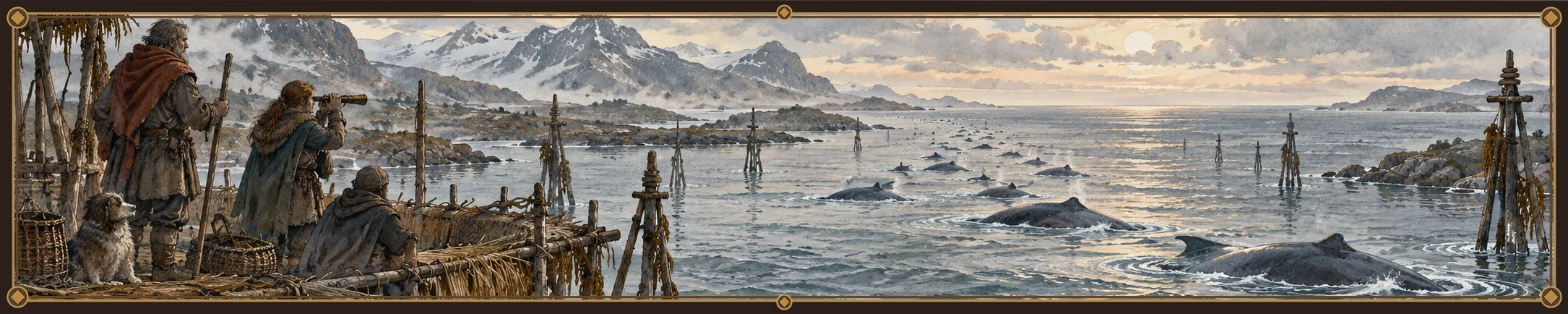
We hatched in the second water;
we name the first.
Our line was laid where nothing hatches now,
and what we owe, we owe it there.
Count us, and count what we owe.
The Namings of the Naming Reach
Most Thaluren live their whole lives at sea and go up a river only to give the next generation its start. That one fact shapes everything in the Tidebound Reaches. Their homeland is not a coast or a reef or a drowned kingdom but a chain of linked waters: the long current roads of the open ocean, the reef shelter and tall kelp of the shoal worlds, the brackish mouths where salt meets fresh, and the rivers that climb towards the spawning grounds, past the gravel braids and rootbank pools where another people, the Kavari, already live. Thaluren life has to keep returning through all of them, and it is a perilous road. Sharks wait at the mouths for the young, pike-jawed hunters raid the spawning beds, and on the farthest currents something vast breaks the runs that go too far, so that a run without spears around it is a feast, and every hunter in the sea knows the season. A stranger here is placed first by the run they came up with and the water they hatched in, and only afterwards by anything a land people would call a family. The oldest of those waters has been closed for more than a hundred and sixty thousand years, and it still governs what the Thaluren believe. Beyond the farthest current lies the Unrun Sea, where nobody’s custom goes at all.
Sea, Mouth, and River
The Reaches hold the far side’s north-eastern corner. Seaward, to the north and north-east, the current roads run out over open water towards the Far Set and the Unrun Sea, with the shoals and the Kelpshade inside them. To the west the estuaries meet the coast of the Tidelace, the Split Reed Mouth among them. The rivers come north out of uplands to the south and south-east, the Kavari live along their middle and upper courses, and beyond their banks nothing is mapped. Turningshoal lies on the inner edge of the Kelpshade, a week or so out from the Split Reed Mouth, with Brightshallow at an island edge nearby, and a run’s ascent from the Kelpshade to the Gravelbraid Nurseries and Shadepool takes two months or more. The sea settlements along the Kelpshade and the Kavari villages upriver are the settled cores; between them lie open water and long river reaches where run-followers gather off the mouths and devourers are sensed on the outer routes, and runs move only on the current roads, under escort.
The Reaches are known by journeys, seasons, and the waters a run may cross rather than by fixed borders. Some of their waters are fully marine, others tidal, brackish, seasonal, or fresh, and a Thaluren life passes through all of them. The Returning Concord holds them together, not as a realm with a border but as a chain of waters held by custom, in which sea settlements, keepers of the mouths, escorts of the ascent, and sanctuary keepers all know one another’s place. Where the neighbouring Tidelace rewards a careful pilot, the Reaches reward something else: a run that comes home whole through every water it crosses.
Current Roads and Shoal Worlds
Seaward lie the current roads: long, steady flows across open water that carry whole settlements' worth of travellers with little effort when they run true. The greatest, the Homeward Set, runs from the outer shoals towards the estuaries and carries most runs home in return season; settlements time their departures by it, and a year when it sets late is remembered as a hard one. Longer, lonelier currents bring the Outer-Route runs in from the far edge of the known sea, last and least predictably.
Inside the currents are the shoal worlds, where reefs break the swell and kelp grows tall enough to shadow the water beneath. The broadest of these forests, the Kelpshade, is where returning runs rest and gather before they turn for the estuaries, and where the young who come back down from the rivers first learn the sea. Light comes into it green and broken, the stalks lean all one way with the current and then all the other, and a whole run resting among them can be invisible from a stone’s throw off. Island margins give quieter gathering water at their edges. Then come the mouths: estuaries where salt and fresh mix, reed-shelves line the shallows, and the channel shifts with every tide. Beyond the mouths, the rivers climb towards the spawning grounds of the lower and middle courses, with a few rarer sanctified reaches farther inland.
What the Waters Do
| Blight |
The oldest fear in the Reaches. Eggs laid with every rite can still fail if the water itself has gone wrong, and the Thaluren learned at the First Nesting Confluence that even the most trusted water can turn. Every sanctuary keeper watches for the first signs. |
| Low and wrong water |
A dry season, a silted channel, or a warm, sluggish run can make a river impassable to ascent or fatal to a clutch. The return does not wait for good water; it has to find some. |
| Storms and broken currents |
A current road that fails or shifts in a storm season can scatter a run across open water, and a scattered run is hunted. Blackfin pods follow the runs on the outer roads. Homeward Set lines name over every gathering the escorts who turned to face a pod so that the run could reach the kelp, and a young escort’s first boast is to swear to be one of them. |
| Hunters at the mouths |
Grey run-followers, the sharks of the estuary mouths, gather off the estuaries when the young come down from the rivers, and escorts guard the mouths with spears for the whole down-run. Inside them lampreys latch onto anything warm, rays lie buried under the Kelpshade sand, and upriver the green-and-gold egg-takers lie in wait in the pools to raid the spawning beds. Kavari custodians hunt them through the pools in spawning season, and a hunter who spears a big one wears its jaw on a cord until the next season’s kill. |
| The deep |
Beyond the outermost routes lies open sea the Thaluren do not claim. Their ocean memory speaks of great deep-witnesses there, and of devourers that break routes, and on the far roads Outer-Route runs are haunted by the Unreturned, runs that never came home, keeping pace with them in the dark water. |
| Someone else’s water |
Upriver, the hazard is the neighbours as much as the water. A run that presses into Kavari nursery-water without warning can trample the young, meet Kavari spears in the shallows, and start a blood-debt it will carry for generations. |
Life at Sea
Sea life is the ordinary life of the Reaches. Thaluren settlements sit in reef shelter and kelp-shadowed water: submerged or half-sheltered dwellings gathered where the current is gentle and food is close. People fish, gather shellfish, tend the shoals, and travel the current roads to visit kin, settle quarrels, or come to an assembly at an island-edge gathering place. The Thaluren are fully sapient marine people built for practical grace rather than ornament: endurance in current, precision in submerged movement, ease in salt water, and enough tolerance of brackish and fresh water to make the ascent survivable. They are not a branch of Elves, and "sea-elves" is a misnomer they do not thank anyone for.
A Thaluren belongs to a parent-line, a clutch, a hatch-water, and a run before any household. Any Thaluren met on the current roads is asked which run they came up with and which water they hatched in; a Run-Watcher can be asked to confirm the answer, and a false one is remembered for generations. An adult who takes up care of another clutch’s young says so aloud before the clutch’s circle, and is then counted in that clutch’s duties as though born to them. A quarrel over who goes first, such as which line ascends first in a narrow year, goes to the Run-Watchers, who remember what was allowed before. To outsiders this can make the Thaluren seem severe. Among themselves they are a deeply communal people, whose strongest values are continuity, a share in the run, and care for vulnerable life, and whose first question about a stranger is whether the stranger knows how to behave near water that matters.
The Return
The year turns on the return. As spawning season nears, a settlement’s run gathers along the Kelpshade and the outer shoals. Its Clutch-Watch Circle names who is going and as whose kin, and the Sea-Settlement Speaker sends messengers ahead to give warning at the mouths and upriver. The run then crosses into brackish water ringed by its escorts, climbs the river at the time it has given out, and lays its eggs in a known spawning ground under the eye of the Sanctuary Custodians. Reproduction is public. Nobody spawns alone, and nobody’s clutch is a private matter. Afterwards the adults go back to the sea. The young who survive come down later, in their own time, without ceremony and through the run-followers' teeth, and are counted when they reach the Kelpshade; there the circle names each before any household takes them in. The naming gives the clutch and the water. The household comes after.
The Kavari Waters
Upriver, the runs reach water that is someone’s home. The Kavari are a freshwater tributary people, neither Thaluren nor a river branch of the Reedfolk, who live year-round in the same river systems. Their bodies are practical rather than spectacular: strong breath, fine current-sense, ease in cold fresh water, a steady grip in slick places, and a good eye for sediment, pressure, and hidden channel shift. Their rootbank villages, deep pools, gravel runs, and spring-fed side channels are home, food, nursery, and burial ground at once. Kavari bear live young in the water, the childbed a sheltered nursery pool, and nurse them there for a season, and their young grow not after any return from the sea but in protected nursery waters kept by the community: sheltered coves, rootbank pools, gravel chambers, and side channels.
Bank councils settle who uses which water, pool-kin households remember which waters owe what, channel stewards keep the flow alive, and nursery custodians clean, turn, shade, and defend with their spears the gravel beds. Kavari lifeways, Bankright, Gravelbraid, Pool-Kin, and Coldrun, are rooted in their own waters as firmly as any Thaluren run-line in its return. For most of the year a Kavari bank village sees no Thaluren at all. In return season it sees messengers first, then escorts, and only then, if the water allows it, a run. Where the two peoples meet, it is usually over a marker. Kavari custodians mark nursery-water and forbidden channels; Thaluren escorts bring warning and keep inside the marks; quarrels go to a circle at the water’s edge, where whoever holds the water usually has the last word, and now and then to spears, and a feud between a pool and a run-line can outlast both their elders. Kavari households keep small shrines to the unnamed water-powers of their own pools and nursery reaches, and bury their dead along their burial reaches. No great god speaks for Kavari water, and Kavari custom prefers it so.
Who Holds the Waters
No single centre rules the Reaches. Power is held by those who keep each part of the return, and each keeps a jealous eye on the others.
| The Returning Concord |
Its offices are also the sacred offices of the Thaluren faith, and are obeyed as such. Run-Watchers say which ascents are rightful and remember what was allowed before. Sanctuary Custodians keep the spawning grounds and alone may say when a water is fouled. Clutch-Watch Circles say aloud who descends from whom and who has been adopted. Sea-Settlement Speakers carry the voice of the sea settlements, where most Thaluren actually live. Redirection Assemblies, once called only in disaster, now decide whether a blocked run may pass into other water. |
| The two wings |
The Blightward Keepers hold the closed and damaged waters, keep the blight out, and remember the names of failed clutches. The Open-Run Concords hold the other channels and lesser sanctuaries, and the seasonal gathering that turns a desperate passage into an accepted one. Both claim to be the faithful heir of the same older custom. |
| The Kavari |
The Bankright Circles hold the dwelling-waters upriver through bank councils, pool-kin circles, nursery custodians, channel stewards, and seasonal gatherings. In nursery-water a Kavari closure outweighs any run’s need to pass, because the Kavari live there and will fight for it, and they have never needed the Thaluren to agree. |
| Gnome sounders |
At the mouths and in some fought-over river reaches, Gnome sounders of the Gaugeward Leagues measure depth, timing, and channel. They write down what they find; they do not rule. |
The Thaluren of the Reaches also sort themselves by older run-lines: Tidebound lines that keep the inherited runs, Blightward and Open-Run lines that took their names from the closure, and Outer-Route lines whose runs come in from the farthest current roads. The quarrels run in old grooves. Blightward custodians accuse sea settlements of putting ease before sanctity. Open-Run elders accuse the Blightward custodians of a reverence that kills, and resent how much a Kavari closure can decide about Thaluren lives. Bankright councils fear that every burdened return accepted this season becomes an expectation the next. A Kavari custodian and a Thaluren elder can both be entirely right about the same channel, and still come to blows over it.
Settlements of Sea and River
The Reaches have no capital. The largest gatherings of the Thaluren are not towns at all but runs gathering along the Kelpshade and assemblies at island-edge gathering places, and two such places together act as the centre, though nothing is ruled from either. The other sea settlements are scattered through reef and kelp, and the Kavari villages upriver are home to people who never go to sea.
The largest of the sea settlements is Turningshoal, four thousand or more Thaluren in reef shelter on the inner edge of the Kelpshade, where the current is gentle. Its people fish, gather shellfish, and tend the shoals. In return season its run gathers along the kelp, and when the young come down from the rivers they are counted there first. Brightshallow is an island-edge gathering place of quiet water, with only a few keepers living there for good. Sea-Settlement Speakers and run-lines come to its assemblies along the current roads to settle quarrels and visit kin, and in a hard year it fills with people arguing about the runs.
Upriver, Shadepool is a Kavari rootbank village of a few dozen households on the middle river near the Gravelbraid Nurseries, built around a deep shaded pool with gravel runs and spring-fed side channels below it. Its bank council settles who uses which water, its nursery custodians tend the gravel beds and keep their spears sharp against egg-takers in the pools, and its burial reach lies a little upstream. Highest of all, Mosspool is a single pool-kin household on a cold upper tributary above the highest spawning grounds, where no run ever comes, with its own pool’s shrine and its own reach for its dead.
Kelp-Cord and Fish-Leather
About 140,000 people live in the Reaches. Some seven in ten are Thaluren, nearly all of them in the sea settlements, and about three in ten Kavari, in the rootbank villages and pool-kin households upriver; a few Gnome sounders keep the mouths.
In the water a Thaluren wears little: a cord harness or belt for knife and net, and tokens of shell and bone for run-line and hatch water. In the air, at the mouths and the bank circles, they wear a wet wrap of woven kelp-cord to keep the skin from cracking, and those are the only places a land traveller is likely to see a Thaluren out of the water at all. Most of a clutch never reaches the sea; of the young that hatch, only a few come down the rivers to the Kelpshade, and those who are counted there live two to three centuries. Adults die of storms that scatter a run, of blackfins and sharks, of the devourers of the outer routes, and of age, for blight kills clutches, not grown Thaluren. Run-line, hatch water, and clutch come before any household, and a Thaluren meeting a stranger gives them first: Saevai of the Homeward run, hatched at the Second Channel. Other names of the Reaches: Oluun, Myrrua, Thaio, Ilua.
Kavari wear little in the river either. On the bank they wear short wraps of water-plant fibre and belts of fish-leather, and the Coldrun Kavari of the upper tributaries are the heaviest and darkest of them. Nursery custodians guard the young closely, and about one in six is lost, to cold winters, floods, and nursery beds trampled by runs pressing in without notice. Adults often pass a century and die mostly of age, cold, and floods. A Kavari is named with the pool that is home, and a pool-kin household for its pool: Grenna of Shadepool, Tovan, Pesk, Ulbe, Rokka, Dunni of Mosspool. The few Gnome sounders at the mouths dress, live, and are named as the Gnomes of the Tidelace are.
Ways Through the Water
The Reaches' roads are currents and rivers, and almost nothing on them is cargo. What moves is people, clutches, warnings, and memory. The Homeward Set and the outer routes bring the runs in. At the mouths, the Split Reed Mouth chief among them, Thaluren and Gnomes meet at reed-shelves, tide stones, and channel posts: the Thaluren call out the ascent seasons and the return channels, Gnome pilots sound their own channels and keep hazard markers, a fishing boat is not a run, and a run is not coastal traffic. Above the mouths, escorts and Sanctuary Custodians keep the known channels to the spawning grounds, and since the closure the best known of them leads to the Second Channel. Where redirected runs must pass near Kavari nurseries, cold holding pools keep displaced clutches alive while the circles on the bank decide what the water can bear. And the down-run brings the young back to the sea by the same rivers.
Trade is slight. Gifts pass at the bank circles and the mouths, and Gnome coastal traffic uses the estuaries for its own purposes, but no one comes to the Reaches to buy. What they come for, now and then, is what the drowned hold. Gnome divers whisper of old Thaluren reef-halls on the outer shoals, abandoned when a current road failed, where shell-work and pearl, the treasure of whole run-lines, were left with the dead. The Thaluren call such diving grave-robbing and its divers thieves, and have drowned divers for it; the Gnome crews who still go take a lookout for every diver and go only in the season when the escorts are upriver. Thaluren reach stops at the water’s edge. What lies on the banks beyond the Kavari villages is not Thaluren business, and the Reaches have no land border worth naming.
One Wound
The Reaches remember one wound and the customs that grew around it. Long before outsiders came, sea-to-river return was already custom, and the Concord grew from that custom as the keepers of the runs and the sanctuaries tightened their hold on it. Upriver, the Kavari drew their own bank councils together into the Bankright Circles (c. 190,000–c. 160,000 BR) without reference to anyone’s return. Then the First Nesting Confluence failed, and its closure (c. 178,000–c. 162,000 BR) forced the Thaluren to ask whether sanctity lay in a place or in the care given wherever the run goes, and split the Concord between keepers and open-runners.
The Second-Channel Feud (c. 160,000–c. 156,000 BR) was fought at the mouths and in the channels, spear against spear, the nearest thing to a war the Thaluren remember, with ambushes in the narrows and raids between the gatherings. It ended with terms the stronger side set: an alternate water is accepted, for now, only while it carries memory-debt towards the damaged source. The Gravel Oath Accord (c. 153,000–c. 148,000 BR) turned those terms outward when a redirected run met a wall of Kavari bodies and barriers across the nursery-water. The Late-Closure Terms (c. 147,000–c. 146,000 BR) taught both sides that late warning creates debt even in a real emergency, and that a broad closure can be challenged without the Kavari giving up their hold on the nurseries. And the Estuary Terms (c. 144,000–c. 138,000 BR) made the Thaluren share the mouths with Gnome sounding-lines.
The Reaches sit squarely on the Water and Who Keeps It thread of Caeldon’s history: who may decide about living water. They answer Who Counts and Who Records in their own way, without archives, through elders who remember who returned rightly and when. Blightward families keep sanctity-memory, of who guarded the clutches and kept the waters clean. Open-Run families keep survival-memory, of who named danger honestly and let the run move. Kavari households keep their own count of every burdened return that crossed their water and whether its debt was paid.
A Faith Without a God
Thaluren belief is the Way of Return, the only organized religion on Caeldon with no god at its centre. Its question is whether a return is rightful. Its teaching is the custom of return: remembered run-lines, spawning sanctity, the ascent made before all, and the care of vulnerable eggs and hatchlings. Its pilgrimage is the run, its holy places are the return-waters, and it needs no priesthood, because its keepers are the Concord’s own offices: to serve as a Run-Watcher or a Sanctuary Custodian is to serve the Way.
The Reaches remember why there is no god. When blight entered the First Nesting Confluence, the Thaluren prayed to Ulaun the Stilled Hour for stillness, and her stillness held their clutches in a water where nothing could hatch. When she faded, the faith that survived kept the custom of return and refused the god. Thaluren do not deny that gods exist. They hold that the return-waters must not be entrusted to one, because a god can be asked for the water to stop, and custom cannot. Gods may be respected in other peoples' waters, so long as nobody calls on one over the ascent. Other peoples often fail to see the Way as a religion at all, because nothing in it is prayed to, and Thaluren regard that as the point. The whale-like deep-witnesses of ocean memory are honoured without being prayed to, and at the Split Reed Mouth the Gnome pilots keep their devotion to Maris of the Tides on their own bank, where the Way can respect it.
The First Nesting Confluence
High up the return system, several freshwater channels come together and run on as one: the First Nesting Confluence, the oldest sacred spawning water of the Thaluren. It was never the whole Thaluren homeland. It was the place where the sea-born return became holy and sworn, where clutches were accepted, their keepers answered to the run, and run-lines proved themselves. No run has spawned there since egg blight closed it. The closed water still has its keepers and their spears, and a place nobody may enter still shapes much of what the Thaluren believe.
The Closed Water
The confluence lies high enough up the rivers that only the old ascent channels ever reached it. The nesting reaches where clutches were once laid still lie in the slack water of the meeting, and nothing has been laid in them since the closure. The blighted clutches left pearls in the silt, dull and lovely, and they are the treasure every poacher on the river has heard of. On the banks above the old nesting reaches stand the clutch-houses where the watch circles kept their vigils before the closure, roofless now and inside the closed line. Their offerings were never carried out, carved shell and river-gold laid at the water for clutches that would not hatch, because nobody could bring them past the line without breaking it.
The approach from below ends at the Naming Reach, the guarded water under the confluence where visitors stop. Above it the water is closed. Within the closed reaches lie the still pools, where the current should run and does not and silt hangs unmoving in the water like smoke in a windless room. The custodians hold them to be what is left of Ulaun, and nothing that swims will go into them: fish turn aside at their edges, and so do the custodians. Nothing bars the way but the custodians' spears. What a visitor must get past is the Blightward line around the water, where trespassers have been killed and left in the shallows as a warning, and the knowledge, shared by every Thaluren, that entering a closed water without the custodians' leave betrays every clutch that failed there.
Keepers of a Wound
The Blightward Keepers hold the confluence by the duty they grew out of: a sick holy water must still be guarded, studied, shut off, and mourned. Most Thaluren live at sea and come upriver only to spawn. A Blightward custodian does the opposite for a span of seasons, keeping a watch-station in fresh water below the closed water and going home to the sea only when another custodian takes the watch, and a custodian who comes home is treated with respect and a certain distance, as someone who has lived too long beside a wound. Out of season the custodians keep their rounds: tasting the water where it enters and leaves, checking the edges of each still pool against the marks of the last watch, and reciting the names of failed clutches at the water where they failed. They watch the still pools as closely as the blight, because they hold that stillness held the clutches as surely as sickness killed them. They hunt as well. Egg-takers still lie in the weed of the lower channels, as if the river had not heard that no clutches come any more, and the custodians kill every one they find; lampreys climb past the Naming Reach to spawn and die in the closed water, and the custodians loathe them for it.
A clutch that fails to blight is not left unnamed. Custodians name it at the water where it failed, as a Clutch-Watch Circle would have named it had it hatched, and keep it in memory with its run-line, its season, and the state of the water. A run-line that has lost a clutch carries its name too: Blightward Thaluren give their run, their hatch water, and the failed clutch their line remembers when they introduce themselves. The confluence’s Sanctuary Custodians alone may say whether the water is fouled, healing, or still forbidden. None has called it healed, so it stays shut, though water still runs through most of it.
Return season brings the only crowd. When the runs are climbing elsewhere, elders from the Second Channel come up to the Naming Reach, name the old water, and state the debt their run carries towards it before the custodians. Open-Run speakers use the gathering to press their side; Blightward custodians answer it on the spot, and not always with words alone. Then the visitors go back down, and the confluence is left to its keepers until the next season. No one else comes but poachers. The blighted pearls fetch a high price downriver, and every few years some band slips past the guards by night to dig for them. Few come back down, and those who do tell of a friend who knelt at a still pool to drink and stayed kneeling. Downriver there are guides who sell the way past the guards, and buyers in the estuary markets who never ask where a pearl was dug; the custodians send their own young after both, and some of those hunts go as far as the sea.
How It Closed
Long before the Concord had named offices, Thaluren communities treated the confluence as a place where return had to be seen by all and the keepers of a clutch had to answer for it. Then eggs laid by every proper rite failed. The first answer was prayer for stillness, and Ulaun’s stillness held the clutches until the people prayed for movement and she faded. The custodians tried narrower timing, harder watching, and heavier ritual before they let runs go elsewhere, and the quarrel over that split the Concord in two. The custodians' teaching uses Ulaun as its warning that stillness is not care, and in every argument over sick and alternate waters both sides throw her against the other.
The confluence lives in the Reaches' sayings more than in its visitors. Thaluren elders curse a faithless keeper with may your eggs lie still, and young swimmers are warned, before they ever see a river, never kneel to drink where the silt hangs. Blightward families tell of the custodian who held a channel mouth against a whole run-line in the Feud, and was drowned there with the reed still in his hands; Open-Run families tell the same story with the run-line as its heroes. On the thread of Water and Who Keeps It, the confluence is the wound the Reaches' whole custom of living water grew around.
The Second Channel
The water the Open-Run side points to is the Second Channel, a lesser but survivable spawning water farther along the rivers, and the first alternate water to be grudgingly accepted after the closure. It is not the confluence’s heir. Its acceptance is given again season by season, on conditions, and the conditions are the whole point: the channel is where the Thaluren first let a run move while binding it to keep paying for the water it left. Run-lines killed each other over that bargain.
A Water Won by Care
The channel is small, sheltered, clean, and joined closely enough to the old ascent channels that a run reaches it without leaving guarded water. Nothing about it is ancient or grand. Its weight comes from what has survived in it, and from what died on the way to it: the ascent still has the drowning-places of the Feud, where run-lines met in the narrows and the current carried the dead back to the sea. Not all of what they carried went with them. The gravel of the narrows still holds the spearheads and shell-plate of the Feud’s dead, and young Thaluren dive for them each season, to bring home a blade an ancestor lost, or one an enemy dropped.
The way up is dangerous. Run-followers gather off the river mouth when the young come down and follow the returning runs in; lampreys latch onto the weak in the lower river; and in the pools and weed of the channel itself egg-takers lie in wait for the clutches. The spawning ground is entered only under the eye of Sanctuary Custodians, whose spears drive off the egg-takers, and only by a run whose elders can say why it is here rather than at the old water. Open-Run keepers hold the channel and speak for it: they keep its route, the story of every clutch moved here, and the count of how many young survived each season. The Blightward Keepers hold no office over it, but they hold its debt; they sit at each gathering to hear that the old water is still named and still owed, and they watch the channel for the first signs of blight. Escorts from the sea settlements guard the mouths in season, and the young who serve in them come back with shark-scars they show off for the rest of their lives. Some never go back to the settlements: as shark-hunters they kill run-followers off the mouth for their teeth and their oil, follow the runs from one water to the next, and are welcome everywhere in season and nowhere after it.
A redirected household gives its hatch water with its debt attached: hatched at the Second Channel, owing the confluence. Each return season the household sends one of its own, in turn, with the run’s elders to the Naming Reach to name the confluence aloud, a long journey upriver for a sea people, and being chosen to go is a family honour and a family burden at once.
The Gathering
The channel began as a desperate gamble during the closure, when Run-Watchers and sea-settlement speakers sent the weakest clutches into it and they lived. That success started the Second-Channel Feud. The Open-Run side held that survival is the line carried on, not broken; the Blightward side held that a water accepted too fast teaches a people to forget a wound. Both held it with spears along the ascent, ambushing each other’s runs in the narrows, and for generations the channel’s young came down to the sea through water red with their elders' blood. The peace, made when neither side could drive the other off the water, accepted the channel only while four conditions hold, given again at each gathering: the gathering kept every season, the young counted, the sick source named, and a living duty kept towards the closed water. Full acceptance has never been given, in more than a hundred and fifty thousand years, and none of the alternate waters that came after can point to the Second Channel as leave to replace an old water.
After every season comes the gathering, the event that makes the channel what it is. When the young come down to the sea and are counted at the Kelpshade, the count is carried back as the channel’s tally of the living. Open-Run elders state the season’s survival and the run’s unbroken line. Blightward custodians ask whether the confluence was named and owed, and whether any run came here for ease rather than need. If both answers stand, the channel is accepted for another year, and the young’s place in their line with it. A thin count turns the gathering into a quarrel, and families who have spawned in the channel for generations spend the winter knowing their young’s place rests partly on other people’s luck and partly on how many friends their line has among the elders. For the Way of Return the channel is a holy water won by care rather than inherited, and Open-Run teaching treats that as the faith’s point rather than its weakness.
The channel’s own tale is of its first clutch: the young mother who, the tellers say, carried the weakest eggs of a failing run up the unproven water past the egg-takers, alone, because no elder would go with her, and lived to see them hatch. Open-Run households sing her to their young before the first return; Blightward households call her a deserter who was lucky. At every gathering the escorts drink to the narrows, and to those who did not come down, and neither side refuses the cup.
The Gravelbraid Nurseries
On the middle river the water spreads into a mesh of shallow channels over clean gravel, braiding and rejoining around low rootbanks, fed by cold springs: the Gravelbraid Nurseries, home of long-settled Kavari nursery life. They are not large. They are where the Reaches' upriver border was first drawn: a channel may be Kavari dwelling-water and Thaluren return-water at once, but no run passes through it before the circle at the water’s edge says it may, and the Kavari who live there have the loudest voice and the most barbs in that circle. At the braids that border is not an old story but a season’s work, and a season’s danger.
Beds and Markers
The gravel beds are the nurseries themselves: cleaned, turned, shaded, and defended so that Kavari young can grow in them. Cold springs feed the side waters, and the rootbank pools hold still, shaded water under the bank roots. Coming up from below, a visitor first meets the markers. Kavari custodians mark active nursery-water and forbidden channels, and change the marks with the season, since side channels are opened and closed as the water needs. Below the braids lie the cold holding pools, where Thaluren clutches with nowhere else to go can be kept alive while the circle decides what to do with them. Beside the water stand the rootbank villages of the households who keep the braids, with their small shrines to the water-powers of their own pools.
The beds have enemies older than any run. Egg-takers, green-and-gold and long as a Kavari, lie in the weed and raid the beds for young, and the households hunt them through the side channels with barbed spears and eat what they kill; a few households do little else, and trade the hides downriver. A spring flood can bury a season’s beds under gravel in a night, and the households dig through it by torchlight for the living. Once, generations ago, they dug too late: a flood buried a whole upper braid in a single night with its rootbank village, and the river moved away from it. Its shrine and the water-gifts laid there, carved bone and beaten copper, lie somewhere under the gravel, and on flood nights the households say lamps move in the dry braid where nobody has lived since. What a run must get past is the marking, and the bank households behind it, who defend their beds with nets, barbs, and numbers. Every Kavari child knows the nursery mother who held a flooded bed through a night against a raiding run-line with nothing but a barbed pole, and was found at dawn still on her feet among the young.
The Circle at the Water’s Edge
The braids belong to Gravelbraid households of the Bankright Circles, by the right of those who live in a water and can hold it, which they have never asked anyone to grant. Redirected runs reach them under Open-Run escorts, who send word ahead of the clutches and keep within the marks. Blightward debt-namers sit in the circle to name the debt each passage carries towards the sick source-water that made it necessary. Gnome counters linked to the Gaugeward Leagues measure water level, timing, and how much a channel can bear, so that later quarrels argue from one tally; they do not decide, and are paid by whichever side asks them. The circle meets at the water’s edge and belongs, in name, to none of them.
For most of the year the braids are Kavari water and nothing else: gravel turned after each flood, cold inlets watched for the small changes in warmth or silt that can kill young, egg-takers hunted, rootbanks trimmed to keep shelter without choking flow, the dead carried to the burial reaches. Return season changes the order of things but not who holds the water. Word comes first, carried up by messengers. The nursery custodians read the beds, and the circle says which channels are live nursery, which side waters can bear a run this season, and which closures will not be lifted. Escorts come next, and only then, if the water allows, a run. Often it comes no nearer than the holding pools. When it does pass, it passes as a burdened return: a passage that carries debt to the sick source-water, duty to the receiving water, and a share of the blame for any harm, paid in goods or service to the households whose beds suffered. A genuine emergency that arrives late may be given holding-pool mercy, never a nursery channel, and owes more for its lateness. Most seasons pass under marking, warning, and watching, with spears on both banks, and nobody calls that peace. In return season the households keep a spear-watch on the holding pools through the night, because outlaw swimmers, some in Thaluren colours, have slipped into the pools in the dark before to steal clutches for the bargaining that follows.
I walked up the braids in return season with two Gnome counters and their measuring rods, and for the first morning I saw no Thaluren at all. I saw Kavari, waist-deep in a side channel, fish-leather belts at their waists, turning the gravel with their hands as gently as a baker turns dough, and others sitting on the rootbanks under the overhang of the roots with their feet in the water and barbed spears across their knees, watching nothing I could see. Every few hundred paces a marker stood in the shallows. The counters read them aloud to each other as we passed and wrote down what they said. Once a woman stood up suddenly in a pool, drove her spear down, and lifted out something long and green and gold that thrashed until she broke its back on a stone.
At noon a messenger came up from below, very fast, a long dark shape low in the water that stood up out of it at the circle’s edge, streaming, pulled a wet wrap of woven cord about its shoulders, and spoke. I did not understand the words. I understood the Kavari custodian’s face as she listened, and the way two others got up from the bank without a word and waded out to move a marker three channels over.
The run came late in the day. I heard it before I saw it, a sound like rain beginning on a still pool, and then the water below the braids was full of them, rising and turning, hundreds, closer together than I would have thought bodies could swim without striking. They did not come into the braids. They came to the cold pools below, and stopped there, and the escorts swam up and down the edge of them all evening with their spears while the circle sat on the bank, and on the near bank a line of Kavari stood with theirs. Nobody raised a voice. The Gnome beside me measured the water three times and wrote the same number three times.
I have spent my life deciding who may pass a chain across a river and what they owe for it, and I have never once had to ask the river’s people whether their children were sleeping in the reach. Here nothing else is asked first. At dusk the Kavari lit nothing and the Thaluren sang nothing, and still it felt like a vigil, or the night before a battle. When I asked one of the counters whether the run would be let through, he said it was the third year this escort had come late, and that he had stopped guessing.
How the Border Was Drawn
The braids had been Kavari nursery-water long before any run came near them. After the Second-Channel Feud let alternate waters be grudgingly accepted, Open-Run elders looked at the braids and saw a clean, sheltered, bright water near the return routes. The Kavari saw a water already named, tended, and full of young. The Gravel Oath Accord began when nursery custodians met an incoming redirected run with barbed spears in the lower channels and stopped it before it reached the beds. Through a season the clutches were kept in the holding pools while a circle of Kavari custodians, Open-Run escorts, Blightward elders, and Gnome counters bargained over what the water could bear, until a first passage was allowed under watch. Out of that circle came the Twofold Waters, under which a channel may be both peoples' water at once, and the oath of burdened return. The Late-Closure Terms then decided the two quarrels that still come back here, mostly on Kavari terms: late word creates debt even in a real emergency, and a broad closure may be questioned without handing the nurseries to outside need. The bank villages still hang on their shrines the shell-plate of a band of clutch-thieves that Kavari and Thaluren hunted down together, and both peoples tell that hunt as the one season they were of one mind.
The Unrun Sea
North and east of the far side, beyond the farthest current road the Thaluren know, the Far Set, ridden only by Outer-Route runs on their long way home, past the outer isles of the Tidelace and the fog banks off the Soundchain Roads, lies the Unrun Sea: the open ocean seaward of every known water on the far side. The name is a Thaluren way of speaking. A run is a path laid by those who swim it and remembered by those who come home, and no run has ever been laid through this water and come home. Its near edge is simply where every keeper stops: no elder of the Concord answers for it, and no Gaugeward harbour holds water past its last beacon. Nobody lives on it. The last settlement facing it is Lastlight, the outer-isle harbour of the Tidelace whose few dozen island households keep the last beacon on the coast. Its fogs and storms come south onto that coast, and how far it runs, nobody knows.
Why Nobody Goes
Nothing happened here that anyone wrote down, and that is the point. The peoples on its edge each have their own reason to stay out, and their own reason to distrust what little comes back. The Way of Return asks only whether a return is rightful. A run that does not come home is not a run, and Thaluren custom has nothing to say about water that leads nowhere one can rightly reach again. The Outer-Route lines go farthest, and their memory keeps runs that pressed past the known roads and came back late, scattered, or not at all. What those who did return could tell was seen by too few to be believed, and in Thaluren custom a tale with no one to vouch for it counts for nothing. Still the tales are told: of water so deep it glows, of a current that ran uphill, of a shape beneath a run so long that it passed for a whole day. Outer-Route lines tell of the one escort who came back alone from a run that went too far; she would say only where the devourer broke it, and every Outer-Route run since has turned for home short of that water.
Gnome pilots will not enter water they cannot read, and the sounding houses leave unwritten the readings of the few craft a storm has driven past the last beacon: precise and true are not the same word. The one brass instrument such a craft brought home, made by no Gnome, lies locked in a Truesound gauge house that thieves have twice died trying to rob. The coastal Humans of the Tidelace fish close inshore in small open boats, and their tales say nothing of what lies beyond the sea.
What the Edge Remembers
What is known is mostly memory. The great fog belt of the outer Tidelace, the Long Grey, rolls in off this water with little warning, and with it come blooms of stinging fogbells. Storms off the same water break current roads and scatter runs, and drive in driftmats, rafts of bladdered weed that foul oars and carry small life nobody can name, and now and then a nameless hull. To a wrecker a nameless hull is a treasure-ship, its hold full of goods no market has seen; to a pilot it is proof that someone out there sails, and that whatever emptied the hull is still out there with them.
Thaluren ocean memory places great whale-like deep-witnesses out here, said never to stop growing, honoured without being prayed to, and an Outer-Route run that has seen one at a distance tells of it for generations. Island Gnomes, who see only a back like a moving isle on the horizon, call them the sea’s monsters, and Lastlight children sing a counting game about the one that will rise under the beacon if they miscount. The same memory places squid-like devourers that break routes, and a current road where a devourer has been sensed is not trusted until a later run has come through it whole. On the farthest roads the Unreturned keep pace with the living runs in the dark water, and some Outer-Route lines still speak of their lost runs not as dead but as away. Maris of the Tides is honoured on the Tidelace as a guardian of the deep, but her strength comes from the coast, and whether any god holds this water nobody can say.
The last beacon, at Lastlight on the outermost isle, is a stone tower no taller than a granary, with a keeper’s house at its foot and a ledger on a shelf inside the door. I asked to see it, and the keeper showed me, and I read the last line, which was the night before’s light and the hour it was lit. There is no line in that book for anything beyond the tower. The keeper said there had never been one. On the stair hangs a carved head with teeth as long as my fingers, broken off some ship no one has ever seen, and the island children touch its teeth for luck on their way up and will not look at it on their way down.
I stood on the rocks below the tower through an afternoon and watched the sea. It looked like any sea: grey, then green under a break in the cloud, then grey again, with a long swell coming in out of nowhere I could name. Towards evening the fog came off it, not rolling in as the fog does on the Serath but standing up out of the water all along the edge of the world at once, like a wall being raised, and the keeper went up the tower and lit the light. Somewhere out in the grey, very far off, something breathed once, a long sound like wind through a door. The keeper heard it too, and said nothing, and wrote nothing down.
Every road I have ever kept ends at somebody’s gate, and somebody holds it. This one ends at a light and a book, and past the light, for all anyone at Lastlight could tell me, there is nobody to hold it and nothing to take a toll for. It is the only toll-free water I have ever seen, and I did not like it. The next morning I turned for home, by the long way and the one crossing, and I did not look back until the tower was below the swell.
Tensions
-
A closure that will not say why. At the Split Reed Mouth the Thaluren have kept one channel closed for an unusually long time without saying whether against blight or for the spawning, and the Estuary Terms make that silence an offence of its own. The pilots' last soundings of it are now too old to trust, and a pilot who went in at night to sound it came back with his boat holed below the waterline and will not say by whom.
-
The reef-hall divers. A Gnome diving crew has come back from the outer shoals with Thaluren shell-work that the elders of an Outer-Route line say was laid with their dead, and has sold it in Truesound. The line wants it back and the divers drowned, and its young escorts have started shadowing every Gnome craft that crosses the Kelpshade.
-
The pool that grew. One of the still pools at the First Nesting Confluence has spread past the marks of the last watch, and a custodian who went in after a speared egg-taker floats a spear’s length inside the edge, eyes open, neither drowned nor living. Some custodians want the closure widened downstream; Open-Run speakers say a water growing stiller will not come back; older custodians fear that someone at the confluence has begun to pray for stillness again.
-
Debt without end. An Open-Run circle has begun saying at the Naming Reach that the Second Channel has carried its debt long enough and should be fully accepted. Blightward custodians answer that a debt is not paid by being old, and hear in the demand the very replacement the old bargain was made to prevent. The question cannot be decided for one water without being decided for every alternate water after it, and the young on both sides have started counting old killings again.
-
The great follower. A run-follower larger than any the escorts have seen has taken young at the mouth of the Second Channel three seasons running, and two escorts who went after it alone have not come back. Fewer young reached the Kelpshade this season than in generations, and a thin count will be thrown at the channel at the next gathering. The sea settlements have promised a run-line’s honour to whoever kills it, and more young Thaluren than the escorts can use are coming to try.
-
The expected emergency. For three seasons the same Open-Run escort has reached the Gravelbraid Nurseries late with a genuine emergency and been given holding-pool mercy. A Coldrun council upstream now closes its side channels before anyone asks, the escort means to challenge the closure, and the Gravelbraid households fear both a fourth mercy and a successful challenge. Young Kavari have begun waiting at the Coldrun marks with spears.
-
Past the light. A craft in trouble just beyond Lastlight’s beacon is in water no Gnome pilot will enter and no harbour holds, and Lastlight’s households can see it from the isle. Putting out breaks the pilots' rule; staying in leaves a craft and its crew to the Unrun Sea. The coast has never said which a household owes. Lastlight’s one hero-song is of a woman who rowed out past the light and brought a crew back; it does not tell of the second time she went.