Chapter 1. A World in Two Halves
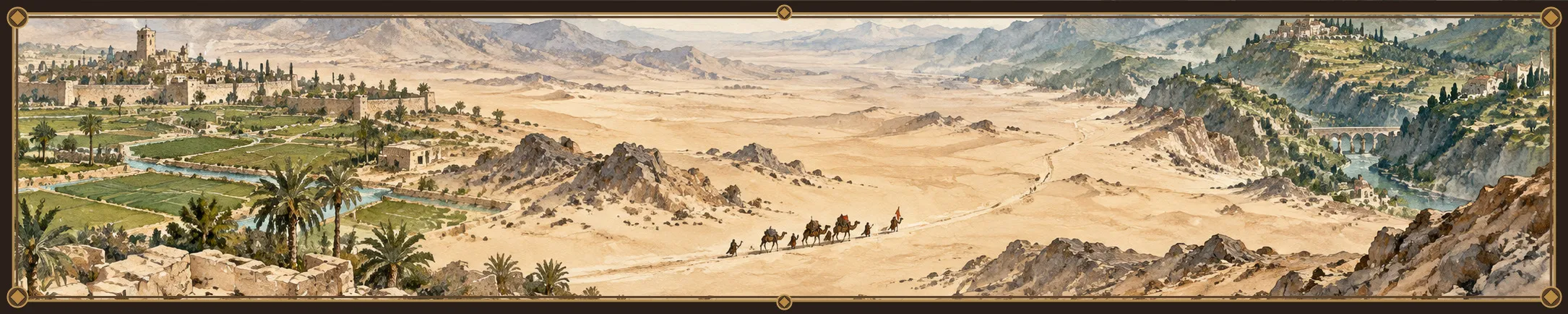
I kept tolls on the Serath for most of my working life and thought I knew what a road was: a thing somebody holds, and takes his toll on, for as long as he can hold it. Then I went out across the glass and found a whole half of the world holding its roads in ways no League toll-house has heard of, and between the two halves a desert that nobody holds at all, where the dead walk the old shorelines and the sand keeps what it takes. I have written both halves down as I found them, tolls and tallies first, because that is the only way I know how to see a country. The rest I have written down because nobody would believe me otherwise.
A Road-Book of Both Halves
Ask a basin farmer how wide the world is and the answer comes at once: as wide as the Serath runs, as high as the holds, as deep as the forest lets a stranger walk. Ask a Gnome pilot on the Tidelace and the answer comes just as quickly and is entirely different: as far as the last beacon, and not one sounding further. Neither of them is wrong, and neither has any reason to think of the other. Medieval Caeldon is two inhabited halves that keep separate lords, separate gods, and separate harvests, joined across a desert by one road that almost nobody walks. The cradle-web is old, crowded, and quarrelsome: the ground on which Elves and Dwarves have fought and feuded for half a million years, and on which Humans, far younger, have joined the quarrel with steel and made it louder. The far side is just as old in its own way, a country of wind, folds, tides, and returning waters, where Orcs, Halflings, Gnomes, Thaluren, and Kavari fought out their customs of water and passage without ever hearing of the cradle’s. Between the two lies the Glassbelt, where furnace-lords' vaults lie under the sand. Beyond them lies a sea no one has crossed, and around them a planet no one has charted.
Not One World but Two
The first thing to understand about medieval Caeldon is that the map most of its people carry in their heads is a map of half of it. The crowded country that the oldest histories tell of, where the first great wars between peoples were fought and the first great settlements made, is one gathering of peoples on the planet, not the planet itself. It is called the cradle-web, because so much began there and so much of it is tangled together. Forest, mountain, and river basin press against one another; every border has a people on each side of it and often a third living in the border itself; and nearly every crossing has more than one house that wants to hold it. But that crowding belongs to this one country. It is not how Caeldon is everywhere.
On the far side of a desert lies the second half, called simply the far side. It is not a frontier of the cradle-web, and it was not settled from it. It has its own peoples, who became themselves on its own ground; its own orders, as old as many in the cradle; and its own heart, which lies nowhere near any forest or hold. Its quarrels are over wells, soundings, harbours, and spawning water, and a cradle lord would find most of them strange and all of them familiar: whoever holds the water decides who drinks.
What joins the two is a single overland route across the Glassbelt Interior, Caeldon’s first true desert, and it is not a road in any sense a League toll-keeper would recognize. No power on either side deals with any power on the other. No league or lord has an envoy, an oath, or a toll on the far half. No Human caravan or settler makes the crossing, and no sea route joins the halves. The people who do cross are road peoples, who have no land to speak of on either side and who keep the way across because keeping ways is what they do. They carry goods, news, marks, and gods, a little at a time, and they are the reason a traveller who has seen both halves keeps meeting the same faces at the hardest crossings of each.
The pages that follow walk the cradle-web first, then the far side, then the desert between them and the edges where every map stops. The atlas parts of this book go region by region; this chapter keeps to the shape of the whole.
The Shape of the Land
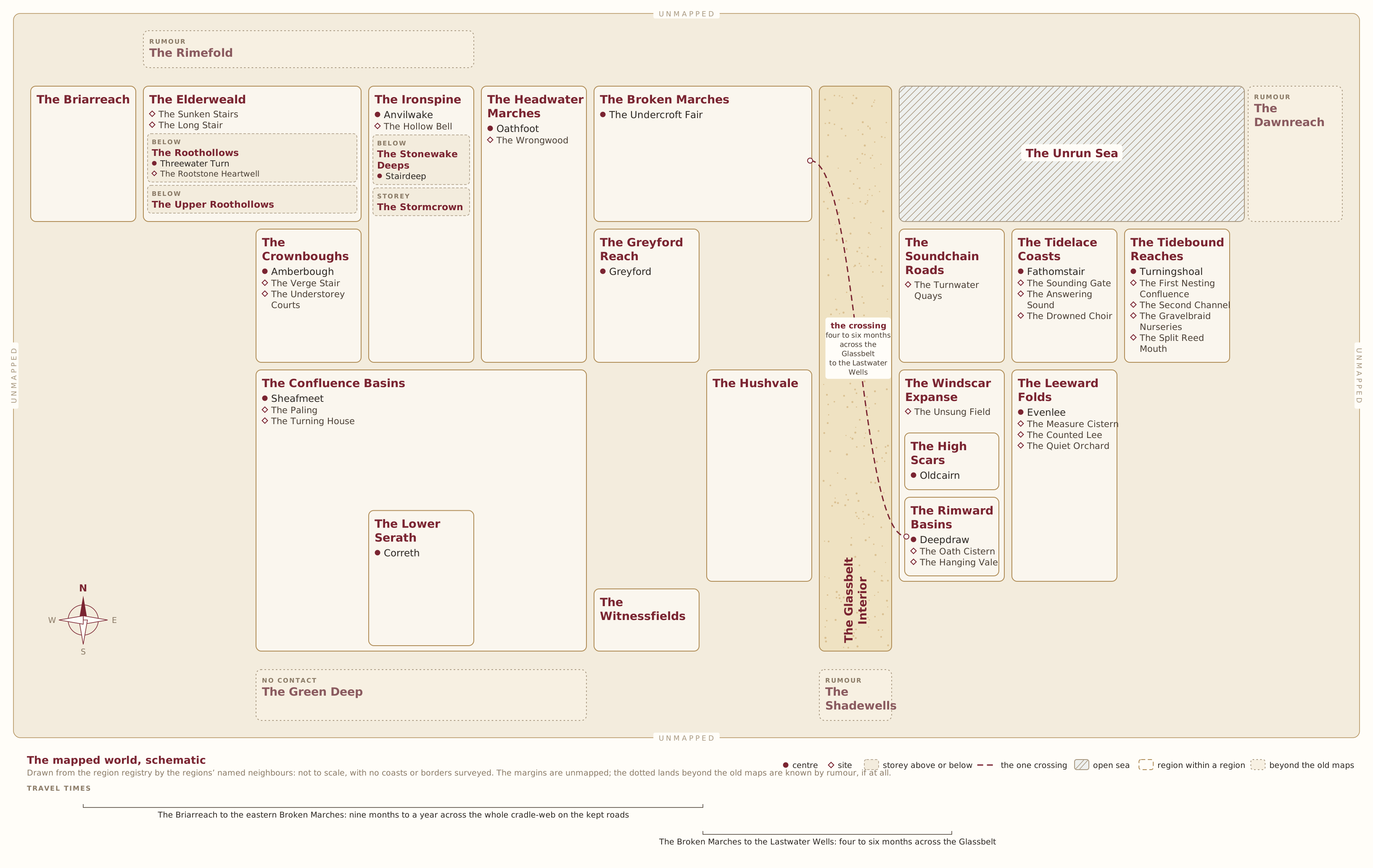
Seen whole, the known world is one long landmass. The cradle-web holds its west, the far side its east, and between them lies the Glassbelt, a desert that runs north and south further than anyone has followed it. Off the far side’s northern and eastern coasts lies the Unrun Sea. Beyond those edges nothing is mapped: not the cradle-web’s north or south, not the ends of the desert, not the uplands behind the far side. The map in this chapter dots in four lands there that no medieval map shows; they are told at the end of the chapter. Nobody on Caeldon measures any of it in miles. Distances are told in days, weeks, and months of ordinary travel, on foot, by cart where there are roads, by boat where the water carries, in fair weather and in a company that knows the way. The land is very large and most of it is wild. People live in protected cores (river corridors, hold valleys, grove rings, fold terraces) with wide, deadly country between them, where wolves, raiders, and older things wait, and nobody goes from one core to the next except in an armed company on a kept road.
The Cradle-Web Laid Out
The cradle-web is built around one range and one river. The Ironspine runs north to south through its middle, some four months' walk long as far as anyone has mapped it, with the bare crest of the Stormcrown along its top and the Stonewake Deeps far beneath its middle; a summer pass takes two or three weeks to cross it. The forest lies along its western face: the Elderweald in the north-west, the Crownboughs to its south-east in the corner where forest meets mountain, and the Briarreach in a broken belt along the Elderweald’s western and south-western edge, with the Roothollows under the eastern Elderweald. The foothills lie along the eastern face: the Headwater Marches below the southern half of the range, the Broken Marches north and east of them behind the March Wall, and the Greyford Reach on its river where the two Marches meet.
Every river runs off the Ironspine and gathers southwards. The Headwater rivers come down the eastern face and bend south-west, the forest streams run south out of the Elderweald, and in the Confluence Basins, the wide valley country below forest and foothills, they join valley by valley into the Serath, which carries the corridor of the Lower Serath south towards an end nobody has mapped. The sealed Witnessfields lie on dry uplands east of the lower river. In the south-east, past the last Headwater hills, rough country climbs to an unnamed range at the desert’s edge, and at its eastern foot lies the fog of the Hushvale.
The distances are long by any measure. A grain barge takes about four weeks from Sheafmeet in the middle valleys down to Correth and two months or more to come back up by towpath and road; a cart takes about two months from Sheafmeet to Oathfoot under the gates. A company crossing the whole cradle-web, from the Briarreach in the west to the desert margins of the Broken Marches in the east, needs nine months to a year on the kept roads, and pays a toll at every bridge and ford that someone is strong enough to hold.
The Crossing and the Far Side
The crossing runs west to east, from the eastern ruin margins of the Broken Marches, with the Hushvale’s fog two or three weeks south of the track, to the Lastwater Wells on the inland rim of the Rimward Basins. Well to well it takes four to six months on foot with pack animals, and nobody starts it in the hot months.
The far side runs from a dry west to a wet northern coast, with two walls of rock between. The Windscar Expanse fills the west against the desert, under a dry wind off the Glassbelt. Its closed Rimward Basins lie in the south-west; north and east of them the land climbs the Shearline, a great escarpment facing south over the basin rims, into the shelves and passes of the High Scars, and beyond the Scars dry country runs on north to sea cliffs. East of the Basins, behind the north-south ridge of the Lee Wall, lie the Leeward Folds. The coast runs along the far side’s north from west to east: the Soundchain Roads below the Windscar cliffs, then the inner harbours of the Tidelace Coasts behind their island chains, facing the Folds inland, and at its eastern end the river mouths of the Tidebound Reaches, whose longer rivers come north out of unmapped uplands. The Windscar has no rivers at all, and the Folds send only short ones north to the Tidelace estuaries.
Here the distances are emptier. From the Lastwater Wells to Deepdraw is three or four weeks, and from Deepdraw the escorted Lee Road needs seven or eight more over the Lee Wall to the first fold. From the desert rim to the sea is about four months overland, and the longest escort routes take two or three months from Oldcairn on its high shelf down to the Turnwater Quays. Along the coast it is four or five weeks by pilot craft from Turnwater to Fathomstair and about three weeks' sail on to the Split Reed Mouth.
The Peoples in Numbers
Some 5.3 million people live in the mapped world, very few for so much land, and the halves are nowhere near the same size. The cradle-web holds about 4.5 million of them; the far side holds about 800,000, roughly as many as live along the Lower Serath alone. Humans are nearly two in three of everyone, and almost all of them live in the Confluence Basins, the most populous region on Caeldon with some 2.4 million people, and along the Lower Serath, where 600,000 to 800,000 crowd the corridor more tightly than anywhere else. The Headwater Marches follow with about 400,000 and the Ironspine with about 320,000, most of them Dwarves; the three forest heartlands hold some 290,000 together, the Broken Marches perhaps 120,000, the Stonewake Deeps 80,000, and the Roothollows 40,000. On the far side the Halflings of the Leeward Folds are the largest people, about 240,000; the Orcs of the Windscar and the Gnomes of the coast number some 180,000 each, and the Thaluren and Kavari of the Tidebound Reaches about 140,000 together.
Towns are few. Correth on the Serath, with forty thousand or more, is the largest in the world. Truesound on the Tidelace and Anvilwake in the Ironspine hold some twenty thousand each; Sheafmeet, Oathfoot, Pellith, Stairdeep, and the court seat of Amberbough ten thousand or so. Everyone else, in either half, lives in a village, a grove, a hold, a fold, a station, or a camp of a few dozen households, behind a palisade, a hedge, a gate, or a wall of slings, and every core holds far more of them than any map names. The atlas parts give each region’s people in turn.
The Cradle-Web
The cradle-web is the best-remembered country on Caeldon, and the most crowded. Its oldest peoples have lived in it for something like half a million years. Its Human lords have been building in it, fighting in it, and writing it down for some forty thousand. Most of what any writer will first imagine of medieval Caeldon (walled river towns, Dwarven gates in a mountain face, an Elven forest that will not be cleared, a lord’s hall loud with a quarrel over a failing bridge, a sealed door with something knocking behind it) is cradle-web material.
Forest
At its heart stands the Elderweald, the old-growth forest at the centre of the Elven world, home of the Wood Elves and of the Rootcrown Concord. Its paths are walked open rather than cut, its dead are given back to the living ground among the trees, and its groves have quarrelled with the Ironspine over water for more than four hundred thousand years and with the basin farmers for nearly forty thousand. Bears den under its root-mat, moss-coated deer walk in its oldest groves, and barred stairs lead down from it into a drowned world. Every other Elven heartland began as part of it. The Crownboughs, in the forest’s south-eastern corner against the mountains, are a cultivated canopy where trees have been trained into halls and terraces over more lifetimes than most peoples have history, the homeland of the High Elves and their Crownbough Courts; behind the polished face its great houses turn outward lie blood duels on garden-walks above the drop and dead halls where the silver mirrors still hang. The Briarreach, at the forest’s harder edge, is a belt of thicket and wet ravine where the Thorn Elves of the Thornbound Circles learned to remember Caeldon as dangerous rather than generous. Arrows come out of its hedges at anyone who walks in unasked, and Troll houses keep its ravine crossings and make every traveller pay.
Beneath and beside the forest lie the Roothollows, root-caverns where the forest’s roots come down through the ceiling and grow into the stone. The Dark Elves of the Gloamroot Covenant live there in house chamber-clusters strung along their Known Ways, under an old oath that a refugee at the door must be let in. Above them, between the deep groves and the surviving hollows, lies a storey nobody enters: the Upper Roothollows, drowned and barred in a catastrophe more than three hundred thousand years ago, a drowned kingdom both sides can point to and neither can reach, its dead unburied and its house-treasures where the water left them.
Stone and the Deep
Beside the forest runs the Ironspine, a long mountain belt and the oldest Dwarven homeland, its holds cut into the mountain faces and its mines and underways running down into the rock. No throne rules it. Each hold rules itself under the Ironspine Holds, bound to the others by very old oaths about what must be kept standing. Its gates have held against sieges older than Human memory, and its abandoned holds lie open to anyone who dares the dark and the bad air. Far below the mountain holds lie the Stonewake Deeps, the deep central hold-cluster of the Stonewake Compact, where more of the lower world’s routes and water converge than anywhere else, and where a sealed door is at once a hold-elder’s judgement, a prayer, and a border. Behind some of those doors something still knocks. The Deeps' edge towards the Roothollows has been fought over with the Dark Elves for more than three hundred thousand years.
Above the holds the Stormcrown rises into bare ridges and storm shelves where the vanished Upland Colossal world left its terraces, ridge roads, and weather shrines, and giants' tombs that no one has opened. No hold or lord has ever held it. Its lower edge is where the holds' gate-watch and the Headwater lords' grants give out and a taboo takes over.
Basin and March
Down from the mountains the rivers fall into the Confluence Basins, the broad lowland heartland of Humans: wide valleys, deep fields, and linked rivers gathering towards the Serath. More Humans live by the plough here than anywhere else, and the Confluence Marches, the first great Human civilization, are a field of lords, walled towns, and shifting alliances held together by no crown, only by shared habit: the same gods, the same oaths, and the same ways of ending a quarrel, by sworn word, blood-price, or the sword. Plenty draws hunger, and the Basins have outlaws in the flood-forest, wolves at the folds in hard winters, lords who burn each other’s barns, and the drowned who walk back out of the river in spring. The Reedfolk kept the lower waters as the Floodkeeper Houses long before the first basin town and still do. On the river’s lower course the Lower Serath is a crowded corridor of walled towns bound into the Serathic League by sworn oaths and the fear of breaking them rather than by a crown, with river-thieves in the reeds and wreckers above the shoals.
Upstream, the Headwater Marches are foothill country between the Human farmland and the Dwarven mountains, the oldest shared country of Humans and Dwarves on Caeldon, living by the escorted exchange roads that climb from basin granaries to the hold gates and by the swords that guard them. Beyond the March Wall the country goes feral: the Broken Marches are a ruin-belt of failed works and broken routes where nobody rules, the main regional home of the Goblins, and a place where Kobolds, Wrought, Ogres, Trolls, Salvage Peoples, and Humans in trouble all make a living from what stronger ages left behind. Vault-breakers strip its cellars, bounty-takers hunt its tunnels, and outlaws hold its roads. Where the two Marches meet stands the Greyford Reach, with its patched bridge, its two banks, and its quarrel over who pays to keep the crossing standing and who takes the toll.
East of the Lower Serath, where the basin fields thin into dry upland, lie the Witnessfields, the sealed homeland of the elder Archive-Law world: terraces, marker roads lined with inscribed stones, and archive-cities whose gates have been shut for more than a hundred thousand years. Nobody lives there, and every treasure-seeker on the Serath has heard what might lie behind a gate that has never been forced: the wealth of a world that wrote down everything it owned.
The Character of the Cradle
The cradle-web is layered. A traveller who walks across it in a year passes more history than most far-side peoples keep in a lifetime, and is reminded of it at every toll. Colossal roads run along the heights of the Ironspine and through the Broken Marches on grades no living builder could lay. Dwarven bridges older than the towns beside them carry the Headwater road. Inscribed marker stones in the Witnessfields go on watching with nobody left to watch. Some Headwater road sections still carry the camp-marks of the debt-bound Ogre camps that built them, and no Ogre band will cut those marks away. The present lives on all of it, and the oldest grudges in the cradle are older than the people now nursing them.
It is also crowded with peoples who need one another and resent the need. Elves and Dwarves meet across the forest verges and the Verge Stair. Humans live between them, borrowing Dwarven craft and High Elf ceremony and resented for both. Reedfolk keep river knowledge the Human towns cannot do without and have almost no say in what the towns decide. Goblins live inside Dwarven hold walls on seams their ancestors held before there were holds. Kobold crews keep the narrow underwork of the mines. Wrought descended from Dwarven workframes work the forges and keep repair houses in the foothill towns. Ogre bands carry the heavy loads under sworn terms, Troll houses keep the worst crossings, and Edgeway kindreds walk their circuits between the ruins. Giants are rare enough to be rumour.
Its faiths are as crowded as its roads. The Sworn Accord of the Human corridor world enters its gods by name in every oath-house: Anvelle the Harvest-Mother at the first sheaf, Serovan the River-King at the spring rise, Ostrin the Lantern-Bearer for those who want to know where the toll money went. The Held Covenant asks its questions at every Dwarven gate under Kerrund the Stone-Warden. The Ordered Bough keeps the High Elf temple-gardens. Under and around them run the gods of the people who count for less: Varn the Shadow-Stalker in the ruins, Tavi the Bard of the Broken at Compact gatherings, Abrel the Changeling for Headwater youths caught between two peoples, Ghessa the Hearth-Mother at Ogre fires, and Ennor the Grave-Watcher at the graves of most cradle peoples, who honour him under names of their own.
The Far Side
The far side lies well outside the cradle-web, and its peoples became themselves there. Its first named orders are a hundred and fifty thousand years old and more, and most of the customs they still live by were fought out in a long chain of feuds, raids, and wars between about 160,000 and 98,000 BR, in the age the histories call the Far-Side Terms. Each time the stronger side dictated terms, and the terms that held became the custom of the far side for the rest of its history. Later far-side songs look back to them and add nothing new. A Gnome harbour family that points to terms older than the first Human town in the basins is doing nothing unusual.
Wind
The Windscar Expanse is the far side’s exposed heart: dry uplands, escarpments, and interior basins with salt or dust floors, desert-edge rather than true desert, defined less by any one place than by scale, separation, and the hard work of staying alive and remembered across it. Its people are the Orcs, its civilization the Windscar Pacts. Packs of dun dogs follow the herds and take stragglers, raiders wait at the wells for parties weakened by the crossing, and a circle of scar vultures over a pass tells an escort that someone did not get through. It has two halves of its own. The High Scars are the travelling half: wind-broken shelves and storm-cut passes held by moving escorts, where a road is not a built surface but a line of knowledge, cairn chains across the shelves and passward shelters at either end of the exposed stretches. On the fading cairn-lines stand the Cairn-Wakers, escorts who failed to warn and cannot rest. The Rimward Basins below are the anchored half: closed basins whose rims carry the strongholds, defended wells, and rock-cut cisterns that let Orc life stay in one place long enough to matter. The inland rim of the Rimward Basins is the edge of the whole Windscar, and beyond it the wells give out.
Fold
Past a ridge that takes the wind for them lie the Leeward Folds, the Windscar’s opposite: sheltered hollows, stepped terraces, orchard belts, and cistern-fed valleys, the first named homeland of the Halflings and of the Foldward Commons. No town rules them. What binds them is a conviction every child learns before it can count far, that a good fold can be eaten by its own success, and in a dry year every hungry band on the far side remembers where the water is. Orc escorts from the Windscar side and Gnome traders from the coast reach the Folds constantly, and are fed, watered, and traded with at the fold edges; almost none of them ever walk up the terraces. Those who try uninvited, thieves and raiders alike, meet the fold’s young on the walls with slings.
Shore
Seaward the land breaks into the Tidelace Coasts, a broken coast of inlets, island chains, tidal straits, cliff harbours, and fog belts where nobody enters the sea without reading it first. They are the homeland of the Gnomes and the heartland of the Gaugeward Leagues, a league of harbour towns without a capital, held together by soundings, beacons, breakwaters, and old harbour families who say who may come in and when. It is a beautiful coast and a hungry one: the fog hides drowned crews, the shoals hide drowned harbours, and on the darkest nights there are fires on the headlands that no Gnome lit. Along the coast’s outer, Windscar-facing edge runs the Soundchain Roads, a chain of roadsteads, lee sounds, transfer quays, and pilot stations where escorted Orc parties come down the cliff stairs and are met, counted, and fed by Gnome station crews who keep their inner harbours behind them.
Return
Further along the far shore the Tidebound Reaches bind sea and river into one water-world: pelagic current roads, shoal and reef settlements, estuaries, and upriver spawning approaches. The Thaluren live their whole ordinary lives at sea and come upriver only to spawn, and the Returning Concord holds the Reaches together not as a realm with a border but as a chain of waters held by custom, in which every keeper knows the others' place. It is a perilous road: sharks wait at the mouths for the young, pike-jawed hunters raid the spawning beds, and on the farthest currents something vast breaks the runs that go too far. Upriver the runs reach freshwater that is already someone’s home: the tributaries of the Kavari, whose Bankright Circles hold the rootbank villages, deep pools, and nursery gravels all year round with barbed spears.
The Character of the Far Side
The far side is not one frontier mood. Its three great landward homelands meet hard country in three different ways. Orcs cross it by escorted passage and hard covenant, Halflings hold it by bounded plenty and reserve custom, and Gnomes chart it closely enough to live on without ever calling it tame. The water peoples add a fourth way, a return that must come home whole through every water it crosses. A far-side traveller is asked different questions at every border: who brought you, what can be spared you, when you said you would come, which run you came up with.
Its peoples meet one another constantly, and almost never anyone from the cradle. Orc escorts bring parties to the Halfling fold markets and to the Gnome stations. Gnome pilots and Thaluren run-watchers share the estuaries under terms first set at the Split Reed Mouth. Thaluren and Kavari meet wherever a run climbs into resident water, and not always in peace. Ogre burden-camps come up to the High Scars for heavy work, and Troll crossing houses hold the worst passes; both reached the far side by the one crossing. And on the Tidelace live a few coastal Humans, in hamlets on the beaches and outer coves between the Gnome harbours, fishing from small open boats under Gnome harbour custom. Their ancestors drifted out along coasts and river mouths during the Unrecorded Age, and nobody recorded the journey. They have no Sworn Accord, no memory of the basins, and no knowledge that the cradle exists.
Its faiths are its own. The Thaluren keep the Way of Return, the only organized religion on Caeldon with no god at its centre: its doctrine is the rightful return and its pilgrimage the run itself. The Windscar belongs to two Orc gods, Ushkar the Ancestor-Warden, who keeps the names of those who held passage and strikes the names of those who broke it, and Rakhal the Storm-Caller, the wind that breaks whatever has gone stale. The folds keep Tamsel the Season-Weaver at the Festival of the Turn. Gnome harbour towns and Human hamlets alike keep shrines to Maris of the Tides. The cradle’s gods are almost unknown here, except where the crossers carried them.
How the Halves Differ
Set side by side, the two halves answer the same questions in different ways, and the differences are a writer’s best tool for telling a reader which half a story stands in.
The cradle is crowded; the far side is wide. A cradle traveller is never far from someone else’s border, and someone else’s toll. A far-side traveller is often far from anyone at all, and the question is less whose ground this is than whether the next water will be there. In the cradle every bridge, ford, and pass has a lord or a house that holds it and a rival who wants it; on the far side the few places where everyone must stop, a well, a cistern hall, a beach yard, an estuary, are the places worth fighting for.
The cradle writes; the far side counts and sounds. In the basins a bargain is sworn aloud before kin and priest and written down, and a careful scribe keeps a second copy somewhere else, though what is written records only what the stronger party has already decided. On the far side the reserve is counted aloud at the cistern hall, a sounding family’s mark is cut on every post it sets, and an escort’s name rests on whether the parties it guided arrived. Both halves care intensely about remembering. They disagree about what is worth remembering, and how.
The cradle’s oldest quarrels are about rank, refuge, and ground: which people is the elder, who abandoned whom in the deep, whether a settlement owes anything to the forest it cleared. The far side’s are about water and timing: whether a delay was honest, whether a well was hoarded, whether a run came home rightly. Both are quarrels about who counts. They are fought with different weapons.
Some kinds of country occur on both sides. Old roads and burden routes run through the Headwater Marches and across the High Scars; wounded crossings and bad passes exist in the Briarreach and on the Whetgap; frontier settlements with hard seasonal work stand on both sides of the desert. But the peoples in them differ. On the cradle roads Humans and Goblins keep the escort; on the far-side passes it is Orcs. Ogres work on both sides, and Trolls keep crossings on both, and rare Giants are rumoured on the high shelves of each. Humans of the inland cradle and Orcs never meet. Neither do the Reedfolk of the cradle rivers and the Thaluren or Kavari of the far side, though all three hold that water is kin and memory as much as terrain, and would understand one another’s quarrels at once.
The far side keeps its own memory of its own past, in harbour tallies and by voice, unknown to the cradle. The cradle’s memory of the Unrecorded Age is fragments in Dwarven archives, Floodkeeper house-memory, and sealed archive-cities. Neither half reads the other’s.
The One Crossing
The two halves touch in one place only.
The Ground
The Glassbelt Interior begins where the Windscar’s last defended water gives out. On the inland rim of the Rimward Basins a chain of defended wells on the outermost spurs, the Lastwater Wells, marks the last water any Pact custodian keeps. No oath drew that edge. The land drew it, with help from the old overburn of the Ash-Furnace world. Parties going out drink there for the last time. Parties coming in reach it first, often in poor shape, and not always as friends: last season a party of desert crossers refused at one well came back with a struck-name band and took it.
Beyond, the country is salt pans and the dry floors of a vanished inland sea, ash-coloured flats, stone deserts, ruin fields, and the glassed ground that gives the desert its name. It was dry before anyone lived in it, and people made it worse twice: the overburn of the Ash-Furnace world, and a salt-people whose devotion to preservation helped kill their own sea. It is a country of dead fire and dead sea, where the salt-crusted dead walk the old shorelines at night, figures fused into the ruins whisper after those who rob them, and every crosser has heard of a furnace-lord’s treasure-vault that the sand uncovers once a lifetime and covers again. The desert as crossers know it is told in The Windscar.
Its other edge faces the cradle-web, at the foot of an unnamed mountain range, where the desert gives way to the cradle and the fog of the Hushvale stands on the horizon.
Who Crosses
The Glassbelt is not empty. It is sparsely inhabited at its edges, unevenly crossed, and survivable only through route memory, guarded water, salvage caution, and respect for distances that cannot be forced. No people owns it, and no power has ever claimed the whole.
Windscar peoples know its edges and a few crossing routes, especially from the Rimward Basins and the High Scars, but the deep Glassbelt is no Orc homeland. Orc escorts keep to its Windscar edge, and no escort captain treats a commission into it as ordinary work. The whole way across goes only with a few road peoples:
-
Edgeway kindreds. A few kindreds of the Salvage Peoples run circuits all the way across, keeping the ruin fields of the Glassbelt as they keep the Broken Marches, and knowing where the never-touch ground lies. The oldest never-touch forms of their danger-marks descend from warnings set around vitrified Ash-Furnace ground. That is why kindred marks turn up on both sides. They hunt well-raiders without mercy, and a raider they take is left staked by the well he robbed.
-
Troll crossing houses. A few houses of the Crossing-Oath Houses keep the way across, which is why house orders stand both in the Headwater and Broken Marches and on the far-side passes of the High Scars.
-
Ogre burden orders. Some burden orders of the Hearth-Weight Compacts know the crossing too. The Compacts formed along the Headwater roads; their terms reached the far-side camps through these few orders.
-
Salvagers. A scatter of Goblin and Wrought salvagers among the Salvage Peoples work the desert’s ruins and cross with what they find.
None of them owns the region. All of them are people with no land of their own, who are worth something because they keep, carry, and know. That is the whole answer to why the Glassbelt is crossed at all: the only peoples who can live by a road nobody else will keep are the peoples who live by keeping roads. Now and then a band of treasure-seekers out of the Broken Marches tries the near ruins without a kindred guide. The kindreds find their camps afterwards, and sometimes their maps, which are sold again at the Undercroft Fair to the next band.
What Crosses with Them
The crossers carry little in bulk. What they carry is custom, and it has left its mark on both halves.
They carry gods. Troll houses swear their crossing-oaths under the title of the Mountain-Father on the High Scars as they do in the Briarreach and the Broken Marches. Ogre camps keep Ghessa the Hearth-Mother at their fires on the far side only where the burden orders of the crossing carried her. Corrow the Gale-Runner, god of the moving kindreds, goes wherever their circuits go, and across the ruin fields of the Glassbelt, where the kindreds keep the crossing, there is always another camp being told to move on. And Ennor the Grave-Watcher, who sits at the graves of most cradle peoples, is known beyond the cradle only where the crossing peoples keep him at their own graves along far-side routes. The far-side peoples otherwise finish their dead under gods of their own. Ennor has no Orc worship. Among the Orcs the dead belong to Ushkar, who keeps those who held passage and strikes those who broke it, and the two gods meet only where crossing peoples bury their dead along routes the Windscar escorts also keep.
They carry custom. Hearth-weight, the Ogre rule that a camp is fed and sheltered before it lifts anything, is the same on the High Scars as on the Headwater roads, and a far-side escort captain who hires a burden-camp to clear the Whetgap meets terms a Headwater lord would know, and learns, as the lord did, that the camp will not lift until it is fed. The Troll houses hold their crossings by oath on both sides of the desert, decide when a crossing is too dangerous to use, and take their price for keeping it. Kindred keepright, which belongs to whoever has kept a work alive across generations, goes wherever the circuits go, and lords on both sides laugh at it.
They carry people. Half-Orcs, rare individuals of Human and Orc parentage, are born where crossing kindred routes meet Windscar escorts, or on the Tidelace coast. They are not a stable or widespread line, and their lives sit where mixed-world life meets the hard duties and harsh judgement of the Windscar.
And they carry news, though the halves make little use of it. Whatever passes between them passes with the crossers, at the speed of a camp on foot. The salvage carried with it is another matter: fused glass and old metal from the furnace scars fetch good prices in the Broken Marches, and the kindreds say none of it is clean.
The Fog at the Far End
At the Glassbelt’s cradle-facing edge, at the foot of the unnamed range, lies the Hushvale, a basin and valley chain under fog that never lifts since a waking Record-engine and the rite that hid its survivors sealed it around c. 1,200 CR. Nobody has come out in more than a century; its story is told in Sealed and Silent Places.
To those who make the crossing, the Hushvale is fog on the horizon at the desert’s cradle end, a route nobody takes, and a danger-mark that means do not go further. Still people go: delvers after gravesalt, a grey-white residue said to keep a corpse fresh and an oath unbroken; outlaws who think the fog safer than a lord’s gallows, and the bounty-takers who follow them; and the kind of fool who has heard that under the mountain lies a vault of the dead older than any kingdom. Rumours of the salt reach the Glassbelt’s salt-traders. The thing itself is almost unknown outside.
The Edges of the Known
Every medieval map of Caeldon ends somewhere, and the edges are as much a part of the world as its centres. Some are edges of ground nobody can cross. Some are edges inside the cradle itself, places people can point to and cannot enter.
Sealed Places Within
The cradle-web holds several countries that are known only from outside. The Upper Roothollows have been barred for more than three hundred thousand years; the forest keeps the tops of the stairs that once led down, the deep world keeps the names of what lay at the bottom, and nobody enters between. The Witnessfields stand uninhabited, their archive-cities not ruined so much as shut, and the most careful scholars and salvagers stop at the gates; the herders who face the markers pray no one ever goes further. The Stormcrown is left unmapped above the Long Tread and the kindred circuits: nobody below knows where its hidden basins lie, how many Giant lines still live in them, or which summit, if any, the Mountain-Father sleeps beneath, and something under the summits beats like a heart. And the Hushvale, the youngest of them, lies at the cradle’s desert edge with its fog and its forgetting. The atlas walks each of them; here it is enough that the cradle, for all its crowding, has holes in it, and that each hole is somebody’s treasure-dream.
The Unrun Sea
Off the far-side coasts lies the Unrun Sea, the open ocean seaward of every known water: past the farthest current roads of the Tidebound Reaches, past the outer isles of the Tidelace, past the fog banks off the Soundchain Roads. The name is a Thaluren way of speaking. A run is a path laid by those who swim it and remembered by those who come home, and no run has ever been laid through this water and come home.
Its near edge is simply where every keeper stops. No elder of the Returning Concord answers for it, and no Gaugeward harbour claims water past its last beacon. Each people on its edge has its own reason to stay out. The Thaluren live for the return, and their custom has nothing to say about water that leads nowhere they can rightly reach again; the Outer-Route lines go farthest, and their memory keeps runs that pressed past the known roads and came back late, scattered, or not at all. Gnome pilots will not enter water they cannot read, and open sea cannot be re-sounded or marked. Craft driven past the last beacon by storm or fog have come home with readings no second craft could confirm, and the sounding houses do not enter them in their tallies: precise and true are not the same word. One came home with a crew too frightened to sail again and a brass instrument no Gnome had made, which a Truesound gauge house has kept locked away ever since; thieves have broken in twice to reach it, and the second pair were found drowned in the harbour with nothing in their hands. The Tidelace Humans fish close inshore, and their tales say nothing of what lies beyond the sea.
What is known is mostly memory. The Far Set, the outermost current road the Thaluren know, is marked by nothing else, and the water beyond it is the Unrun Sea. The great fog belt the coast calls the Long Grey rolls in off this water with little warning and can shut the outer roads for days. Thaluren ocean memory places great whale-like deep-witnesses there, said never to stop growing, honoured without being prayed to, and squid-like devourers that break routes; a current road where a devourer has been sensed is not trusted until a later run has come through it whole. Now and then weed-rafts, strange wreckage, and a nameless hull drift in to the coast. To a wrecker a nameless hull is a treasure-ship, its hold full of goods no market has seen; to a pilot it is proof that someone out there sails, and that whatever emptied the hull is still out there with them.
The Rest of the Planet
Past these edges nobody on Caeldon can say what lies. Whether there are other continents, polar lands, or other climates; where the Unrun Sea ends and what lies across it; whether islands break it anywhere; whether any of the lost Outer-Route runs found water to live in: the peoples of both halves have no answer, and most have never had a reason to ask. The Glassbelt’s own interior keeps its secrets too. Crossers tell of oasis towns deep in the interior and of lamps seen at night where no well is marked, and every circuit has a crosser who will swear, after the last of the water is shared out, that he saw towers in the heat beyond the mirage roads, and that the lamps were moving towards him.
The Tidelace Humans are the quiet proof that the world is wider than either half’s map. Their ancestors left the cradle so long ago that nobody remembers they left, and reached a shore no one in the basins would ever hear of. Other far-shore Humans may live on coasts no one has charted. The Tidelace hamlets are only the ones that are known.
Beyond the Map
The dotted lands at the edges of the map are what this book knows and the Medieval Era does not. Four lands lie past the old world’s maps, each with its own peoples, powers, and long history, and nobody in either half has seen one and come home to be believed. What reaches the old world is a wreck on the tide, a cloth passed through many hands, a road that runs north into the snow, and from the fourth, nothing at all. The broad strokes below are canon; the names of their cities, thrones, and dynasties, and most of what they remember, are left open.
The Dawnreach
Across the Unrun Sea, north-east of the far side, lies the Dawnreach: terraced river valleys under the monsoon, two thrones that hold their rivers by the sky’s favour and lose it in a dry year, bell monasteries hung in the mountain passes, and the island sea-kingdoms of the Lantern Isles. Its Humans have been apart from the cradle since the Unrecorded Age. In its wet forests live the Sihri, an insect-like people the height of a child, whose click-song is their speech, their memory, their warning, and their prayer. Along its river mouths live the Runs That Arrived, sea-folk descended from Thaluren Outer-Route runs that pressed past the Far Set long ago, found rivers to spawn in, and never came home; the Tidebound Reaches still call them the unreturning. To the far side the shore is a pilot’s tale of lights low on the horizon after a storm. The nameless hulls the wreckers strip are its island captains' funeral ships, sent west on a current with their dead and their wealth, and the brass instrument in the Truesound gauge house is one of its pilots' current-wheels. Nobody who opens a hull knows it.
The Shadewells
South beyond the deep Glassbelt, past a sand sea no crosser from the north has walked, stand the Shadewells: walled oasis towns sunk deep around their wells on the Salt Road, their streets roofed with great awnings, whose caravans travel by night behind star-reckoners paid like princes. Here a working takes its cost first from shade. It eats the shadows around it, and ground where great workings were done long ago lies as shadowless glare-fields where the sun burns twice and nothing grows. So the cities keep shade as other lands keep grain, in deep courtyards and under awnings of shade-cloth, and a working cast in a city takes from them before it takes from the wells, the herds, and the people; the shade-cloth weavers are among its powers. In the deep sand south of the road live the Shorn, Orc camel-clans descended from struck bands that walked south out of the Rimward country after the Rimward Passage War, and out of the dunes' old zones come things that drink the shade from whatever they pass. The old world has a cloth and a well. One Edgeway kindred’s longest circuit ends at the Bright Well, where strangers wait in the cool months under an awning of pale cloth to trade that cloth for salvage, and it goes on through the Lastwater Wells and the Soundchain quays to the Tidelace harbours, which call it foundling shade because nobody can say where it comes from. Under it the air stays cool in the full noon sun, and neither the kindred nor the strangers have ever told the other where they live.
The Rimefold
North of the Elderweald and the Ironspine, weeks of snow beyond the last forest and the last hold, lies the Rimefold: ice cliffs and fjords frozen nine months of the year, where Human clans hunt seals and small whales from the ice edge, set their dead standing in clear ice in the Asking Halls, and go up in the long dark to ask them for counsel. Behind the White Stair, a colossal flight cut into the coast cliffs, the Rimewrights keep their halls in the glaciers: a lesser line of the Giants who walked north out of the Stormcrown in the deep past, grew smaller in the cold, and are the last people on Caeldon who still build at the colossal scale. The old world knows only the road. The Long Tread runs north past the last gate hold and the last Edgeway cairn and on into the snow, and the caravans that followed it did not come back. Once in a generation a warden finds on it something that was not there before (a cord of braided whale sinew, a black-stone knife with a handle of white bone, a cairn of a shape no kindred builds), and the holds keep it and do not discuss it.
The Green Deep
Across a strait south of the cradle-web lies the Green Deep, and of it the old world knows nothing; even its name is this book’s. It is jungle over drowned stone: brown river-mazes braiding among islands, and in them, half sunk, the stepped cities of an elder world the old regions never knew. It is held by the Sollun, small six-limbed river people whose every hive is one mind in hundreds or thousands of bodies, and some of whose bodies, cut off too long from their hive’s song, have strayed into selves. The cradle peoples have no seagoing ships and know no coast on their southern side, and the Sollun do not cross open water. No wreck, no good, and no rumour has ever crossed the strait.
Going There
Writers may send explorers to any of the four, and a medieval expedition is an epic in itself: months of open water no pilot will enter, two months of sand beyond the last Glassbelt well, two months of snow on a road kept by no one, or a strait nobody has charted and the fevers on its far side. Whoever goes finds the broad strokes above and everything else for the story to make. Whoever comes back will not be believed.
Tensions
-
Graves on a shared route. Where crossing peoples bury their dead along routes the Windscar escorts also keep, Ennor’s custom and Ushkar’s meet at the same graves. Ushkar may strike a name; Ennor will not leave the one who bore it at the threshold. A crosser buried there under one god lies in ground the other people’s dead belong to.
-
What the sand uncovered. A Goblin salvager came in to the Lastwater Wells half-dead after the last storm season, with a furnace-lord’s seal of red glass and a tale of a vault door standing clear of the sand. Three crews are racing to outfit before the hot months close the crossing, and the Edgeway kindreds refuse to guide any of them until someone says whether the door stands on ground the Fused Dead keep.
-
South of the Expanse. Nobody has mapped what lies south of the Windscar Expanse. Herders tell of grass beyond the last well, of a dry river-bed lined with old stones, and of a kindred that went to look and never sent word. A band of hire-spears now says it found that kindred’s last camp-ring, its hearths cold and its spears still racked, and is selling the way to anyone who will pay; two kindreds are arming to go, one to bring the dead home and one, the first suspects, to take the grass. A kindred that took its herds there would graze ground no treaty-ground has ever heard of, and the Pacts have never said whether their oaths go with it.
-
The locked instrument. A Truesound sounding family wants the brass instrument no Gnome made, to follow its readings past the last beacon. The gauge house refuses; the family is hiring a crew anyway, among them hands from the wreckers' coast who say they have been aboard a nameless hull and know what it carried.