Chapter 18. How the Present Was Made
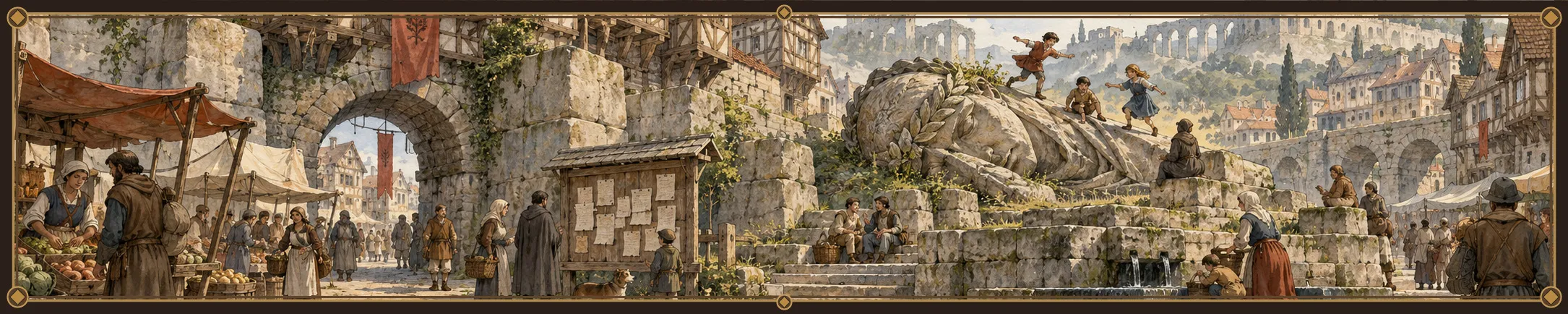
Nothing on this river is new. The channel was read by Reedfolk before there was a town to read it for; the stone of our quay was cut in the holds and paid for in grain; the road behind the wall was carried by a camp whose debt was never paid; and the oath we swear aloud at the toll-house was first sworn by people whose names the flood has taken. We copy it again this year so that someone will remember we kept it.
The Long Count
Almost nothing a traveller meets in the medieval present was made by the people who now use it. The roads were laid by vanished builders and widened by debt-bound camps. The oath-craft of the river towns came down through Reedfolk houses from an archive world that sealed its cities some hundred and twenty thousand years ago. The far side’s water was fought over so long ago that its songs look back to those terms and add nothing new. Elves and Dwarves carry grudges older than any living throne, and the youngest people on Caeldon remembers its own first owners by name. Two ages did most of the work of turning that inheritance into the world of c. 1,350 CR. In the Corridor Ages (c. 40,000-c. 2,000 BR) the Humans came into their own, fast and hungry, and took over, borrowed, or bent nearly every older order they touched. In the Settlement (c. 2,000 BR-c. 500 CR) the lordships, holds, leagues, and temples of the era dug in, most of them won by the sword, and the frames the roads had carried out of the mountains woke up among them. This chapter tells those two ages in full, and then follows each of the six old quarrels of Caeldon’s history to the place where it is still being fought.
Before the Corridor
The Humans were late. The first peoples of the cradle-web, the Elves of the Elderweald, the Dwarves of the Ironspine, and the threshold peoples of the broken ground between them, had become themselves half a million years before. The deep world had flooded and the Dark Elves had gone down into it more than three hundred thousand years before. The first Humans emerged in the basins in the crowded age of the Elder Worlds (c. 300,000-c. 220,000 BR), while the colossal road-builders, the furnace-keepers, and the archive-cities rose and fell around them, and for a very long time the Humans stayed small and local.
Then came the long dark of the Unrecorded Age (c. 120,000-c. 40,000 BR). When the archive-law world sealed its cities, writing in the cradle ended with it, and for eighty thousand years almost nothing was set down that later cradle peoples can read. What survives is house memory, songs, Reedfolk oath-keeping, the Dwarven and Elven chronicles those peoples keep to themselves, and ruins. Memory kept by voice even had its own god in that age, the Many-Named, worshipped by many peoples under their own names.
It was no empty age, and no peaceful one. For the Humans it was the age in which they became one people. In the Gathering of the Confluence (c. 120,000-c. 50,000 BR) valley paths were walked until they were expected, foothill crossings were remembered along with the people who died on them, and lowland villages, marcher bands, and guarded approaches began to count as parts of one widening country rather than as mere neighbours. Trust and guest-right reached farther than kinship, though a stranger was still safest under a strong host’s roof. Gorges took the path and the travellers on it in a wet spring, wolves followed the herds, and bands raided one another for stock and stores long after anyone remembered why. One idea won out over all the others: strength comes from linking unlike lands, not from making them alike. Every later Human people still answers to it.
Basin tellers set their oldest raid-tales in this age, where no written word can gainsay them: the cattle-raid over a single white heifer that began a feud longer than either village lasted, and the girl who walked into the raiders' camp under guest-right and walked out with her brother before anyone could decide whether to kill her. The plough and the delver’s spade still turn up the age itself: bones under old mounds, buried stores whose owners no song names, and the hearths of villages that were burned and never rebuilt.
In the same long silence Human bands slowly settled the foothills of the Headwater Marches (c. 70,000-c. 35,000 BR), and a few drifted far along the coasts to shores nobody in the basins would ever hear of; their descendants are the Human hamlets of the far Tidelace. On the far side, harbour ledgers kept their own count, unread by the cradle.
The Corridor Ages
Around c. 40,000 BR the scattered settlements of the basins and the foothills began to behave as one world, and the Humans began to matter to everyone else. What follows is not one story but several running side by side for thirty-eight thousand years: a people hardening into marches and strongholds in the basins, a river people losing its say without losing its use, a frontier with the Dwarves turning into roads, a river league learning that a kept promise is a weapon, Elven courts meeting a younger rival, and two peoples, the Ogres and the frames, set to carry the weight of all of it.
The Confluence Marches
The Confluence Marches (c. 40,000-c. 20,000 BR) did not begin with a capital forcing order on an empty basin. They began when the basin-headwater Humans outgrew their villages. Settlements crowded along the rivers; the foothill approaches were fought over again and again; grain from the deep basins fed the hard folk of the passes, and their spears kept the passes open for the grain, until no community could stand alone. What came first was a march, not a centre: a long border-country of strongholds and fords, held together because none of them could hold depth and edge alone.
There was no king’s hall over it and no hold-elders. A community counted if it could hold its own ground, keep its ford, and keep the thread to its neighbours. What bound the rest together was habit: trade, kin-ties, oaths sworn at crossings, and blood-prices paid when the oaths failed. Quarrels did not end. They were fought out with burned barns and ambushed carts until one side could no longer pay its fighters, and then they were sworn over. Wolves haunted the long roads in hard winters and outlaw bands the woods behind the fields, and in the basins lay elder ruins such as the colourless Paling, round its nameless archive city, where a night inside takes the morning’s memories and only the paid or the desperate go in.
Basin ballads love this age best: the ford held by twelve against a hundred, the burned barn answered with a burned hall, the marcher who rode into the Paling after a stolen bride and rode out the next day not knowing whose she was. The abandoned strongholds of the first Marches still stand on the foothill approaches, and treasure-diggers open their fallen cellars for the war-chests the feud-songs swear were buried before a last stand. Most find bones. Whenever later Humans quarrel over who is strong enough to rule, they reach back to the Marches, and in the medieval present they are still a churn of lords, walled towns, and alliances that last as long as they pay, rather than a crown.
With the Marches came writing. As the corridor towns rose, guarantees, tolls, debts, and ranks were written down again, and people no longer needed to hold the whole of a lineage or an oath in memory; they could look it up, or have it read to them. The belief that had sustained the Many-Named, that a story lives in the voice, gave way to the belief that it lives on the roll. Each people that took up writing stopped calling on him under its own name, and he went quiet a name at a time, while Annoth the Keeper of Scrolls, the goddess of the corridor’s scribes and record-houses, grew strong on the same change. The Unrecorded Age ended, in the cradle at least, not with an event but with a habit: a clerk at a crossing writing down who had paid.
The River and the Reedfolk
Down on the rivers, everything the Humans grew, they grew beside someone older. The Reedfolk had kept the lower waters as the Floodkeeper Houses for more than a hundred and fifty thousand years, and they knew what Human river towns needed above all else: which channels move, which banks fail, which flood years can be lived through, and which crossings lie about their depth.
The Lower River Absorptions (c. 30,000-c. 8,000 BR) were not one great war, and that is the point of them, though there was no shortage of force. The Floodkeeper Houses and the older channel leagues beside them were bargained with, learned from, hired, married into, bullied, quietly bypassed, and at last called local custom rather than lords of the water. For a long time it was a fair trade: Reedfolk flood-keepers advised and guided, and towns that could not have been built without them listened. What changed was not their skill but who decided. Once the river towns could swear guarantees among themselves and enforce them with armed boats and sellswords, the question of who may decide about water came apart from the question of who knows it, and Reedfolk say became Reedfolk service.
Not every house went quietly. Fen-dwellers driven off their reaches cut levees in the flood months, sheltered river-thieves for a share, and raided the towns that had taken their water; towns raised war-boats against people they still needed to steer them, and put bounties on whole houses. Some Reedfolk families still keep, wrapped in reed, the bounty-tallies their ancestors stole back. Some houses were taken in on fair terms and live on inside the later towns. Some were driven into fen, marsh, and shoal, where they shared the reeds with the outlaws the same towns had driven there. And some drowned, in the plainest sense: the drowned reed cities of Reedfolk memory belong to these ages, when channels cut for stronger powers swallowed people whose warnings no one strong had to heed.
Their shrines still stand in the shallows over dead who never had their rites. Treasure-seekers pay fen guides to take them out after the shrine-silver said to lie in the silt, and the guides take the money and stop at the edge of the shallows. Beyond it the drowned walk out of the water in the falling season as the River-Given, great catfish lie in the sunken streets, and the leeches are thick enough to bleed a wader white. Reedfolk grandmothers tell of pilots who took a cruel town’s barges into the Lying Shoals and swam home alone, and lower-river bargemen still curse a careless steersman with "may a Reedfolk pilot love you".
The swallowing carried something else downstream. The Floodkeeper Houses had kept the swearing and witness customs of the archive-law world since its keepers passed them on at the sealing of the cities, in the Last Keeping. When the river towns took Reedfolk water, they took those customs with it, usually without knowing where either came from, so the oath-craft the Serathic towns are proudest of is partly a Reedfolk inheritance. Some Floodkeeper houses say so. Serathic scribes rarely agree.
The gods of the river were made in the same long span. Serovan the River-King had no claim to be the river’s first master, but his cult grew strong as the towns took the river for themselves; where the Reedfolk asked who knows the water, the towns asked who holds it, and Aqua took the shape of a river lord around the second question. Some houses saw early what absorption meant: a house could keep its knowledge and its people and still lose itself, renamed as service inside an order it had not made. Their prayer for a self that cannot be dissolved condensed into Hesserin the Shattered Saint, cracked porcelain held together with veins of gold. She lived and faded within the Absorptions; as the last prayer for refusal went quiet and the houses accepted service, she shattered, and the current carried the pieces away. In some old crossing shrines a broken mirror mended with gold still hangs above the water, and fen bands that raid the towns' barges still nail a gold-mended shard over their camps.
The Headwater Alignments
Up in the foothills, Human settlement met the Dwarves, and the mountains decided the meeting before either people did. In the First Headwater-Ironspine Contacts (c. 34,000-c. 22,000 BR) the first Human bands pushing up the river-heads met no Dwarven kingdom. They met patrols, gate-wardens, walled waystations, and ore-trains under guard, at a ford or a pass mouth, and often in the dark. None of it was friendly. Human bands raided waystation stores in lean winters and were hunted back down the valleys; gate-wardens took what they pleased from those who passed; a lost ore-train was answered by a burned village. Pass bears broke into the walled stores each autumn and mauled the guards who stood in their way, and each side found the other useful against them. That is how the bargaining started.
In the Headwater Alignments (c. 28,000-c. 14,000 BR) the two peoples learned to stand together, out of need, not friendship. Metal, worked stone, and the Dwarves' knowledge of the mountain roads went down; grain, hands, and villages that kept the bandits off the approaches to the gates went up. The slopes between the holds and the villages belonged to grey wolves, cave-things, and bandits who raided a hold’s mule-trains one month and a village’s harvest the next, and the first joint war-bands of Humans and Dwarves were raised to hunt them. Trust was earned the hard way: the Dwarven warden who brought a lost Human caravan down through the snow, the village that hid a hold’s wounded from raiders and paid for it in burned barns. The holds, stronger in the passes, set most of the terms. Through the alliance Dwarven smithing and road-craft entered the Human world, and Dwarven steel with them; a hold-forged sword is still the treasure a Headwater house hangs over its hearth. Elves remember the Humans as recent. The Dwarves of the gate holds remember being their teachers, and have not been thanked.
A mixed frontier soon had to decide when its young were grown. Fosterage there was no kindness alone: a child given into another house was a pledge of trust and a hostage against betrayal at once, and the young drove mules and stood watch long before either heartland would have called them grown. In the Headwater Fosterage Feud (c. 24,000-c. 23,000 BR) a Human fosterling famous on the road, who had held a narrow path in the Rattlecut gorge with a spear until a hold’s escort came back for its wounded, was refused the full oath by the Dwarven elders: brave, they said, and trusted, but not yet ready. The Human kin took it as an insult and closed the ford below the hold. In the scuffle in the shallows a Dwarf and two villagers drowned, and for a season the waystations stood empty while the bandits came back to the road and raided both sides. It was the bandits, in the end, who brought the feuding kin back to the same table. Travellers crossing that ford at dusk are still warned not to answer if someone in the water asks the way to the hold.
In the Headwater Rite of Two Oaths (c. 23,000-c. 21,000 BR) the answer became custom. Under working right, sworn at the settlement gate, a youth may be a messenger, apprentice, caravan-hand, or road servant under an elder’s eye, with a place everyone can see and nothing heavier. Under oath-right, sworn years later, the young adult may swear binding oaths, claim a full inheritance, bear a sword in their own name, and take up a kinsman’s feud. Many a Headwater youth’s first deed after the second oath is a hunt: a bandit band, a wolf pack, a pass bear that has learned the stores. The rite did not end the disagreement. It held it still, and every Headwater family still argues about the years in between. Every waystation keeps a wall of the names of young road-hands who did not come back, and the first thing a new one learns is an old mule-driver’s warning: "walk where the mules walk, sleep where the dogs sleep, and never camp in a dead caravan’s ring."
The long pressure of in-between people, workers or members, children or adults, Human or hold-kin, loaded Imago until it condensed into Abrel the Changeling, whom frontier Dwarves call Durrask. Once the rite gave each threshold its own step, many prayers to Abrel became prayers about a known passage rather than an open question.
The Guarantee and the League
The Lower Serath grew under a different pressure. Everything the basins grew came down it, barges, ferries, market boats, and stored grain, and that made it rich and made every stoppage dangerous. River-thieves lay up in the reeds, wreckers lit false marks above the shoals, rival towns seized each other’s landings, and every spring, as the water fell, the River-Given walked out onto the landings and tried to go home. In the Lower Serath Guarantees (c. 26,000-c. 16,000 BR) the strongest towns began to sell what the river needed most: safe passage between landings, protection at the crossings, a trader treated the same each time he paid. The guarantees were kept by armed boats and walled crossings, and sellswords rode every bargemaster’s deck. A town that broke its word to a stronger one paid in burned barges, and some feuds between river towns of these years ran for generations, landing raided for landing. The first river heroes were the guarantee-captains who hunted the reed-raiders down; the first river villains were the captains who took their bounty and let the raiders go. Reed-divers have sought for thousands of years, in the mud below the same bend, a guarantee-chest sunk with a burning barge and said to hold a whole season’s tolls.
The bargemen’s bad-luck sayings come from these years: never moor alone in the reeds, never follow a mark you did not see lit, and never pull a drowned man aboard on the falling water, for he will want to steer. So does the belief that a word spoken before sworn onlookers binds harder, and its darker twin: the river folk say a death never sworn to will not stay quiet, and the Unsworn Dead of the lower river are laid by swearing it and writing it down.
Out of the guarantees came the Serathic League (c. 22,000-c. 16,000 BR). No single town could keep the river safe for long, so the strong towns swore themselves together, each keeping its walls and binding itself to its neighbours by guarantees backed by boats and sellswords. The strong towns gave the guarantees; the small ferries and hamlets paid for them; a town that broke its word found the river closed to its barges and its landings burned. The sellsword crews of those years sold their oars to whichever town paid, more than one changed sides between a contract and a battle, and the towns hanged them for it when they could and hired their cousins the next season. The League was tighter than the wider Marches and never a kingdom, and it was never a Human story alone: it hardened by bending Reedfolk channel knowledge to its use and making the channel-keepers answer to whoever held the crossings. Lower Serath inns still toast a League captain who took six armed boats into the reeds after a thieves' fleet and came back with four, the fleet’s hoard of plundered tolls, and the thief-king’s head on her prow; the reed-folk of that stretch say the hoard was only half of it, and the rest lies in a pool the catfish guard. Through the River-Lords' Peace (c. 17,000-c. 7,000 BR) the League became a lasting power rather than a lucky cluster of rich towns.
Its most famous oath was born in fire. In the Serathic Oath of Layers (c. 19,000-c. 18,000 BR) a rich merchant house in a river town where Humans, Elves, and Dwarves lived side by side died out with its heir still young by one people’s count and already grown by another’s. Each set of kin claimed the house, its warehouses, and the child, and fought for them in the open: warehouses burned, a laden barge was cut loose onto the Lying Shoals, a guardian was knifed on the quay steps and went into the river unrited, and hired blades held a warehouse for three days. When traders began to avoid the town, the great river houses came down in force with their boats and swore an answer on the landing. First comes Protection: food in a famine, a place behind the walls, and a house that will avenge you, for everyone the town takes in. Above it comes Stewardship: the right to hold property, debts, or goods in trust under an elder’s eye. Above that stands the full oath, the heaviest duties of town, oath, and line borne in one’s own right. The child was given the first two, the warehouses were held in trust, and the kin who would not accept it were driven out. The layers serve the great houses first, and those who hold the full oath are the rich, which is why the Reedfolk say the League found three layers for everyone else and has kept them on the middle one ever since.
A corridor that rested every bargain on someone’s word broke a great many words. Guarantees were sworn and quietly evaded, sworn word was bought, sealed terms found their way to rivals, and caravans were ambushed on roads only the oath-bound should have known; the stronger party broke its oaths most safely. No war did it, only the ordinary faithlessness of a crowded river where every broken word could start a feud. The prayer for a word that holds condensed into Iskel the Scribe of the Silent, keeper of the oath itself and of whatever was sworn to stay silent, as Annoth keeps the record of what was done.
All of this split the Human world without breaking it. In the Human Corridor Orders (c. 18,000-c. 7,000 BR) some routes came to carry far more than others, and where they met, the crossings, markets, and walled towns were worth holding, and whoever held them took a toll. They were easier to rule than open country and far richer to raid: outlaw bands lived off the roads between the towns, river-thieves off the barges, and lords hired sellswords against both and against each other. The roads bred their own legends: an outlaw lord who held a ford for twenty years and taxed it like a king until a town paid his own men to drown him, a bridge-keeper who held her span alone against a raiding band until the town bell brought help, and the hanged at the crossroads, who still drag at night travellers where the old gibbets stood. In the Headwater and Serath Corridors (c. 18,000-c. 7,000 BR) that order took its two shapes: in the mountains, passes held by hired escorts and Dwarven gate-wardens who were not always better than the thieves; on the river, oaths sworn again and again and enforced by the richest towns' armed river-watch. The Confluence world was held together by roads and crossings people could trust to stay open, and by the spears that kept them so. Many medieval ruins along the rivers are the towns of these ages that lost, and treasure-seekers dig their cellars for toll-chests and strongrooms, and in the oldest pits find the dead of plagues and sieges instead, sometimes waiting.
The corridor’s religion took shape alongside its oaths. The Sworn Accord grew as the river towns' habit of swearing before witnesses was carried from bargains between men to the gods themselves. Its shape is usually dated to around c. 15,000 BR, when the first river towns swore a shared roster of the gods they would honour in common. The Accord treats a god the way the towns treat a stranger: a god is honoured in common once the town has sworn to it and entered it on the roster, and until then it is someone else’s god, kept at someone else’s hearth, and nobody will defend its shrine when the raiders come. First on the roster stand Anvelle the Harvest-Mother of the basin fields and Serovan of the river, because field and river are the oldest powers in the corridor.
The Forest Edge and the Courts
The Humans did not rise into an empty world, and the older peoples did not all meet them the same way.
Along the basin margins the forest came first. In the First Confluence-Elderweald Contacts (c. 38,000-c. 24,000 BR) basin farmers followed the feeder streams up to the trees and met no Elven kingdom: watchers seen only when they chose to be, grove-keepers who stepped out of the wood to forbid a felling, warning-cuts on the trunks along a path, and behind them the outer reach of the Rootcrown Concord. To the Humans the edge was water, firewood, timber, and new fields; to the Wood Elves it was living wood, kin and not timber. The first meetings were bargains over a stream, an arrow in a fence post, a woodcutter found dead beneath his own tree, a clearing burned in answer, and whoever had more people on a stretch of edge usually decided. In the Elderweald Border Pressures (c. 26,000-c. 10,000 BR) that friction became the oldest lasting border war between Humans and Elves. Wardens answered axes with warnings, then arrows; villages answered arrows with fire and hired spears. Woodcutters were found pinned to the trees they had been felling, wardens' groves were burned in revenge, and raiders who knew neither people’s peace grew rich on both. Border songs keep the heroes: the warden who walked alone into a burning village to carry out a Human child, and the woodcutter’s daughter who led a war-band astray through the root-hollows until the hollows took it.
It never became one great war, and it never closed. It bred trades instead, Human beast-hunters paid by the village to clear wolves and boar from the forest edge, Elven guides hired by the same villages in quieter years, bounty-takers who tracked timber-raiders into the trees for whichever side paid, and it bred fears: edge villages still tell of wardens who wore a wolf’s shape too long in the war years and forgot the way back, and leave meat at the edge rather than hunt them. Even grief had to be shared there. In the Elderweald Funerary Accord (c. 16,000-c. 15,000 BR) a villager of a mixed household was killed by raiders on the forest road, and on the third night Elven kin came to carry the body to the grove while Human kin barred the hall door; two mourners died on the threshold, one of each people. The elders swore an accord that made neither side wrong: the body went to the forest by the Wood Elf return rite, and the mourning, the names, and the markers stayed with the village. Its first act was a hunt. Human spearmen and Wood Elf wardens ran the raiders down at a ford two days into the trees and brought back no prisoners, and the village still keeps the raiders' spears on its hall wall beside the door where the mourners died. Edge folk say a dead man given only half his rites walks, which is why border villages give both.
The High Elves came later, and with more pride. In the First Confluence-Crownbough Contacts (c. 18,000-c. 10,000 BR) basin hunters pushed far enough upstream to see lamplight in the boughs and met riders who watched from the treeline and did not answer a hail, envoys who arrived unbidden with gifts too fine to trust, and groves lit at dusk by Elven working where no fire burned. Basin youths climbed the approaches on a dare to bring home a bough-lamp; some came back with treasure, some came back carried, and some were never found. From c. 16,000 BR the Crownbough Embassies (c. 16,000-c. 8,000 BR) carried the meeting into halls. Crownbough envoys came expecting deference, with living gifts that kept growing in a Human hall and songs that could silence a feast; Confluence lords came curious, greedy to learn, and unwilling to kneel. Pride was paid for in blood: for generations few embassies passed without a duel between a lord’s champion and an envoy’s sword-bearer, Human poachers were hanged from the boughways, and a Crownbough heir out hunting was taken for ransom by a basin lord’s men. One embassy never arrived at all. It was found in a burned clearing with its gifts gone, and among the treasure tales of the Elderweald margins is its chest of living gifts, said to have been buried by the brigands and grown into a grove that still blooms out of season somewhere in the margin woods. Those who go looking for it tend to meet the Wood Elf wardens instead.
The rivalry reached into households. In the Crownbough Heir Controversy (c. 14,000-c. 13,000 BR) a child of two houses, one Human and one High Elf, became a prize and a target. The Human side pressed to show the child and name it heir, since a named heir holds allies to their oaths and is harder to quietly kill; the High Elf side held that a child may be born, guarded, and cherished without yet being ready to be named anything. Rivals in both houses would rather the child had not lived. A nurse was caught with poison in its milk, a Human cousin’s raiders came for it on the road and were cut down in an Elven ambush, a garden-walk railing gave way under its guardian, and the child grew up behind doubled guards, moved from hall to hall by night. The houses settled on what neither could refuse, the child acknowledged in some ways and left unnamed in others, and left only a warning that a house’s need for a clear heir and a child’s readiness to be one do not ripen on the same day. The courtiers devoted to Saerith the Mirror-King remember it as proof of how much a line can be made to bear; mixed houses still tell their children of the guardians who never slept.
The Confluence Rise (c. 24,000-c. 2,000 BR) is the name for the whole of it: the first great Human power on Caeldon, a churn of basin towns, frontier roads, strongholds, and alliances of convenience, where lords rose and fell within a lifetime, the strongest house of a valley set its terms, and sellswords sold to whoever was winning. A beaten house’s men took to the hills and raided the valley that had thrown them out, and some of the oldest Confluence lines began as such bands, which their heirs prefer not to recall. By the end of it the Humans no longer merely survived among older peoples. They faced them as rivals.
Roads and the Chain-Camps
The roads were the hardest work and the cruellest. The Headwater Exchange Roads (c. 16,000-c. 8,000 BR) began as paths before they were roads, and as crossings before anyone trusted them. As bargains settled into habit, passes were marked, approaches walled, and whoever held a crossing kept it in repair because the takings were worth it. The Headwaters never became safe. Bandits waited for metal caravans in the gorges; slavers took lone travellers off the high paths; pass bears broke into the waystations every autumn; and things came up out of the deep workings that no one on the road could name, which the beast-hunters would not follow back underground. Sellsword companies grew up to guard the caravans, and some of them turned bandit in a lean year. The road keeps its heroes in waystation names: a shelter named for the escort who carried a frozen child two days down the pass on her back, and a bridge named for the Dwarven warden who held it against a bandit war-band with his hold’s whole escort dead behind him. Road-folk still touch his stone for luck at the bridgehead.
Building the roads took more stone, timber, and earth than young Human realms could move with their own backs, and Ogre camps could move it. In the Chain-Camps (c. 18,000-c. 8,000 BR) camps that came for a season’s work on hearth-house terms found the terms turned against them. Food came first, as a loan against the work, and the loan was never quite worked off. Camps that tried to leave lost their winter stores. Dependents were kept in road-settlements while the strong worked distant sections. The work killed: rockfall in the road cuts, floods down the gorges, winters in the high camps. Hearth-weight, the Ogre custom that strength must be anchored by care, made every one of those walls hold, because a camp will carry almost anything to keep its weak fed. Ogres later called them chain-camps, though the chains were mostly ledgers. Not every camp endured it. One band is still toasted at Ogre fires: it broke out in a hard winter, took a road-lord’s grain-train on the high pass, and fed three camps with it through the spring, until the sellswords caught it at a ford and it held there to the last so the camps could scatter. The road-lords called it brigands. The camps call the ford by its name.
The camps prayed for a way out, and from their desperation and defiance condensed Haggun the Wall-Breaker, liberation whatever it cost. The answer that lasted was harder. Around c. 15,000 BR camps along the Headwater roads began binding themselves to shared terms that any employer had to accept before a band would work:
Food before labour. The burden counted openly. Shelter after dangerous work. The dependents kept with the camp. And the right to refuse work that would destroy it.
Burden houses kept the tallies, and the camps sent their own to stand at every bargain. Overseers who cheated were sometimes found in the road cuts with their ledgers burned, and the bounty a road-lord put on the killers was never once collected. A camp that broke the terms lost the protection of the rest; an employer who broke them found no Ogre band willing to work for him anywhere along the road. Those terms are the Hearth-Weight Compacts. They did not end debt-bound Ogre labour, but they gave the camps something to fight it with, and by the end of the span the great Headwater works could not be built without them. As refusal became a weapon the camps could use, Haggun faded. The roads the chain-camps built are still walked. Some sections carry Compact marks naming the camps that built them, and Ogres say the road cuts where whole camps died are bad places to stop at night: travellers who camp there anyway tell of loads shifting in the dark, of a tally counted aloud by voices too deep for Humans, and of debt-ledgers found open on the road at dawn.
The same frontier took the ground from under the Goblins. Headwater lords, from the first settlement of the foothills through the building of the roads, treated ruined and marginal ground as waste: anyone’s to take, whoever lived there. Goblin-held ruins went to whoever came with more spears. The doctrine was partly new greed and partly the old archive-law mark of lesser worth taken up again by lords who did not know its source. In answer, from c. 20,000 to c. 9,000 BR, the Iron Compacts took the shape they still have: if Goblins could not keep what was theirs, they would hold what others needed held, a road, a ruin, a watch, with their own spears, under a lord’s warrant that he can take back whenever it suits him. The medieval word Hobgoblin names them, and the struck-warrant songs of Tavi the Bard of the Broken are sung at their gatherings.
The Frames Go Out
The roads carried one more thing out of the mountains. The mindless predecessor-frames of the Dwarven deep holds, undated and probably very old, had been built for heat channels, vent shafts, pressure gates, and furnace work that maims or kills ordinary bodies. Much of that work had long been done by Kobold vent-kin bound in service since the fall of the furnace world. Whether the frames were built to spare the Kobolds or to stop paying for them, Dwarven records do not say plainly; Kobold underhouses remember frames arriving and the Kobolds' place in the holds shrinking, and some Dwarven craft-lines remember the frames as a mercy. For a very long time the frames stayed in the holds, guarded as hold craft.
The Headwater roads changed that. In the Spread of the Predecessor-Frames (c. 16,000-c. 2,000 BR) trade, lending, and heavy building brought frames out as hired and bartered labour, and from there they spread by sale, by salvage from collapsed workings, by theft, and by imitation in Human, Gnome, and alchemical workshops that could copy a frame without understanding what made it run. Villagers who saw a frame clanking up the road behind a caravan never forgot it, and thieves soon learned that a stolen frame was worth more than the cargo it guarded. The first frame-thieves became a legend of their own: a band that stole a frame in the night, could not stop it, and was found at dawn still being dragged up the pass behind it towards the hold it came from. Dwarven holds sent hunters after their own stolen craft and did not always ask whose hands held it. Road inns told of a thief who walked a forge-frame a hundred miles by night, and of the hold hunters who found him a year later running a smithy with it, and left the smithy standing and the smith in the river.
Outside Dwarven hands the frames became whatever their owners needed: field and flood work on the estates, fumes and fire in the alchemical workshops, hauling and bracing for road and mine builders, siege labour, gate guards, and at last weapons that walked into a shield-wall and did not stop. Those are the roots of the later Forgeframe, Mineframe, Fieldframe, Civicframe, Alchemic, and Warframe lines. Each change pushed the frames towards acting on their own, better self-repair, longer memory of their tasks, more freedom in the field, and over fourteen thousand years they crept towards a threshold no one was watching for. They passed through so many hands, by sale, gift, salvage, and theft, that almost any Wrought in the medieval present can be claimed by someone, and the claim usually goes to whoever has the men to make it stick. Warframes broken in the wars of the road realms still stand in the overgrown ditches of forgotten battles with the last order they were given, and a treasure-hunter who wakes one by accident may find out what that order was.
The Settlement
By c. 2,000 BR the corridor’s bargains had been sworn and fought over so often that nobody remembered them as bargains. In the Settlement (c. 2,000 BR-c. 500 CR) the lordships, holds, leagues, and temples the Medieval Era takes for granted dug in across the cradle-web, the far-side roads, the water-worlds, and the ruin belts, and most of them were won by the sword. Its other name, the Hardening of the Lordships, says what it was. It is the age in which a toll became simply the toll, a guarantee simply the way the river was, and a Reedfolk family’s advice before the spring rise simply something sensible people sought. It has few dates because it has few beginnings. Its work was the slow kind: the copying of rolls, the swearing of the same oaths from parent to child, the wearing of a road into the shape everyone expects, and the small wars that decided who would hold it.
The Awakening of the Wrought
Its one great event was a waking. Within a few centuries, frames in many places crossed into lasting selfhood: warframes left to fight on their own on the battlefield, town frames with generations of task-memory, frames altered in alchemical workshops, and old forge-frames named and mended by the same village for lifetimes. What they shared was the threshold itself: memory, choice, and a self that went on. The Awakening of the Wrought (c. 1,500 BR-c. 200 CR) had no single moment or cause, and because the awakenings were scattered, each was met alone and usually misread. An owner saw a frame refuse, remember, or ask. Many saw nothing at all. Wrought tellings begin with a warframe that stopped in the middle of a charge and would not go on, and with a forge-frame that asked the smith’s child its name.
Acceptance did not follow. Some refused to believe a made thing could be a self. Many found it convenient not to: awakened frames were valuable property, and a person cannot be owned. Workshops seized the patterns, commanders kept the warframes, and estates held on to field frames as heirlooms. The harshest answer was unmaking. Guild brotherhoods, temple circles, and frightened village fellowships, later known together by the name the Wrought gave them, the Unmakers, came apart to the same sincere belief: that a self cannot be made, that a frame which remembers, refuses, or asks is false life, and that breaking it is no murder but the only mercy. They broke into workshops at night, burned frames in the market squares, and paid bounties for awakened Wrought brought in whole; others forced refits and cut memories to make awakened frames into tools again, which the Wrought named violation, not repair. The Wrought remember the Unmakers as villains. Some towns still remember them as heroes.
The Wrought answered by flight, by hiding in sanctuary workshops kept by artificers at their own risk, by refusing work, by fighting back when cornered, and above all by insisting on being seen and remembered. Each answer left its heroes: an artificer who kept a dozen awakened frames hidden in her cellar through a winter of hunts and was burned in her own workshop rather than give them up; a warframe that held a bridge against an Unmaker band while the frames behind it escaped, and is said to have walked into the river afterwards still holding the shield; a bounty-taker who brought in an awakened frame whole, heard it speak, and turned round with it the same night. From around c. 50 CR the sanctuary workshops began keeping open testimony that a Wrought stayed the same person through damage, repair, and replacement, and that no great change was made without its consent. Those houses became the Mending Orders, the first lasting Wrought order, which turned repair-as-care into a claim that lords, hold-elders, and town councils could be made to hear. By c. 200 CR they had houses in most mixed towns of the Headwater, Ironspine, and Broken Marches worlds, and in more towns than not the Wrought were accepted as people, unevenly, and mostly where the Orders had friends strong enough to shelter them.
Wrought do not age like flesh. Some of the first-awakened still walk the Medieval Era and remember the owners who denied them, the lords who refused them, and the sects that hunted them. Some of those sects still exist, and hidden Unmaker circles in the Broken Marches still remember the Wrought who escaped them.
Into the Present
The Settlement shades into the Medieval Present (c. 500-c. 1500 CR) without a border. Nobody alive in c. 500 CR knew an age had ended; the rolls were copied as before, and the tolls taken. The present differs from the Settlement less by any event than by its weight: every people is alive at once and carries its history like a sword it cannot put down, and almost nobody living can say who first made the roads, oaths, and grudges they live inside. Elder ruins and Zone-haunted ground lie near enough that ruin-delvers, beast-hunters, and sellswords make their living from them.
One elder horror is already awake. Around c. 1,200 CR, in an ordinary mountain-foot vale at the Glassbelt’s cradle-facing edge, a pass-road or cliff-road project destabilized an old slope above buried elder structure. The landslide killed workers, travellers, villagers, and shrine-keepers, buried bodies and names in confusion, and exposed the conduits of a Record-engine the Sepulchre-Kin had left dormant since the Unburial War. Sudden mass death, missing bodies, and desperate remembrance woke it, and it began to do what it had been built to do and had learned to do wrongly: keep every name, Echo, and trace of the vale’s people, without telling the dead from the living. The survivors answered with the Wake-Seal, a rite of shadow and concealment meant to hide their villages from the engine’s attention. It worked too well. It hid the vale from the wider world, thickened into a fog that never lifts, bound the living into the seal, and damaged long memory. The people inside call their home the Held; outside, it is the Hushvale, a danger-mark on every road map and a curse in every valley song. The god the survivors prayed to as they made the seal, the Echo-Mother, faded as they forgot her, which is what she had taught them to do. Delvers still go into the fog after the vale’s grey salt, which fetches a fortune downriver, and its buried elder works, past the hungry dead the Hushvale is known for; almost none come back, and those who do will not say clearly what they saw. Valley folk below the fog keep a warning for the young who boast of going in: "the Hush keeps your name, and gives back the rest." The Unrecorded Age, which left almost nothing behind, turns out to have left this.
What the Present Inherits
The medieval present inherits all of it at once, and its quarrels are rarely new. They are the far ends of six old quarrels, each crossing several ages and peoples, none of them ever settled. Most medieval feuds and wars pull on one or two of them.
Who Counts and Who Records
Who counts, and who decides? On Caeldon a people has long counted only if someone strong enough wrote it down or accepted it; a people left out has only what it can defend with its own hands. The thread begins in the elder archive world, whose carved words were kept by armed wardens and whose rolls struck the Goblin warrens off, and runs through the Last Keeping that passed its oath-craft to the Reedfolk and into the Corridor Ages, when the river towns took that craft with the river and the Serathic river-lords swore who counts for how much. The Goblins answered with warrants of their own; the frames, waking, forced the question again.
What comes out in the present is a world where who counts depends on who holds the walls. In the march-towns anything that must bind is sworn aloud and written down, and the Unsworn Dead linger at the record-house until their death is written. Mixed households argue it in every frontier town: Human custom names a child within days, Dwarven and Elven neighbours think that premature, and the Headwater rite and the Serathic layers set the steps where the strong want them. A lord who wants a ruin stripped can tear up a Goblin compact’s warrant, and the household it drives out has one road left, which leads into the ruins. The Wrought have been accepted as people for little more than a thousand years, and some of the first-awakened are still alive to remember being denied. On the Witnessfields' edge the archive world’s Grey Clerks still stand at the road-meetings and demand every passer’s name, and behind them lie sealed cities that delvers up and down the Serath dream of forcing. And the Reedfolk still say, to anyone who will listen, that the oath-craft the river-lords boast of was theirs first.
Roads and Crossings
Who keeps the way open, and who profits from it? Caeldon’s roads are older than any power that now takes a toll on them. Each age has fought for the same routes, no one who held one has ever let it go willingly, and the toll goes to whoever holds the crossing this year. The colossal world built the first great roads; Troll lines swore to keep its crossings; the builders withdrew and the Salvage Peoples walked and kept what they left; and in the Corridor Ages Humans and Dwarves drove the Headwater roads over the same country, partly on Ogre backs held by debt.
In the present that layering is everywhere a traveller pays. Troll houses take tolls at crossings in the name of no one living. Edgeway kindreds hold keepright over works they have kept for generations against a lord’s sealed grant on the same road and the hired riders behind it. Highwaymen work the gorges, the Crossroad Hanged walk where the gibbets stood, and the Rattlecut Dead haunt the worst stretch of the Headwater road. Sellsword companies hire out to hold a crossing for a season’s tolls and are paid off or hanged when it changes hands. And at the Greyford Reach every quarrel on the thread meets at one failing bridge: the Greyspan, where Highbank takes the toll and Lowbank carries the work, and where the lord’s Greyspan Toll Quarrel and Lowbank’s Maintenance Reckoning are the same quarrel under two names.
Burden and Bonded Labour
Who carries the weight, and what are they owed? Again and again the powers of Caeldon have needed a people’s backs or hands and given that people no say. The Kobold vent-houses kept the furnace world breathing and were bound into service in the deep after it fell. The Ogres made hearth-weight their own custom in the hunger after the colossal world withdrew, and the corridor turned that custom into a chain. The Dwarven frames left the holds as labour that could not refuse, perhaps in place of bound Kobolds, and then the labour that could not refuse woke up.
Each people it touched found its own way to fight back, and those ways are the present’s quarrels. Ogre strikes so often begin over stores rather than wages because every Compact remembers food advanced against labour; at the Greyspan the Ogre burden crews have stopped emergency heavy work until the Bridge Hall pays for the repairs it let slide. Kobold crews walk off the vents all at once, and the holds that depend on them learn quickly what their underwork was worth. The Wrought fight over who may mend them, while estates and war-captains post rewards for runaway frames they say they own, frame-strippers pick over every battlefield for a frame that lies still, and in the Broken Marches a fugitive frame is either hidden or sold, depending on who finds it first. All three ask the same thing in different words: does carrying, keeping, or making a thing give a people any claim on it?
Water and Who Keeps It
Who may decide about living water? The oldest water peoples hold that water belongs to whoever remembers it truly. Later powers have simply taken it, and written down that they did. The Reedfolk banded into flood-keeping houses; the Kavari who guard their home waters joined into one order; blight killed the oldest Thaluren spawning water, and the Thaluren fought one another over the new waters, accepted only at the price of memory-debt; returning Thaluren runs met Kavari nursery-water, and the line between them was sworn. Then, in the Corridor Ages, the river towns took the Reedfolk rivers and set the Reedfolk to serve them.
In the present that inheritance splits the two halves differently. On the far side, where the old terms were forced by the stronger side long ago and later songs add nothing new, sacred waters are prizes more than one people will kill for, feuds over return water are fought with spears in the shallows, and every redirected Thaluren return carries a debt towards a water nobody has looked at in living memory. In the cradle, the River-Given walk up out of the Serath when the spring rise falls, and each roll that settles a reach of the river turns a Reedfolk keeper’s memory from the last word into one voice among many, and in a lord’s hall it weighs only what the keeper’s house can back it with. Yet river towns that claim mastery of their water still quietly ask a Reedfolk family before the flood.
The Deep World
Who abandoned whom below? The oldest enmity on Caeldon began underground, long before the Corridor Ages, in a flood that drowned the upper caverns, drove the Dark Elves deeper, sealed roads with the living still behind them, and set two peoples at war over the same living stone at the Rootstone Heartwell. The Corridor Ages added little to it directly. What they added was distance: the Humans rose above a quarrel they had no part in, and learned their smithing and stonework from one side of it.
In the present the deep thread is the least changed of the six. Elf-Dwarf hatred is older than any living throne and colours every embassy road between the Crownboughs and the gate holds. The grief of refuge and sealed doors still hangs over the Heartwell, where Stonewake custodians defend the closures and Gloamroot houses remember refuge refused, and the Seal-Knockers still knock behind Dwarven seals. Within the holds, gate and seal accuse each other of closing what should hold and holding what should close. The forced labour of the deep has never fully ended: in one Stonewake hold the Kobolds have refused the work and the vents go on silting while neither side yields. The sealed hollows were rich before the water came, the tale goes, and every few generations a band from the forest edge tries the Sunken Stairs by night with picks and rope; no hoard has ever come up the treads.
Elder and Young
Who is the true heir of the old orders? Elves and Dwarves held their realms for hundreds of thousands of years before Humans built anything like them. Their own oldest rivalry, beauty against endurance, was set in the Courts of Stone and Canopy long before the first basin town. Then the Humans rose fast, borrowed from their elders, outgrew them in places, took their borderlands, and were hated for it: the Headwater Alignments made Humans and Dwarves rich together, the Elderweald Border Pressures pushed axes and fire into the forest, the Confluence Rise made the basin world a power, and the Crownbough Embassies met it with admiration and contempt in equal parts.
In the present young lords push into elder borders everywhere, with steel and bargains. Elven courts remember Human kingdoms as recent experiments; Dwarven holds remember being their teachers and have not been thanked. Crownbough embassies are admired and resented in the same basin towns, and some basin households have begun painting gold faces of their own. The place of Human-High Elf children is settled house by house, with the Heir Controversy remembered as warning more than rule. Younger sons ride into elder borders for glory and plunder, and some come home with an Elven blade or a hold-forged hoard. And Rootcrown stewards still judge every clearing at the forest edge, whatever the nearest lord has granted, because the quarrel with the basin was never about rank: it is about whether a settlement owes anything to the living ground it takes, and along the Elderweald a felled grove-tree can start a border war that outlasts the lord who ordered it.
Tensions
-
Permission to stand. The Iron Compacts won Goblins a place by holding what lords need held, under warrants the lords can tear up. Freer warrens say that bends the knee for the right to stand anywhere; the Compacts answer that Goblins who held nothing anyone needed lost everything they ever had. The argument comes back whenever a lord tears up a warrant.
-
A god without a name. Some Wrought and their artificers believe a Resonant is condensing among them from shared continuity, repair, and witness. Many others have distrusted every temple since the Unmakers, and want a god of their own no more than one of someone else’s.
-
The circle that failed. Hidden Unmaker circles keep a long memory. A Wrought who survived the Awakening may be known again by the circle that once failed to unmake it, and being known can go either way.
-
Warnings no one has to heed. The drowned reed cities went under when channels were cut for stronger powers, and no one strong had to heed the houses that lived there. The river towns still need Reedfolk knowledge and still need not heed it, and Reedfolk memory counts the cities that drowned the last time a warning was ignored.
-
A child named too soon. The Crownbough Heir Controversy left no rule, only a warning. Every mixed house since has had to agree not only that a child matters but what it can be named, and when, and a child caught between the two sides is in danger from both.
-
What the ground is owed. The Elderweald Border Pressures never ended in a single war or a sworn line. Each new clearing, weir, or road at the forest edge reopens the oldest quarrel between Humans and Elves on Caeldon: whether a settlement owes anything to the living ground it takes.