Chapter 4. The Civilizations of the Medieval Era
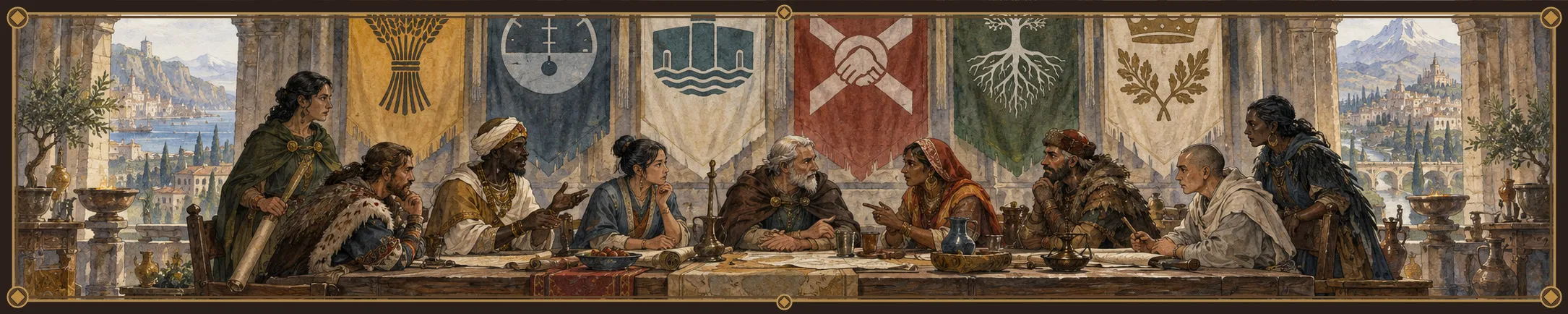
Ask the hold what it has kept,
ask the grove what it is growing,
ask the town who saw it sworn,
ask the road who carried it:
four answers, and one roof to sleep under.
The Gate-and-Grove Copybook
A species is what a person is born; a civilization is what a person lives under, and whom they must answer to when it comes to blows. On medieval Caeldon the two rarely line up neatly. A Dwarf of the Ironspine and a Dwarf of the Stonewake Deeps keep the same faith and argue about it bitterly. A half-Elven ferry child on the Serath is protected from birth and may wait years before the great houses let her swear for the family boat. An Ogre may spend her whole life on other people’s roads and still belong to an order older than any of the towns that hire her. The names these orders carry, Concord, Courts, Compact, League, Houses, Kindreds, are their own and describe them only loosely: one Compact is a deep Dwarven hold-cluster, another a Kobold crews' bargain, a third an armed Goblin company holding a road. None of them is safe. Each has its wars and feuds, its raiders and outlaws, beasts and dark things at its edges, and ruins its people are warned away from and go into anyway. What matters to a household is the moment it meets the order: the day a child is named, a marriage is sworn, a count is read aloud, a stranger arrives at the edge of the light, a debt is called in, a feud comes to the door. This chapter goes through the twenty-two named civilizations of the medieval world and stops at those moments.
Orders and the Lives Inside Them
Most of these orders are very old. The Rootcrown Concord of the Wood Elves took shape around 490,000 BR, the Ironspine Holds of the Dwarves not long after, and the youngest Elven and Dwarven orders were already ancient when the first Human basin towns were raised. The Human orders, by contrast, are recent: the Confluence Marches came together between about 40,000 and 20,000 BR, and the Serathic League a little later. The youngest civilization of all, the Mending Orders of the Wrought, is barely thirteen centuries old, and some of the people it was founded to hide are still alive. Age does not make an order strong, but it does make it proud, and the older orders treat the younger ones with every shade of patience, from courtesy to contempt.
Three things are worth knowing before going order by order.
Some orders hold ground and some do not. The Elven, Dwarven, Human, Reedfolk, and far-side orders each have a country: a forest, a mountain, a river, a fold, a coast. Six others hold no land at all. They live in other people’s countries, on the roads, crossings, ruins, and underworks that the landed orders cannot keep alive without them, and their strength is work, passage, and the plain fact of being needed rather than any ground of their own.
Some orders live inside others. The Stonewake Compact is a civilization within the Ironspine Holds; the Serathic League is a civilization within the Confluence Marches; the Blightward Keepers and the Open-Run Concords live within and around the Returning Concord. A Stonewake Dwarf is an Ironspine Dwarf too, and a League town still swears under the Marches' gods. The inner order is usually the sharper, stricter, or narrower form of the outer one, and the two quarrel the way close kin do.
Order is held, not written. Everywhere, in the holds and the Elven courts as much as on the Human frontier, it rests on custom, oath, kinship, and the strength of whoever holds the hall, the ford, or the water. Rules are few, set by the stronger party, and favour it. What each people does differently is how it makes a person count among its own. Elves are accepted slowly, in stages, by people who have watched them grow. Dwarves are cut into stone. Humans are sworn and written down. Reedfolk and Thaluren are remembered, aloud. Halflings and Gnomes are counted and measured. Orcs are recited, with the crossings they held. Wherever a writer sets a story, the question of how a person comes to count among their own people, and what happens when someone stronger decides they do not, is already waiting.
The Elven Orders
The Elven orders follow the branches of the Elves more closely than any other people’s orders follow theirs. The Wood Elves of the Elderweald are the oldest branch and the Rootcrown Concord the oldest order; the Thorn Elves of the Briarreach and the High Elves of the Crownboughs grew out of it, each into a civilization of its own; and the Dark Elves of the Roothollows hardened under catastrophe into a fourth. All four share the Elven habit of slow acceptance: a person comes into their place slowly, and is not forced into final form before they are ready. Each order bends that habit to its own fear.
The Rootcrown Concord
The Rootcrown Concord has no seat, no crown, and no court. It is many groves of the Elderweald under trees older than the Concord itself, held together by memory and by duty to the living forest. It is the oldest major Elven civilization on Caeldon, consolidated in The Founding of the Rootcrown Concord (c. 490,000-c. 460,000 BR), and it is the root from which the High Elf and Thorn Elf civilizations later diverged. The basin Humans live beside it more closely than beside any other Elven power, and misread it more often, mostly as absent. The Wood Elves believe a people owes its life to the land that feeds it, and they hold their neighbours to that belief with warnings first and arrows after.
How it holds together. Within a grove the elders and ritual keepers are heeded for the memory of place they hold, and a matter that crosses groves goes to a circle of the groves concerned, which no grove can be made to obey (the groves and their circles are told in The Forest Heartlands). At the basin edge a third kind of voice has grown up that holds no office at all: the edge mediators, people whom both Elves and Humans believe about kin, remembrance, and the right completion of a life. And the grove’s hunters are its guard. They track whoever cuts a living tree, turns a stream, or sets a fire in the wrong place, and the timber thieves and poachers of the moss-coated greenharts who come in from the basin side every few years seldom go home.
How a household meets it. The Concord meets a person most sharply at arrival. A grove declares someone adult when its elders and ritual keepers agree that the person has arrived. Each says so aloud at a grove gathering, and one keeper’s doubt does not overrule the rest but puts the matter off to the next season. A household that moves to another grove is not counted of its new grove until it has walked that grove’s paths through a full year and learned where its dead lie, so that a family arriving in spring is still a guest at midwinter, however warmly it is fed. What a grove fears is the forest floor: hollows that open under the leaf-litter, some reaching down towards the root-depths, where the fallen are heard calling for days; the great tree that comes down in a night; fire most of all, and the axe that comes after. Its hunters also hunt what the forest sends: bears flooded out of their hollows, wolves at the edge farms in a hard winter, and the Skin-Lost, shape-changers who forgot the way back and hunt with a person’s cunning.
Outsiders meet the Concord at the edge of the trees, where a settler must ask the nearest grove whatever a lord has granted. A grove may refuse a mill village the weir it needs, saying that a stream’s course is not the grove’s to give. A lord may grant a clearing on his own word and find it growing back over his settlers' fences, with arrows in the dark if they persist; some questions wait a generation, and some of the neighbours have stopped waiting. And under the floor lies the lure: basin inns tell that the lost lower groves lie at the bottom of the deepest hollows with their grave-goods untouched, and parties of treasure-seekers go down after them with ropes and lamps, while the grove above decides whether to cut the ropes.
What it remembers. Every Elven branching is remembered in the groves as a leaving. The groves do not call their Crownbough and Briarreach kin wrong, but they keep count. Their quarrel with the basin was never about rank; it is about whether a settlement owes anything to the living ground it stands on, and it was fought with marked trees and arrows on one side and firebrands and paid swords on the other, stretch by stretch, by whoever was stronger there. Along the edge the war is still in the wood: old trunks with Human arrowheads grown deep into the bark. The same quarrel reached even into mourning, and was settled there in The Elderweald Funerary Accord (c. 16,000-c. 15,000 BR), where Wood Elf return of the dead and Human mourning were reconciled without either side treating a death as a private matter.
The Crownbough Courts
The Crownbough Courts of the High Elves are what became of one part of the Rootcrown world when it pushed towards refined magical shaping, courtly hierarchy, and deliberate design: Rootcrown Elves grown proud, ranked, and lofty, living high among the boughs of trees their ancestors bent into halls. They were founded in The Founding of the Crownbough Courts (c. 390,000-c. 375,000 BR), and they are the oldest standing power that most cradle-web Humans and Dwarves deal with face to face. Where Wood Elf groves live within growth as it comes, the Crownbough houses bend it to their will. Their halls, galleries, and garden-walks are grown, coaxed by magic and centuries of patient shaping into forms no forest makes alone, and in later ages finished with shaped stone and metal too.
How it holds together. Several courts rule rather than one crown, each gathered around a few great houses that settle rank, protocol, and presentation by custom, oath, and what their groves, wealth, and sworn followers let them enforce; quarrels between equals end in a duel of shaping, or in a duel of champions on a garden-walk with nothing beneath it (the courts and their duels are told in The Forest Heartlands). The other authority belongs to the tenders of the Ordered Bough, the High Elf faith of tending life towards its intended form, and a tender’s not ready, said of a garden, a house, or a person, weighs against the court’s.
How a household meets it. The moment that matters most is presentation, when a house of rank shows a young High Elf at court with a piece of shaping they have carried on themselves, and the court reads the work and the person together (the custom is told with the Crownboughs in The Forest Heartlands). The great houses remember which presentations came early, over a tender’s not yet, and a house that can present no one for several seasons is spoken of as unfinished; few words in the Crownboughs are crueller. At the end of a life the dead go back to the family grove under the Bough’s rites; the court sends one of its own only for the great houses, and for everyone else the return belongs to the house and its tender.
What a house fears most is its own hall. A failed house leaves rooms where Saerith’s silver mirrors still hang, showing the viewer a better face, and some who look too long never come away the same. A lesser house that sought perfection through the chrysalis of Imago may have let out an Ill-Hatched thing that once was its heir and now lurks in the understorey, a monster the house must hunt down itself, by night and without lamps, so that the court will not see. Below the boughs, bears roused in spring kill gardeners on the forest floor, and hall canker can rot a great hall from the cut inward until it falls in a storm with its household inside.
Temper and reach. The Courts value refinement, memory, and lasting excellence, and they incline towards condescension to shorter-lived peoples and to anyone they think less finished. A court may receive a Human embassy with every courtesy and never rank it above a lesser house. A great house may sponsor a Human household’s child at court, and gain a debt worth more than the child. A basin lord may copy Crownbough gardens, protocol, and gold-painted faces, and be thought ridiculous by the courts he imitates. An Ironspine envoy may be offered the best seat in the hall and the worst reading of his hold’s history in the same evening. And one house may hire Human hall-breakers to bring a mirror out of a rival’s abandoned hall, and will not ask how many went in: a dead house’s silver, its grown armour, and grafts from groves that no longer exist are the great lure of the canopy.
Whether the children of mixed Human-High Elf households count as kin is still settled house by house, and the Courts remember its sharpest test, The Crownbough Heir Controversy (c. 14,000-c. 13,000 BR), as a warning of what such quarrels cost. Inside the Courts the deepest argument is over Saerith the Mirror-King, the god of prestige, lineage, and perfect form: his devotees call finished form the Bough’s fulfilment, the older tenders call it its corruption, and his standard travels further than his worship, into lesser halls where it shows as dangerous rites of self-perfection and quiet despair. Faith in Practice takes that argument up.
The Thornbound Circles
The Thornbound Circles govern most of the Briarreach, a belt of broken woodland, thorn, and ravine at the harder edge of the old Elven forest, where Wood Elves living on that harsh edge through the worst ages of the world grew sharp, watchful, and slow to trust. The Thorn Elf branch hardened first, in The Hardening of the Briarreach (c. 425,000-c. 410,000 BR); only afterwards did it take civilizational form, in The Founding of the Thornbound Circles (c. 405,000-c. 392,000 BR). They live by the bow and the hedge. Their settlements are as Elven and as rooted as any grove, but hidden behind thorn walls grown for war, in a forest they remember as trying to kill them. They are not cowards. They are hunters and watchers, and they keep the memory of every danger the forest ever held as if it might come back tomorrow.
How it holds together. A circle is a cluster of settlements bound by mutual oath and, above all, by the power to say who may approach and to back it with bows; circles stand together when pressed, but none commands another, and their hedges are their walls (the circles and their hedges are told in The Forest Heartlands). On the ravines of the Briarreach the Circles live beside Troll houses of the Crossing-Oath Houses, which hold no forest, only crossings; the two have stood side by side for a very long time without ever settling where one’s say ends and the other’s begins.
How a stranger meets it. Earned hospitality is the Circles' own, and it is the first thing anyone from outside meets. A stranger waits at the Waitfield or a hedge-edge until watchers come with three questions, the last of them who will answer for the stranger if they do harm, and is let in, if at all, by steps: the outer fire, the blind way, and only after seasons of return the known way, always under a sponsor who swears your harm is my harm and pays for whatever the guest does as though they had done it themselves. The steps are told with the Briarreach in The Forest Heartlands. A Human axe-gang that comes with a lord’s grant and hired swords may be let come a day into the forest before the arrows start. A Troll crossing house may sell safe passage over a ravine to travellers who still cannot enter the woods on either side. And the pockets of ground the Thornbound will not enter and do not explain draw a treasure-hunter past the hedges every few summers, and what is found of him is left at the Waitfield as a warning.
The Gloamroot Covenant
Beneath the forest, in the Roothollows, the Dark Elves live under the Gloamroot Covenant. It is the order of a branch that hardened under catastrophe and sealing before it became a civilization: the sequence runs from The Roothollow Rupture through the sealing and the darkening of the Roothollows to The Founding of the Gloamroot Covenant, and the Covenant was assembled out of survivors who had learned that no one else would keep them alive. What holds it together is protection rather than trust. Power belongs to whoever can hold water, food, dry chambers, and a safe way through the dark. Mercy exists, but it is never free, because the Covenant remembers too clearly the flood when the rescuers did not come.
How it holds together. Houses hold chambers, reservoirs, and fungus darks by chamber-right, and with them the households, dependants, and refugee lines that live there. A house is run by its elders, and two of its offices matter to everyone in it: the water-keeper, who knows the house’s basins and what it owes and is owed in water, and the threshold-keeper, who keeps the threshold chamber and speaks for the house when someone asks to be let in. The survival and warding orders first rose to hold back what the catastrophe left loose in the dark, and remain the Covenant’s swords, its guards on the ways, and much of its right to rule. Neither side stands without the other: a house that cannot protect is brittle, and an order that cannot draw on a house’s water and food cannot endure. Route keepers come from the orders and keep the Known Ways: they walk them, decide which stay survivable, lodge in the houses' threshold chambers, and teach the ways to children. Striking a way off the reckoning is theirs to do and theirs to answer for.
Binding all of them is the old custom of refuge, kept by oath and by bitter memory rather than written down, and older than the Covenant. Refuge means shelter in need and protection on the spot, not a place in the house, and the grounds on which a house may refuse are few and grave. Dark Elf life is lived between two convictions at once: that refusing refuge is a betrayal never forgiven, and that every stranger at the door may bring the flood, the rot, or the thing that followed them. Quarrels over who was turned away, or sent down a way that killed them, end in feud as often as in a bargain, and a Gloamroot feud can outlast a Human kingdom.
How a household meets it. A household meets the Covenant at a few fixed points, each told in Stone and the Deep: the threshold, where someone of the house sits every waking watch and a stranger asking refuge must be sheltered, refused on one of the old grounds, or sent on by a Known Way the route keeper will swear is survivable; the water reckoning once each root-year, when the water-keeper says aloud what the house owes and is owed; a child’s first recital of a Known Way; and the root-chamber naming in the root-chamber, for which a household may wait years and a refugee line longer, unless a great house speaks for it. A household that refuses refuge lives with the refusal for generations, and if a way it sent refugees down proves lost, the kin of the lost come asking. A capable young Dark Elf can be trusted on the ways long before the house lets them inherit, as in The Gloamroot Inheritance Ambiguity.
The dangers the Dark Elves fear live in the water and the dark: black-water eels that take children who wade, root-borers that hollow a chamber until it falls, lampless spiders that curtain the ways nobody walks, and, deepest of all, the sealed Upper Roothollows, where those who drowned themselves to save a refuge came back as the Drowned Court.
Reach and quarrel. Oaths in the Covenant are sworn before the Last Chamber, the god of refuge, accepted as true but not as comforting; the Measured Seal is real too, and suspect, because in Gloamroot memory respectable closure stands too near respectable abandonment. A house may shelter refugees from a failing chamber and spend three generations deciding whether they belong. A house may hold a lesser neighbour’s water on debt and call the debt protection. A route keeper may strike a way from the Known Ways and leave a house on the far side of it outside the region in all but memory. A young Dark Elf may slip past the bars into a struck way to bring back an ancestor’s bones, or the silver of a chamber lost in the floods, and earn a name or a feud by it: beyond the bars the Upper Roothollows keep everything a hundred drowned houses owned when the water came. A house may send its own across to the Rootstone Heartwell with an armed escort to swear its right to the water again before the Dwarves, so that it is never let fall; and an envoy carrying a house’s word to the forest above goes the long way round, through Stonewake and the Ironspine, under the leave of Dwarves the house does not trust. The Covenant’s war with the Stonewake Compact over the Heartwell, begun in The Heartwell Stakings (c. 322,000-c. 316,000 BR), when Gloamroot war-bands came down the root-ways in silence to strike at the Dwarven basin doors, is one of the oldest Elf-Dwarf hatreds, and within the Elven world the Covenant keeps the strongest memory of abandonment by the other branches, a memory the other branches contest. The bitterest curse in the Roothollows is may you find the door shut.
The Dwarven Orders
The Dwarven orders meet a life at its stages, and they cut each stage into stone. A people whose children are still setting into their full form after birth guards cradle-chambers more closely than treasuries, names slowly, and counts a child lost to the mountain as the worst loss a hold can suffer; a people whose holds are part of how they remember themselves treats a broken wall and a broken oath as nearly the same thing. Both Dwarven orders keep the Held Covenant, but in two practices that accuse each other: the gate practice of the Ironspine, which asks Kerrund’s question, will you hold?, and the seal practice of the deep holds, which asks the Measured Seal, must this close?
The Ironspine Holds
The Ironspine Holds are the oldest stabilized Dwarven civilization on Caeldon, founded in The Founding of the Ironspine Holds (c. 460,000-c. 438,000 BR) in the mountains of the Ironspine, and every Dwarf still measures a hold against theirs: gates cut into living rock, halls older than any Human memory, and forges whose fire has never been let out. Their heart is the hold: a fortress-city cut into the mountain around a gate, a forge, a granary, and the tablets of its dead, kept by people who believe that whatever holds up a roof deserves respect and whatever does not deserves none.
How it holds together. Inside a hold, the elders and great houses rule by custom and oath, and a household that defies them finds the forge, the granary, and the gate closed to it. Between holds there is no crown, only old oaths and the strength each can bring, and a hold’s word is worth what its walls and warriors are worth. A leading hold may speak for the Ironspine before the Crownbough Courts or a Human lord’s hall, and any other hold may decline to follow it. Hold grudges are carved, not spoken, and a feud between two holds over a seam, a road, or an insult at a gate-feast can run for a thousand years, fought by ambush in the underways and remembered on both sides' tablets. Place inside a hold is not shared evenly. Kobold crews take the narrow, dangerous repairs in vent runs and mine-edges, often for work the hold prefers not to mention, and Goblin underwall households, descended from those who stayed when the early holds took the seam-warrens, live in the margins of halls that once were theirs.
How a household meets it. The hold is present at every turning of a life: the name-stone in the cradle-chamber, the first oath at the gate, the marriage tablet, the Proving of the Unbroken Line, and the sealed grave. The customs are told in The Elder Peoples (FND) and, as hold life keeps them, in Stone and the Deep. An oath broken at the gate is avenged by the whole hold, not only by the injured kin. What the holds fear is winter on the passes, stone cats and pass bears, flood and bad air in the mine-edges, and Brace-Gnawers in the props; older and quieter is the fear of the doors that were shut with people behind them, and the knocking that still comes through some of them.
Reach. The Holds open and close much of the trade the uplands live on. A hold sells ore, tools, and smithing to the Headwater towns and buys back the grain, wool, and timber it cannot grow, and every bargain ends in a hold’s oath-yard, sworn before a custodian. A gate hold may close its stretch of a road after a rockfall and keep it closed, and turn back with spears the Edgeway kindred that has cleared the culverts beyond for longer than the hold has kept tallies. A Kobold compact may refuse a working, and a hold that will not pay for danger finds its narrow repairs left undone. And the empty holds of the first ages are the great lure of the mountains: forge-work, old weapons, and hoards of metal no archive remembers, with unwoken frames standing between the door and the find. A hold that sees a blade of its own lost pattern in a Human market will pay well to learn where it was found, and then send its axes there.
The Stonewake Compact
Below and at the centre of the Ironspine lies the Stonewake Compact, a civilization within the Holds, holding the Stonewake Deeps, where more of the lower world’s routes and water meet than anywhere else. It was formed in The Founding of the Stonewake Compact (c. 360,000-c. 348,000 BR), and whoever holds Stonewake’s passages and reservoirs holds the deep: the Compact has held them for three hundred thousand years against flood, collapse, Dark Elf war-bands, and whatever comes up from below. Where the Holds are broad, the Compact is small and dense: warded vault-ways, holds that cannot live without one another, chambers full of tablets, and reservoirs worth a war. Route keepers, reservoir wardens, and archive-custodians each hold their part for their house and answer to the hold-elders for it, beside the Kobold underhouses that keep its air moving and the Wrought of its forge and mine levels.
The custom of the seal. A seal is the deepest act a Dwarf of Stonewake can do, because a shut door can save a hundred holds or bury the people behind it, and the great deep houses, whose galleries a seal protects or starves, have made it a matter of oath. The Held Covenant’s questions of closure began here.
-
An ordinary seal on a great passage, chamber, or reservoir needs the oath-marks of several custodians, because it cuts off more than the hold that sets it, and the houses beyond it have kin and spears of their own.
-
An emergency seal may be set by whoever holds the passage when waiting would let a flood, a collapse, or something worse run from hold to hold. The setter answers to the elders afterwards, and the kin of anyone sealed in want an answer.
-
The grounds are few: a roof about to come down, a reservoir about to break, a sickness or a corruption spreading, a failure that would run from hold to hold, or something coming up from below that cannot be held while the way stays open.
-
The two betrayals Stonewake remembers most bitterly are a danger made to look worse than it was so that a rival could be shut out, and a seal meant for a season left shut for ever because opening it again had become too costly.
Before a great closing, or a fight to reopen one, custodians swear before the Measured Seal that it must be done, and before the Last Chamber whether what lies behind it can still hold life. Stonewake treats the two not as rivals but as a hard pair of questions: must this close, and can this still rightly hold?
How a household meets it. People in the Deeps walk past the Compact’s seals every day, and households near one know its inspection round, the custodian’s visit cut into its closure marks, the way surface villages know a market day; a seal whose last mark is old is unwitnessed, and any passer may raise it with the custodians (the round is followed in Stone and the Deep). Deep children learn a counting rhyme for the knocking behind the doors, three for the living, one for the dead, none for the door that holds, and custodians, who know the knocks follow no such rule, let them sing it.
Seals are power in the Deeps, whether anyone admits it or not. A hold may seal a flooded gallery in a single shift on emergency grounds, then spend years answering the elders, and the kin of the galleries it cut off, for it. A custodian may refuse to mark a closure that would divert traffic through a rival hold’s junctions, and say so openly before the elders. A mountain hold of the upper Ironspine may withhold stores on the Hauling Stair to press the Compact over a seal that has cut its deep posting off from water. Two holds at feud over water drawn beyond a share may meet with axes at the sluices, and the hold that loses the fight loses the water with it. And a band of hoard-seekers, outfitted at Stairdeep with rope and caged finches, may slip past the lowest kept routes after the forge-lords' gold, where unwoken frames still stand at their posts in the lost pressure holds, and the hold that catches them coming back may take the gold and seal the way behind them.
The River Orders of the Cradle-Web
The Human heartland of the cradle-web is young country by Elven and Dwarven measure, and the orders that hold it make up in hunger what they lack in age: walls, tolls, sworn oaths, guarantees, and the habit of keeping a second copy, for whatever good a copy does against a stronger neighbour. Underneath them, and older than all of them, runs a Reedfolk order whose oaths are not written but remembered.
The Confluence Marches
The Confluence Marches are the first major Human civilization on Caeldon, coming together in The Founding of the Confluence Marches (c. 40,000-c. 20,000 BR) and spreading through the long Confluence Rise. They are less a realm than a field: connected towns, basin cores, marcher strongholds, and shifting alliances across the Confluence Basins and the Headwater Marches. No crown holds them together. Shared habit does: the same gods, the same oaths, and the same ways of ending a quarrel, by sworn word, blood-price, or the sword. Because Humans are less bound than Elves or Dwarves to one old inheritance, they borrow whatever works from their neighbours, Elf, Dwarf, or Reedfolk, and keep it until something better comes along, and that quickness has long been their edge. Between the towns run long roads, wolf-haunted in hard winters, past ruins nobody has dug to the bottom.
How it holds together. Power is split among whoever can make it stick. Lords hold land and take grain; towns are run by their richest houses, who keep the market and settle their own quarrels; march-towns take what the crossings will bear; Headwater lords live on escort money and on what they can take from travellers who refuse to pay. When two of them fall out, they fight until one side runs out of sellswords or both go to the oath-house of the Sworn Accord, the Marches' organized religion, under which a cult is honoured in the towns only once it is entered on the Accord’s sworn roster of gods.
How a household meets it. A Marches household meets its lord and its gods mostly at the oath-house, where a marriage, an inheritance, a land sale, or a boundary is sworn under an entered god and written down; record-day reads the year’s entries aloud for anyone bold enough to speak against them, oath-days bring the great houses to hear oaths sworn and settle what they please, and a stranger is asked early whose god they swear by (the oath-house and its year are followed in The Basins and the Marches). Agreements are sealed there under Iskel the Scribe of the Silent and accusations brought under Ostrin the Lantern-Bearer, and the scribes and record-houses serve Annoth the Keeper of Scrolls, a god always imperilled by those who benefit from forgetting.
What a household fears is near and plain: grey wolves at the folds in a hard winter, an outlaw band in the woods behind the fields, the lord’s war and the lord’s levy, Spurred Hounds bred for those wars that turn on their own kennels, and the River-Given, the unrited dead of the spring floods, come dripping up the landing steps to find their own doors. In the Headwater Marches a young person is sworn twice before swearing in their own name, under The Headwater Rite of Two Oaths (c. 23,000-c. 21,000 BR), born of an old quarrel over fostered children: first to working right, which lets them carry messages and travel on a household’s errands, and years later to oath-right, the right to swear and inherit. Every Headwater family argues about the years between.
Reach. The Marches are where most cradle-web Humans live, trade, and feud. A lord may levy a share of every harvest on the threshing floor and sell it upriver or uphill to whoever pays best. A march-town takes what a crossing will bear, and a ferry that sinks under a sworn guarantee owes a blood-price to the drowned man’s kin, if they are strong enough to ask for it. A lord at feud may hire a sellsword company for the season, and the villages along the march pay for it twice: once in levy, and once when the company is not paid on time. A foothill lord may pay a bounty in silver for every beast that comes out of the Wrongwood, where the beasts of the burned valley still bear Kindless Broods. And a company of treasure-seekers may come back from the Paling, the archive city with every letter smoothed off its stones, with old silver and without that morning’s memories, and the town will buy the silver anyway. The Marches were never Human in isolation. Dwarven exchange through the Headwaters made them stronger, the Elderweald border taught them the cost of pushing into living country, and Crownbough embassies, arriving in the last twenty thousand years, brought admiration, resentment, and imitation in the same towns.
The Serathic League
Downriver, the Serathic League is the order of the Lower Serath, a civilization within the Marches: fortified river towns, dense exchange, and a hard grip on the busiest corridor of the basin, bound to one another by sworn guarantees rather than by a king. Escorts, guarded crossings, and oaths sworn again and again hardened into the guarantee custom in The Lower Serath Guarantees (c. 26,000-c. 16,000 BR); only then did the towns become a named league. Its towns have walls, but their real strength is the traffic: barges by the hundred on a crowded lower river, every one of them paying. It keeps the Marches' faith, the Sworn Accord, and its own severe god besides: those cheated by river dues that buy nothing, or by quarrels the great houses always win, invoke Ostrin.
How it holds together. Each town answers for its own reach of river and treats carriers from other League towns as its own, held to it by the fear of finding its barges stopped at every other town’s water-gate; inside the towns the great river houses hold the markets and the dues, and guarantors keep the river for them, with armed boats when words fail (the towns and the guarantee are told in The Basins and the Marches). The League’s love of written oaths and sharp lines between people is older than the League: it comes from the vanished Archive-Law Civilization, whose city ruins some Serathic scribes have never heard of, and most of it reached the river through Reedfolk house-custom.
Under The Serathic Oath of Layers (c. 19,000-c. 18,000 BR), which the strongest river houses imposed and then kept, the League counts belonging in three steps rather than one, Protection, Stewardship, and the full oath, and the great houses decide who stands on which; a half-Elven ferry child may run the family boat for years before they let her swear for it.
How a household meets it. Two people meet the guarantee most often: the guarantor sworn for one reach, who writes its dues and its repairs side by side in the guarantee roll, and the bargemaster who pays each town’s dues for a passage tally, so that the next town does not charge for the same water twice.
Reach. A town may refuse a carrier who cannot show the tally from the reach above, and hold the barge until its dues are paid. Two League towns at odds over a reach may each send armed boats to keep it, and the barges caught between them pay twice and pray. A carrier may bring a stack of tallies to an oath-day to show that a reach took dues for a season without a single repair entered against them, and win only if a great house with something to gain takes up the quarrel. A guarantor may take a crew of sellswords and a Reedfolk guide into the reed mazes after the wreckers who light false marks above the Lying Shoals, and burn every hut that has a lamp in it. And under the oldest towns lies a quieter lure: whatever the archive world left in its river cities, which nobody has found and every deep foundation is dug in hope of. Thieves go down into those pits by night, and a town sets guards on them against its own diggers as much as against strangers.
The Floodkeeper Houses
Older than either Human order, and running partly beneath them, are the Floodkeeper Houses of the Reedfolk, founded in The Founding of the Floodkeeper Houses (c. 210,000-c. 182,000 BR). They hold the lower Confluence Basins and the channel country of the Lower Serath as a world of stilt-houses and reed cities, crossing shrines, and kin who remember where the water went a thousand years ago and where it will go next spring. They carry the oldest oath-keeping in the river world: as the elder archive-law world closed its rolls, some of its keepers carried oath scripts and records into the Reedfolk houses, in The Last Keeping (c. 150,000-c. 120,000 BR), where they became house-custom.
How it holds together. The Houses hold no fixed borders, because the water keeps none. Weight goes to those who remember the floodplain truly: who can say which channel still bears a boat, which crossing lies about its depth, which bank will slump under a house, and who keeps the shrine-crossings safe. Flood-keeper houses, shoal leagues, reed-city kin, and shrine-keepers are bound to one another by old oaths sworn across moving water, and a house that breaks one finds every channel-guide in the reach suddenly forgetful. There is no hidden kingdom in the marshes, only a people who have outlasted every flood by remembering it. The Human orders rose beside it and partly over it, each reach settling the matter its own way during The Lower River Absorptions (c. 30,000-c. 8,000 BR), when river towns won the water by hiring flood-keepers, marrying into their families, and moving channels over the heads of houses that would not bend, and the Houses have been bargained with, depended on, pushed aside, and partly swallowed ever since, without ever being erased.
How a household meets it.
-
The flood-telling. After each spring rise, a house’s keepers go out to sound the channels before anyone trusts last year’s marks, then add the year’s water to the house’s remembered roll at its crossing shrine. Whatever else a house writes down, the roll is spoken aloud each year, and children learn the house’s flood years by heart.
-
Marriage between houses is sworn at a crossing shrine. The incoming spouse is taught the new house’s channels, and is counted of the house only once they can tell its false crossings from its true ones.
-
A channel quarrel goes to the keepers of the houses concerned, who swear their memories under the old forms. The memory that matches the water as it now runs usually wins; where the water is unclear, the larger house’s does, and the smaller house may take its grudge into the reeds for a generation.
-
Service. Many households owe service to a Human town, through a pilot’s office the town grants, an inherited duty, or only the habit of being asked before the rise. The house keeps count of that service even where the town does not.
Every child learns the fens' dangers before its letters: the great catfish of the deep holes that pull dogs and swimmers under, leeches and fever in the warm months, and the false crossings that look like any other. Older fears lie out in the drowned reed cities, sunk when channels were moved for stronger peoples, whose shrine-posts break the water at low summer; on some low-summer nights a light moves among the posts, and no house will row out to learn whose it is.
Reach. The Houses are the lower river’s knowledge of itself, and most Human river power still runs on it. A Human town may keep a Reedfolk pilot office by its own grant and still find that the pilot answers to a house first. A house may refuse to guide a boat across a crossing it calls false, whatever the guarantee says. A basin lord may seize a reed island the house remembers as there only in low years, and lose it at the next rise. A Reedfolk keeper may be dragged into a Human lord’s hall and swear by house-custom rather than under any god of the roster, and be believed less for it. A Human lord hunting outlaws in the fens may hire a Reedfolk guide, and a house with a grudge may guide his armed boats onto the Lying Shoals instead. Treasure-divers may pay a house to guide them out to a drowned reed city for the offering-silver of its sunken shrines; those who swim down alone come up with silver, or come up tangled and white, or come up at the next spring rise among the River-Given. Houses that resisted absorption once raised a god of unbroken identity, Hesserin the Shattered Saint, who faded as they accepted service; her insistence survives in the Reedfolk saying that the river belongs to whoever remembers it correctly, and in the boast, made wherever anyone will listen, that much of what the basin towns call their own oath-keeping was the Reedfolk’s first.
Orders Without Ground
Six of the medieval world’s civilizations hold no land. They are not kingdoms, empires, or nations, and they are not the weaker for it. Each grew out of a people’s long experience of being needed and not counted, and each answers it by making its work, its passage, or its presence something the stronger peoples cannot do without: a band that will not lift, a bridge that will not open, a road nobody else can keep. Their strength is walking off together, standing by one another, and a long memory for who paid and who did not. Most of them are strongest in the same places: the Headwater roads, the Broken Marches, the mine-edges of the Ironspine, and the crossings in between, where the landed orders run out of reach and the work of keeping things alive is done by somebody else.
The Hearth-Weight Compacts
The Hearth-Weight Compacts are the first major named Ogre civilization. They live by hearth-weight: strength must stay tied to care, or it turns into something terrible. A household, camp, or work-band is weighed by whether it feeds, shelters, carries, and protects the weak who fall under its burden, and the strongest person is not by that alone the leader. The hearth-houses that first made hearth-weight into camp-custom took shape in the Long Hunger, long ago; the Compacts became a civilization around 15,000 BR, along the Headwater roads, as the organized refusal of the debt-bound labour of the chain-camps. The chain-camps raised a god of breaking out, Haggun the Wall-Breaker, who faded once the Compacts made refusal a custom other powers had to bear; Ogre outlaws of the Headwater hills still chalk his crack on the door of every road-lord’s storehouse they raid.
How it holds together. No compact makes every Ogre camp obey one master. It gives camps, employers, neighbours, and lords the same answers to the same hard questions. Who is fed before work begins? Who sees the burden taken up? What shelter is owed after a job that nearly killed the band? What is owed when a bridge, floodgate, wall, or winter road stands because Ogres carried what no one else could? Burden houses keep the count of work owed and work honoured, and some still hold ledgers from the chain-camps. Camp elders stand by when a band takes up dangerous labour. Hearth-keepers see that food, rest, care for the hurt, and protection for the band’s children are paid, not begged. Road and flood compacts say when a band may down tools and walk away from work that would eat the camp alive.
How a household meets it. Most Ogre households move between hard jobs, quarry hauling in one season, flood repair in another, winter-road keeping elsewhere, and so meet the Compacts at every new job. No load moves until the camp is fed: the employer feeds the band before any work, the weakest first. The terms are sworn before the band, and the work is entered in the burden house’s count. Where a stretch of road was built by a chain-camp, it still carries the camp’s marks, and no Ogre band will cut them away. Ogre religion has no clergy; the burden houses keep the customs of Ghessa the Hearth-Mother beside the camp’s work counts. Ogres fear hunger above any enemy, and every Ogre child is taught to fear it in themselves: the old songs tell what an unfed band becomes. After hunger they fear the chain.
Reach. No heavy road work is done in the Headwater Marches without the Compacts, and their terms reached the far-side camps of the High Scars through the few Ogre burden orders that know the one crossing of the Glassbelt. A lord at war may hire sellswords for his fighting, but he cannot hire anyone else to haul his war to the walls, and sieges along the Headwater roads have been lost because an unfed band set down a ram halfway to the gate and walked away. A crew clearing a colossal road may lift a slab and find a vault the old builders sealed beneath it, and no band’s terms say who owns what lay under the stone it was paid to move. Where the Compacts are honoured, Ogre camps become partners a town cannot do without. Where they are cheated, the roads fill with hunger-bands, strike camps, and bands that will not lift a stone for that lord again. When a band is cheated, someone at the fire says only send the hearth-keeper, and everyone knows what comes next.
The Crossing-Oath Houses
The Crossing-Oath Houses are the first major named Troll civilization, and to them a crossing is never only a road. It is a wound in the land, a repair, a memory of everyone who fell there, a livelihood, a border, and a danger all at once. Their oldest bridge-oaths go back to The Swearing of the Crossing-Charges (c. 230,000-c. 190,000 BR), when Troll lines holding crossings on the elder colossal road network swore charges to the order that built it. That order withdrew, and the oaths were kept anyway. The medieval Houses descend from those charges, spread well beyond the colossal roads and joined by younger crossing families, and their oaths are still sworn under the Mountain-Father by title, which makes the Trolls one of the few peoples who still swear by a sleeping god.
How it holds together. Bridge-oath families keep named crossings for generations, and a Troll’s scars are read like a crossing’s history: this one the flood year, that one the night the span went. Ravine houses take their fee and bargain over warning and safe-conduct. Woundland camps mark unsafe ground and remember old failures. Each house keeps its own count of broken promises, unpaid passage, and travellers lost because a lord or a caravan would not listen. Together they decide who keeps a bridge standing, who takes what from those who cross, who may shut the way, who must shout a warning of rot, flood, or sickness, and who owes the mending when a crossing has torn the land again. On its crossing, a house’s word is the only word that holds.
How a traveller meets it. Medieval people most often meet the Houses at a bridge, a ravine, a flooded path, or a broken road, and there the house decides whether the crossing may be used today and what it costs. One house holds the Rattlecut on the Headwater road by an oath older than any lord’s grant; on the far-side High Scars, houses hold a few passes and landslide routes, and decide when they are too dangerous to use. A bridge fee may be robbery. It may also pay the people who keep flood, rot, landslide, and Failed Mending from swallowing the road again, and the Houses hold that some crossings survive only because Trolls stayed where everyone else built, abandoned, rebuilt, and forgot. They know every danger of a bad crossing: planks that rot from inside, slopes that slide in the wet season, ravine cats waiting for anyone alone at the water, and the Bridge-Dead, whom the crossing families name at every repair and steer travellers by.
Where the Houses are honoured, frontier travel is dangerous but known. Where they are ignored, crossings become places of feud and disappearance, a house shuts its bridge in answer, and someone in the nearest village starts talking about monsters. On the Human side of the Marches troll-hunting is a trade: men who sell a lord a Troll’s head as proof that his road is safe, and who are hunted in their turn by every crossing house that hears the name. A crossing family parts from a traveller with may the span hold.
The Edgeway Kindreds
The Edgeway Kindreds are the first major named civilization of the Salvage Peoples, and a moving order rather than a seated one. A kindred is a kin-linked company of caravans, camps, and repair crews that travels a known circuit between ruin zones, returning season after season to the same broken roads, culverts, wells, spans, and storeworks. Their circuits are oldest in the uplands around the Headwater Marches and the outer Ironspine, where they first formed along abandoned colossal roads in The Walking of the Unkept Roads (c. 175,000-c. 140,000 BR). By the Medieval Era they run through the Broken Marches, the ruin fields of the Glassbelt Interior, and the damaged margins between most cradle-web regions, and a few go all the way across the Glassbelt, which is why kindred marks turn up on both halves of the world. Many kindreds share one body of custom, one mark-language, and a calendar of gathering-markets; no kindred rules another. Their god is Corrow the Gale-Runner, the wind at a moving people’s backs.
How it holds together. The Kindreds hold their place among the ruins through three linked practices.
-
The circuit is a kindred’s inherited route and the heart of its identity: which ruins are sound, which roads still connect, where water survives, what has changed since last season, and which ruins have something living in them. Taken together, the circuits are the most complete working map of Caeldon’s broken places that any people holds, and no single kindred knows all of it.
-
The mark is the shared waymark script cut, painted, or stacked onto ruins along the circuits. Keep-marks say a ruin or cache is spoken for and by whom. Danger-marks grade a structure from braced to unsound to never-touch, and the oldest never-touch forms descend from warnings set around vitrified Ash-Furnace ground. Kindred custom binds the two: a keep-mark is honoured only if whoever cut it leaves the place no more dangerous than they found it. Outsiders learn the commonest danger-marks quickly; few learn to read the claims, and a treasure-seeker who ignores a never-touch mark is the kindreds' favourite cautionary tale, told to children with the warning read the stone, not the story.
-
The keeping is a kindred’s long care for particular works along its circuit: a culvert cleared every spring, a well relined, a causeway braced before the flood season. Under the custom of keepright, whoever has kept a work alive across generations has a voice in how it is used, whatever lord holds it. Keepright is the Kindreds' strongest hold and the source of most of their quarrels with settled powers, and it holds only where a lord needs the kept work more than he resents the keepers.
How a life meets it. A kindred is present at each of its works only a few weeks a year, so its life runs on the calendar of the circuit and on its gathering-markets, held at old ruined sites, such as the Undercroft Fair in the vaulted cellars of a ruined storework in the Broken Marches. The markets are often the only places where people from distant broken regions trade, marry, and settle quarrels, and they are where the ruins' trade gathers: furnace-glass, colossal-work fittings no living smith can copy, coins of peoples nobody remembers, and maps honest about which ruins have something living in them, priced by how many died learning it. Sellsword captains come to hire kindred guides, bounty-takers to ask after faces, and treasure-seekers to buy the right to follow a circuit for a season, which a kindred sells only to those it expects back. The daily danger is in the ruins, ruin hogs in the underlayers and cellar rot in a vault roof, and on the roads between them: bandits who wait at a market’s approaches, rival salvagers who scrape off a keep-mark and take the cache, and lords' men who call a kindred’s cart of salvage stolen goods.
Reach. Road-wardens follow kindred danger-marks without admitting it. Lords and town elders depend on kept culverts and causeways while refusing to honour keepright whenever it costs them. Heirs returning to reclaim "abandoned" holdings find kindred keep-marks already on the stones, and bring hired riders. Where Troll houses and kindreds meet on one road, their marks and their oaths collide (see Roads, Rivers, and Crossings). Where the Kindreds are respected, they are the roads' memory and their menders. Where they are not, their camps are moved on, their marks scraped off, and their kept works left to fail, usually followed by complaints that the roads are getting worse. Kindred heroes are cut as marks rather than sung, beside the danger-marks where something was done, and of a bandit company that once fell on a gathering-market there is no mark at all, which among the kindreds is the worst thing that can be done to a name.
The Iron Compacts
The Iron Compacts are the first major named civilization of the Goblins, and the armed companies behind the medieval word Hobgoblin. Among Goblins a compact is an armed community that does work the settled powers need done and would rather not do themselves: holding a road, watching a fort, keeping a ruin from falling on a town, supplying a garrison, or guarding a gate. A compact holds that work because it is useful and armed, and because the lord who tolerates it would pay more to drive it out than to keep it. The bargain is marked by a warrant, a written grant from the lord that he can take back whenever it suits him; the paper keeps nothing alive once the lord stops gaining from it. The Compacts took their present shape c. 20,000-c. 9,000 BR, as the Human frontier pushed up into the Headwaters and the Broken Marches.
Three losses behind the Compacts. Goblin history is a sequence of ground lost, and the Compacts are built to answer all of it. The Enclosure of the Seams took the seam-warrens of the Ironspine margins, the first Goblin order, into early Dwarven holds. The Unlisting of the Warrens (c. 180,000-c. 150,000 BR) struck Goblins from the holdings they had kept under the elder archive-law world, by the will of the stronger houses that kept its rolls, and left a mark of lesser worth that later powers inherited. And the waste-ground doctrine of the Human frontier treated ruined and marginal ground as anyone’s to take, so that Goblin-held ruins were taken by whoever came with more spears. The Compacts answer all three with one lesson: ground is kept by those who are needed and armed.
How it holds together. A compact’s usefulness is both its protection and its leash. The duty is real and usually hard: holding a road that outlaws prey on, keeping a ruin and whatever lives in it from spilling onto a town, supplying a fort in a hard winter, watching a ford by night. In exchange the compact keeps a hall, a share of the road’s take or the ruin’s salvage, and its own weapons, and it can refuse orders the lord lacks the strength to force. Compacts keep their warrants with great care, recite them at gatherings, and still treasure fragments of archive-era warrants no lord now cares about. Over generations some compacts have become semi-hereditary, and steadier food, exposed work, and the discipline of the spear have made some of their members taller, broader, and more visibly martial than other Goblins: change within one people, not a separate one. At Compact gatherings the songs of Tavi the Bard of the Broken are sung, then cups are drunk to the held.
How a household meets it. For a Goblin household the warrant is the difference between being a keeper and being a trespasser on the same stones. A Hobgoblin family on a warranted road keeps it and watches it, stands escort on its stretches, and can go to a Headwater lord’s hall and be heard. A compact’s spears are seldom idle: outlaw bands, deserters, and lordless sellswords haunt the frontier roads, and the ruins it keeps hold ruin hogs, glove spiders, and older monsters in the deep cellars that a compact walls in rather than fights. Those walls are the first thing a ruin-robber tries to break, since what is walled in with the monster is whatever the ruin’s builders left behind; some robbers are guided in for a fee, some are hanged at the ruin’s gate, and a few are let past the wall to learn why it was built. What a compact fears most is not a fight. It is the day a lord no longer needs it: the torn warrant, the order to be gone by spring, and the march to nowhere that every Goblin song remembers. The Compacts live between two suspicions: settled powers treat Hobgoblins as useful lesser servants, and freer Goblin warrens say the Compacts have bent the knee for the right to stand anywhere. Underwall households in Dwarven holds sometimes ask the Compacts to stand behind grievances older than any warrant.
The Underhouse Compacts
The Underhouse Compacts are the first major named civilization of the Kobolds. Among Kobolds a compact is a sworn bargain among the crews and underhouse lines that keep one underlayer alive: a mine’s ventilation, a town’s drains, a hold’s service shafts, a ruin’s foundations. Their founding date is not known; they grew from older underhouse lines and from vent-kin who survived the ash-furnace world. They carry two inheritances from it: the memory of once deciding whether a furnace could be fired at all, and a deep distrust of protection offered by stronger powers, which so often became a chain.
How it holds together. The crews of a compact bargain as one. They set the terms of dangerous work, keep the shared maps and warning codes, and decide together when a structure is too unsafe to enter. Compacts are local, but they honour one another’s warnings, maps, and refusals, and a crew that breaks a compact’s refusal is rarely hired again by any other. A compact wants no ownership of the mine or the drain. It wants a voice in how the underlayer is used, the right to refuse work that will kill its crews, and pay that matches the danger. Its strongest weapon is walking off together: when a compact calls a shaft or culvert unsafe, no member crew enters it, and the owners discover how much of their world rests on people they never counted.
How a household meets it. Belonging in an underhouse rests on who keeps the underwork safe: who remembers which shaft breathes poorly, which brace is temporary, which old oath-door should not be opened, which route can carry children, tools, or wounded people during a collapse. The best speaker in a surface bargain may not be the one trusted to read a failing tunnel. Kobold crews are the first into a flooding working and the last out, and they know every way the underworld kills: gas gathering in a dead pocket, props gnawed hollow by Brace-Gnawers, a seam that knocks back. Their sound codes, tapped on stone and pipe, carry a warning through a whole underhouse faster than a runner. The older fear of noise in the tunnels once had its own god, Sessik the Tongue-Taker, who faded once those codes made silence a skill; underhouses now honour the Last Chamber under a name of their own, at small shrines in route-houses, cisterns, and escape vaults, exactly the places Kobolds keep. And the crews find things: a crew clearing a drain in the Broken Marches may break into a sealed storework nobody living has entered, and every compact has a rule for it, which the owners above never agree to: the crew that found it names the find, and the compact decides whether the way to it is safe enough to be told.
Reach. In the deep world some Kobold lines are still bound by protection-debts their grandparents swore. The Compacts hide crews who escape, bargain debts down, and treat any house that holds Kobolds captive as unsafe ground for every member crew, which can quietly stop that house’s underwork. A debt-holder’s hunters who go down after a runaway are given a single warning, tapped on the pipe where they stand, and the compacts do not tap twice. On the surface their quarrels are smaller and constant: blame after a collapse, pay for narrow repairs a hold will not admit to, ownership of hidden routes, and accusations of sabotage whenever a refusal costs someone money. They are strongest along the mine-edges of the Ironspine and the Stonewake Deeps, in the underlevels of mixed towns, and in the ruin underworks of the Broken Marches, and they are the only power in the Deeps that can stop the place without a weapon.
The Mending Orders
The Mending Orders are the first major named Wrought civilization, and the youngest civilization in this chapter. They hold no land and crown no king. They are a scattering of repair houses, sanctuary workshops, and sworn speakers who stand up for made persons before lords and elders, and who hide them, mend them, and sometimes fight for them. They began around 50 CR as sanctuary workshops that hid newly awakened Wrought in their walls and swore to who they were, against the Unmakers during The Awakening of the Wrought, and by about 200 CR had houses in most mixed towns of the Ironspine, the Stonewake Deeps, the Headwater Marches, and the Broken Marches.
How it holds together. The Orders' core belief is that Wrought repair is bodily care, not equipment maintenance. They do not stand over every repair, and they do not decide whether every Wrought is still a person after damage: a Wrought is presumed to be the same self unless there is real proof of death or unmaking. Their houses do three things. They save damaged Wrought who need urgent care. They see that a major repair, refit, memory restoration, or chosen change is truly consented to. And they swear, before kin, neighbours, and gods, that a Wrought who has been mended, refitted, or remade is still the same person. They ask of each thing done to a Wrought what they would ask for a person of flesh: was it care, was it an emergency, was it chosen, or was it done to someone against their will? A Wrought who receives needed repair is being cared for; one who chooses refitting is choosing for their own body; one altered without consent is being harmed, however much more useful the work makes them.
How a life meets it. A Wrought person meets the Orders at the moments when repair and control are hardest to tell apart: when a workshop calls the new parts it fitted its own, a craft-house refuses service without a binding bargain, a war-captain calls a warframe his property, or a household calls the changing of a memory harmless upkeep. In friendly towns a repair house is as ordinary as a smithy, and Wrought and non-Wrought alike learn that being mended does not make a person a thing. In hostile places the houses work in secret, and a house may be burned when a lord wants its patients' parts. Every repair house keeps a back door, a hiding place in the walls, and a hammer by the bench: Unmaker circles still hunt in secret, sometimes openly, as bounty-takers hired to bring a runaway warframe back to its lord, who break it on the road before it gets there; parts-thieves strip the fallen in old mines and do not always wait for them to be dead. When a Wrought falls in an old mine or a failed working, a house’s crew goes down after it, past the unwoken predecessor-frames that still labour in the dark and do not know a person from a load. The Wrought have no god of their own yet, and many distrust temples after the Unmakers; some of them and their artificers believe a Resonant is gathering among them now, out of shared mending and remembering. The worst curse one Wrought can lay on another is the Unmakers' word for the bench: may you be corrected.
Reach. Most towns accept the Wrought as people in word and unevenly in deed, and some first-awakened Wrought who lived through the hunts are still alive to say so.
The Far Side
Beyond the Glassbelt the far side of Caeldon has its own civilizations, old and settled, with no dealings with the cradle-web powers in the Medieval Era. Three hold the land and coast: the Windscar Pacts of the Orcs in the harsh interior, the Foldward Commons of the Halflings in the sheltered folds, and the Gaugeward Leagues of the Gnomes on the Tidelace Coasts. Each is a different answer to the same question, how to live with distance and scarcity, and they have fought, raided, and bargained with one another for a very long time, under terms the stronger side dictated and whose names their songs still carry.
The Windscar Pacts
The Windscar Pacts are the oldest named Orc civilization and the first great inland civilization of the far side, founded in The Founding of the Windscar Pacts (c. 180,000-c. 150,000 BR). They hold the Windscar Expanse as a sworn confederation of basin-edge strongholds, guarded caravan corridors, upland meeting grounds, and hard passage custom, and no settlement stands above the others. What holds them together is the escort: an armed company that can bring a caravan across country that kills the careless, and a name that dies if it fails. The clans' lineages, honour, and dead are kept under Ushkar the Ancestor-Warden; the Expanse’s scouring wind is Rakhal the Storm-Caller, who breaks whatever has gone stale.
How it holds together. Power in the Pacts belongs to whoever can bring people and goods alive across the shelves and answer a raid or a broken escort with spears, but known meeting grounds, sworn water and pasture, and an old custom of answering blood keep feuds from becoming wars. Their custom keeps two rights apart: reserve-right, the anchored side’s, strongest in the Rimward Basins, where well-keepers and answer bearers hold the water and reply to arriving parties; and treaty-right, the exposed side’s, strongest in the High Scars, held by route moots, escort captains, and the elders of the treaty-grounds (both are told in The Windscar). The two meet, often with hands on weapons, at the Oath Cistern, and a sworn escorted party sent off without one of its three owed answers is the charge a Rimward custodian least wants to face.
How a household meets it. For an ordinary Orc the Pacts are the treaty-ground gathering, the one time in the year most of the people they know stand in one place, where escort terms are sworn and the dead recited with the crossings they held, as Ushkar’s rite of the Reciting of the Names requires; a kindred whose names are recited badly leaves with less honour than it came with.
The other moment is the retaliation custom. A wrong between kindreds is never answered in secret. The wronged kindred declares its answer aloud at the next treaty-ground: what was done, whose line did it, and what it will take in return. The elders of the gathering hold the answer to the measure of the wrong. A raided herd is answered with animals, a broken escort with goods or a season’s service, and blood only with blood. Once the answer has been taken and reported back at a treaty-ground the matter is closed, and raising it again is itself a wrong. An answer taken without declaration is not vengeance but a raid, and may be answered in its turn. Most answers an ordinary Orc ever sees are paid in animals, and a kindred too weak to take its answer seldom gets one. But when blood is owed, a kindred sends its best, and a young escort who rides out to take a declared answer from a stronger line, and comes back, has a name for life.
Reach. The Pacts' reach runs to the folds and the coast, and they bargain with both, spears in plain sight. An escort captain may refuse a rich party whose route would cross a kindred with an undeclared quarrel against her own. A Halfling fold market may give an Orc escort exchange and rest but not shelter, and an escort that presses for more is held to have broken passage. A Gnome harbour may admit an Orc party to its outer shore and not its inner quays, and an escort that knows the difference is trusted with the next crossing. An escort captain may be hired by a fold to hunt down a struck band that raided its cistern, and take her pay in water. And on the basin floors shard-hunters chip in gloves at the edge of the Hanging Vale’s crystal, for the clear stone the strongholds buy. Bands formed around those whose names Ushkar struck live outside Pact custom, guide for whoever pays, raid the escort roads, and answer to no route moot.
The Foldward Commons
The Foldward Commons are the first major named Halfling civilization, founded in The Founding of the Foldward Commons (c. 170,000-c. 152,000 BR). They hold the Leeward Folds as a world of terraced orchards, cisterns cut into the rock, snug fold towns, and full storehouses, which is exactly what makes them worth raiding. Their oldest question is how to keep a good fold from being eaten, by its own success or by someone hungrier, and their answer is the hard-kept discipline of enough. The turning year of reserve and harvest is kept under Tamsel the Season-Weaver.
How it holds together. The Commons do not grow; they keep. Each fold rules itself through its households, terrace wards, cistern circles, and orchard leagues, and what joins them is the reserve and the oath to keep it: no house, town, or cistern district may consume what the whole fold needs to live, and the measure-keepers see that every count is said aloud and can be checked (the commons and its offices are told in The Leeward Folds). A full fold is a temptation, and Halflings know it: their Orc neighbours come down the Lee Wall with spears and hungry herds every dry season, most as escorts with goods to trade, some as struck bands that take what a thinly guarded cistern cannot keep.
How a household meets it. A Halfling household meets its civilization at the count. At the autumn count the reserve is counted aloud at the cistern hall and any household may challenge a figure; at the commons after it the fold decides which terraces rest; a marriage moves a share between two families' tallies, aloud; and a stranger is fed at a household door without question, while a party is told at the cistern hall what the fold can spare.
Reach. The Commons are the far side’s proof that a people can grow rich and refuse to grow large. A fold may tell a Windscar escort it can spare water but no stores, and had better be able to show the count, because the escort has more spears than the fold. A cistern hall may refuse to open the long-cycle reserve in a dry year and be called a hoarder by the very households it is saving. A prosperous household may hold a lavish Festival of the Turn and be suspected of spending what the fold should keep. A Gnome trader at the Counted Lee may have a whole load refused because its window moved and the fold had already picked for the old one. A fold in a dry run may take on Orc sellswords for the season, and spend the season counting what the guards eat against what the raiders would have taken. And fold grandmothers say the folk of the abandoned Dry Folds sealed their last reserve into jars and buried it before they gave up, seed, saffron, and the old fold-silver, and every generation a few young Halflings go out with spades; most come home with a fright and a scorpion sting, and now and then one is found at the bottom of a cracked cistern. The oldest argument inside the Commons runs between prestige-minded households, who say a fold too narrow in good years loses trust, and reserve-minded keepers, who say abundance is exactly when a people becomes dangerous to itself. Fold elders still point to the terms their ancestors fought out with the Pacts and the Leagues, from the Measure Cistern Reckoning to the Leeward-Tidelace Timing Oath.
The Gaugeward Leagues
The Gaugeward Leagues are the oldest league-world of the Gnomes and their first major named civilization, founded in The Founding of the Gaugeward Leagues (c. 165,000-c. 146,000 BR). They hold the Tidelace Coasts as a chain of cliff harbours, beacon towers, breakwater towns, tide halls, and sounding houses strung along a coast of fog, reefs, and wreck-ground. Every true mark on that coast was set by a Gnome who went out in a small boat to find where the rocks were, and not all of them came back. Calibrated harbours and timed passage are kept under Quennet the Clockmaker, the Gnome god of measured moments.
How it holds together. The Leagues hold no wide lands. They hold harbour mouths, and with them the right to say who comes in. Each town rules itself, bound to the others by shared beacons and common approaches, and weight inside a town goes to whoever keeps the approaches honest: the harbour wards who receive traffic, the tide halls whose elders settle quarrels at slack water, the sounding houses and gauge houses whose readings every decision rests on, and the beacon wardens (the wards and halls are told in The Tidelace and the Soundchain Roads). Since The Sounding Gate Quarrel (c. 155,000-c. 149,000 BR) a sounding house’s word no longer stands on its own say-so: a moved marker or a named hazard must be shown before the families who use it. Above all the Leagues fear the wrecker, who lights a false beacon on an empty headland and strips what the sea throws up, the living included, because a false sign strikes at the one thing Gnomes have built their lives on.
How a household meets it. A Gnome household answers for its readings. A child is counted in the craft when its first reading is declared at the tide hall’s bench and nobody can prove it wrong; each sounding family cuts its own mark on the markers it sets; and every household of a beacon district owes its share of storm-season nights at the tower, each missed one entered against its name in the beacon ledger.
Reach. The Leagues decide who may enter much of the far side’s coast, and when. A tide hall may close a cove for resurvey and leave the Human hamlet on it hungry until the soundings are done, with no say in when that is. Those hamlets live under harbour custom, entered in the nearest harbour’s ledger and bound by the same beacons and closures as Gnome craft, but with no hand in making it; a hamlet usually speaks through whichever harbour ward buys its fish. A sounding family may refuse to move a marker it has kept for generations and hear the receiving wards' request as an accusation. A harbour may pay a bounty for the wreckers who show false lights on the outer reefs and hang them on the breakwater, and then find heads brought in from hamlets that never lit a false fire. A diving family may slip out at slack water to a drowned harbour for the old families' sunken plate, and keep the find quiet from the tide hall. Orc escorts, Foldward partners, and Thaluren run-watchers each know the Gaugeward habit of exactness well enough to accuse the coast of hiding behind it, and inside the Leagues the old quarrel runs between receiving wards who want harbours kept open and calibrators who want them kept right.
The Waters of Return
In the Tidebound Reaches the Thaluren live mostly at sea and come upriver to spawn, and the Kavari live along the rivers they come up. Four civilizations share these waters, and none of them holds ground the way a landward people does: three Thaluren orders bound together by one faith and divided by one wound, and a Kavari order that holds water by living in it, and by the spear.
The Returning Concord
The Returning Concord is the first major named civilization of the Thaluren: a people bound not by borders but by a journey. Every generation its runs leave the sea settlements of the Tidebound Reaches, cross current roads hunted by blackfins and sharks, and climb the rivers to the spawning sanctuaries where their lines began; and every generation the young who survive come back down to a sea that is waiting for them. Thaluren made that journey long before the Concord; the Concord is the oath that keeps it rightful. Its offices are also the sacred offices of the Way of Return, the Thaluren faith, so that worship and rule here are the same people doing the same work. Its creed says a line proves itself by care, not strength; in practice the larger sea settlements and the keepers of the holiest sanctuaries decide whose care counts.
How it holds together. Sworn offices hold the Concord together, not a throne.
-
Run-Watchers remember which lines climbed first and where, vouch for a line, and speak when quarrels break out over who climbs and when; one from a great settlement is heard over one from a small.
-
Sanctuary Custodians keep the spawning grounds, guard them against blight, defilement, and egg-raiders, and have the last word when the beds are in danger.
-
Clutch-Watch Circles say who is kin: which clutch a young one hatched from, and who has taken up the care of another’s young.
-
Sea-Settlement Speakers speak for the ocean settlements where most Thaluren live, and bargain with the upriver sanctuaries.
-
Redirection Assemblies began as rare gatherings, called when a run is blocked, blighted, or no longer survivable, to decide whether a line may climb other waters without losing its right. They now meet far more often, and every meeting is a quarrel.
Beside the offices swim the escorts, young spears who guard the runs on the outer roads and the mouths on the down-run. An escort has no office, only a name, and a name earned against a blackfin pod is sung in every settlement the run passes.
How a settlement meets it. Before a run, the settlement’s Clutch-Watch Circle confirms who is going and in what place in the line, and the Sea-Settlement Speaker sends notice ahead to the mouths and upriver. When the young who survived reach the sea, the circle accepts each of them before any household takes them in: the clutch and the water first, the household after. An adult who takes up the care of another clutch’s young declares it before the circle, and is counted in that clutch’s duties as though born to them. A quarrel over sequence, which line ascends first in a narrow year, goes to the Run-Watchers, who answer from the memory of past seasons, a memory that tends to favour the larger lines.
The wound. The Concord’s great crisis was The Closure of the First Nesting Confluence (c. 178,000-c. 162,000 BR), when egg blight struck the oldest named spawning water and forced it closed to ordinary return. The faith took its godless form in the same span, and two civilizations grew out of the closure inside the Concord, each claiming to be the faithful heir of the same older custom. A sea settlement may give up a season’s ascent rather than climb without its line being accepted, even with raiders in the pools and sharks at the mouth; a Redirection Assembly may let a blocked run pass into an alternate channel and be accused by Blightward custodians of convenience; a run that presses into Kavari nursery-water unannounced may be met with barbed points in the gravel and start a blood-debt both peoples carry for generations; and a Gnome gauge house may measure an estuary’s depth and timing and still have no say in whether a run is rightful.
The Blightward Keepers
The Blightward Keepers are a civilization within the Returning Concord, the answer to a holy water gone deadly: if the place where a people was born has turned to poison, someone must still stand guard over it, keep out the thieves, name its dead, and never let it be forgotten. Before the sworn watch, the blight was met with prayer for absolute stillness to Ulaun the Stilled Hour, a god who faded when containment became a prison; the Custodies' faithful containment is the living answer to her failure. Closure is not abandonment to them. A closed confluence remains a debt, and a damaged run remains Thaluren even when living clutches must climb elsewhere. They watch the water, keep the young away from it, warn of blight, and stand guard with spears where other Thaluren would rather not look: against pearl-poachers who dig in the closed reaches by night, against egg-takers, and against the curious who kneel at a still pool and do not rise. The Concord’s Sanctuary Custodians alone say whether a water can recover; the Custodies keep the watch and the memory around that word.
A custodian’s life. A Blightward custodian lives the Thaluren year the other way round, keeping a watch-station in fresh water below a closed or suspect water for a span of seasons, and names every clutch that fails to blight at the water where it failed, entering it in the Keepers' roll with its run-line, its season, and the condition of the water (the watch is told in The Tidebound Reaches and the Unrun Sea). When blight is suspected anywhere in the Reaches, custodians travel to it, partly to inspect and partly so that no failed clutch there goes unnamed, and a sea settlement that asks for a custodian at the first signs of wrongness may find custodians barring its own young from that water before the season is out. The still pools of the closed reaches hold silt like smoke in windless air, and the custodians' warning to their young is four words long, never kneel, never drink. The Custodies keep their heroes in the same roll, beside the failed clutches, and recite them in the same breath: the custodian who held the Naming Reach alone through a whole night against a band of pearl-thieves and was found at dawn still holding it, her spear fixed upright where she stood.
The Open-Run Concords
The Open-Run Concords are the Custodies' counterpart: risen from redirected return after the closure, they live within and around the Returning Concord and hold that sacred return must stay living enough to move when a fixed water would destroy the clutches it claims to protect. Not every water that keeps clutches alive is rightful to them. A run must be vouched for, remembered, tested, and taken back into the shared memory before it counts in full. Testing is dangerous work: before a run is sent up an unknown river, water-scouts swim it, young Thaluren who climb a strange water alone or in pairs, through egg-takers, low pools, and the perils of other peoples' banks, to learn whether it can hold a clutch. Some do not come back, and their names are given to the waters they died finding. The Concords keep the count of which clutches lived through redirection, which waters proved false, and which hurried passages grew trustworthy enough to become ordinary return. A people can betray an old water by forgetting it, they say, but it can also betray it by letting future life die in the name of fidelity.
A redirected family. A sea household whose run-line once climbed to the confluence now brings its clutches to an alternate water and gives its hatch water with its debt attached, sends one of its own each return season to name the old water at the Naming Reach, and waits each year on the count of its young at the Kelpshade, which accepts the water for another year or turns the count into a quarrel (the Second Channel’s gathering is told in The Tidebound Reaches and the Unrun Sea). Most such households keep the names of every alternate water their run-line has used, so that if one fails they can show the circle every water the line has passed through rightfully. What a redirected family fears is a water nobody knows: a river that runs low in a dry year and strands a run in the pools for the egg-takers, a sanctuary whose blight shows only after the eggs are laid, banks held by Kavari who meet an unannounced run with spears in the shallows, and, at the far mouths, Gnome boats whose crews have learned that a run resting in a strange estuary is easy to net.
The Bankright Circles
Upriver live the Kavari, who never leave their rivers, and the Bankright Circles are their first major named civilization, standing together around 190,000-160,000 BR out of the bank councils, pool-kin circles, nursery keepers, and seasonal gatherings of many linked tributaries rather than from any ruler or capital. They are strongest on the middle rivers and tributaries of the Tidebound Reaches, where Kavari homes and nurseries lie on the same water other peoples want to pass through. The Circles hold the waters they live in, and nothing else. A community holds a water because it lives in it through flood and drought, births and burials, and because there are enough of it on the banks to turn others away. Bank-right is not ownership. It is a hold made good by care for banks, pools, rootbanks, cold inlets, food waters, burial reaches, and nursery places, and by spears when care is not enough.
How a household meets it. Most days the Circles are quiet and local. Bank councils settle access, repair, shelter, and quarrels between neighbours, and the oldest pool-kin usually get their way. Channel stewards keep the water flowing without pretending a river can be held to one bed. An outsider can earn a place by long care, above all by protecting the young. Their enemies are older than any outside run: egg-takers lie in the weed and raid the beds, and the households' hunters chase them through the side channels with barbed spears. When the young are threatened, the Circles stop being quiet. Nursery keepers and bank councils can close a water to passage and trade, and every Kavari on the bank stands behind the closure with nets, barbs, and numbers. River-folk of every people tell of a burial reach far up some tributary where the oldest pool-kin were laid with all their pearls, which no Kavari will name and every pearl-thief wants found; the few who find a burial reach are found in it.
Reach. When blocked Thaluren runs first pressed into Kavari waters, nursery keepers met them with barbed spears, and The Gravel Oath Accord (c. 153,000-c. 148,000 BR) ended in the Twofold Waters rather than a Thaluren victory or a Kavari wall (see Peoples of the Water (FND)). The Circles treat it as a bargain struck under spears and never finished, in which every emergency let through risks becoming an expectation. A Kavari bank council may close active nursery-water to any run, even one the Open-Run Concords have accepted, and no Thaluren order has the strength on the banks to force a way past it.
Tensions
-
Early presentation. A declining Crownbough house presents an heir its tender has called not ready, because it cannot survive another court season with no one to show.
-
The knocking door. A basin merchant house has hired a sellsword company to open a sealed door in an abandoned Ironspine hold, behind which the knocking has never stopped. The hold that sealed it says whatever is behind it is still its own and still shut, and has sent wardens to the door, and the sellswords camp below the gate to see who blinks first.
-
The dropped round. A Stonewake archive-custodian finds that a seal’s inspection round was struck from its record generations ago, yet the seal carries fresh marks. Someone has been cutting them without entering them.
-
The outlaw road. A band left lordless by the last feud holds a stretch of basin road through the woods and takes one cart in ten. Two lords each say the stretch is the other’s to clear, and neither will pay the sellswords first.
-
A missed night. A Gaugeward beacon failed in a storm and a craft was lost. The ledger puts that night against one family’s name, and the family says the night was another’s.
-
The answer that will not close. A Windscar kindred declares an answer for a broken escort. The other side says the escort was properly redirected, so there was no wrong; the elders split, and both kindreds arrive at the next gathering with more spears than they need.
-
A name for a hatched clutch. A clutch the Blightward custodians named as failed in a suspect water turns out to have hatched late and in part. Its young carry a name from the Keepers' roll, and their Clutch-Watch Circle must decide whether that name is a grief, a mistake, or a lineage.